DbcultAccessing Vault...
Cult Review
Senior Film Conservator

There are films that merely tell a story, and then there are those that etch themselves onto the very fabric of one’s consciousness, not just with their narrative arc but with the uncomfortable truths they lay bare. John Gorman’s ‘The Soul of a Child’ belongs firmly in the latter category, a stark, often brutal, examination of moral decay, the seductive perils of urbanity, and the profound, devastating impact of adult irresponsibility on the most vulnerable among us. It’s a work that doesn't shy away from depicting the ugliness of human nature, yet simultaneously holds out a glimmer, however faint, of the possibility of redemption. This isn't a comfortable viewing experience, but an essential one, a cinematic treatise on accountability that resonates with a timeless, unsettling power.
The film opens with Jim, portrayed with a compelling blend of youthful naiveté and burgeoning ambition by Em Gorman, departing the quietude of his rural upbringing. The small town, a bastion of simplicity and presumably moral rectitude, is left behind for the dazzling, disorienting sprawl of the big city. This initial transition is handled with an almost poetic visual language, hinting at the vast chasm between his past and the future he eagerly embraces. The city, in Gorman’s lens, is not merely a backdrop but a character in itself—a vibrant, pulsating entity that promises boundless opportunity and unbridled freedom, but also harbors a darker, more insidious side. It’s a place where the unwary can easily lose their bearings, and more critically, their very soul.
Jim’s immersion into this new milieu is swift and absolute. He quickly finds himself swept up in the “high life,” a dizzying carousel of fancy friends, opulent parties, and superficial pleasures. The film masterfully illustrates this period of his life, not with overt condemnation, but with a subtle, creeping sense of unease. The laughter seems a little too loud, the smiles a little too practiced, the revelry a touch too frantic. It’s a compelling portrait of urban decadence, reminiscent in its underlying critique of societal values to films like Paid in Full, though the latter often focuses on more overt criminal enterprises, while ‘The Soul of a Child’ spotlights the more insidious corruption of the spirit through sheer hedonism. Jim’s transformation is gradual but undeniable; the earnest young man from the countryside slowly morphs into a self-absorbed urbanite, his priorities shifting dramatically from familial ties and personal growth to fleeting gratification and social standing. Gorman’s performance here is particularly nuanced, allowing us to witness the erosion of Jim's character, not as an abrupt change, but as a series of small, almost imperceptible compromises.
The narrative’s pivotal turning point arrives with a sudden, devastating blow: the tragic death of Jim’s brother and his wife in a storm. This event, external to Jim’s urban bubble, serves as a stark reminder of the fragile, unpredictable nature of life, contrasting sharply with the controlled, curated reality he has constructed for himself. It’s a moment that should, by all accounts, jolt him back to a sense of familial obligation and gravitas. Yet, the full weight of this tragedy is initially deferred, a storm brewing not just in the countryside but within Jim’s own moral landscape.
It is Molly, Jim’s steadfast girlfriend, played with quiet strength and moral clarity by Nancy Baring, who bridges the gap between Jim’s forgotten past and his present indulgence. Her decision to bring Goldenlocks, the orphaned daughter of Jim’s deceased brother, to the city is an act of profound compassion and an implicit challenge to Jim’s burgeoning narcissism. Goldenlocks, a character of pure, unadulterated innocence, becomes the narrative’s moral compass, a silent indictment of the adult world’s failings. Her arrival is a visual and thematic disruption, a splash of untainted humanity in Jim's increasingly jaded existence. The film subtly highlights the clash of worlds: the wide-eyed wonder of a child against the cynical sophistication of the city, the genuine need for care against the superficiality of Jim’s social circle.
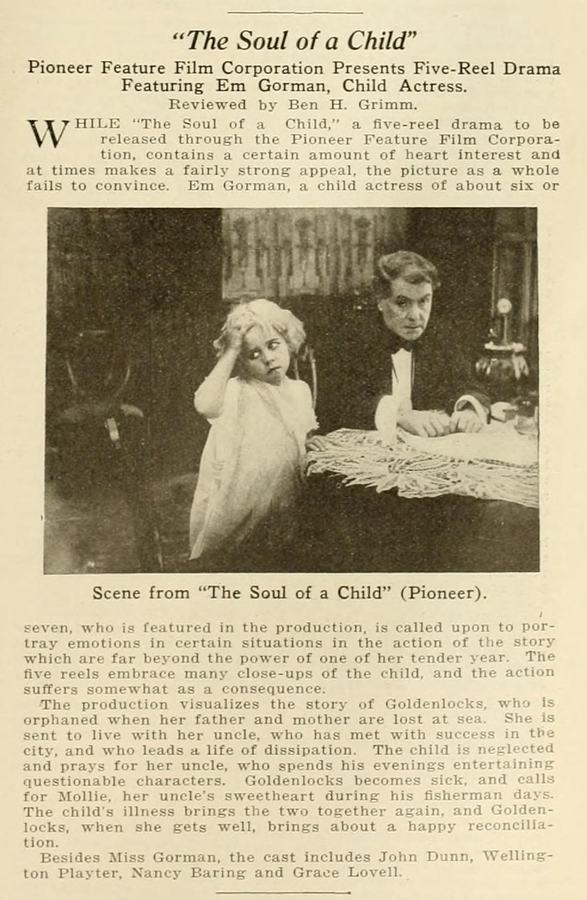
Here, ‘The Soul of a Child’ delves into its most heart-wrenching territory. Jim, utterly consumed by his pursuit of pleasure, finds himself woefully unprepared and unwilling to embrace the responsibilities that come with caring for a child. His neglect is not born of malice, but of a profound immaturity and a terrifying lack of empathy, a self-absorption so complete that it renders him blind to the needs of another. Goldenlocks, a fragile beacon of innocence, becomes a burden, an inconvenience that interferes with his relentless quest for enjoyment.
The film’s portrayal of Goldenlocks’ gradual decline into illness is handled with a delicate yet impactful touch, avoiding sensationalism while conveying the profound tragedy of her situation. It’s a slow, agonizing realization for the audience that Jim’s indifference is literally sickening the child. This sequence is a masterclass in conveying emotional impact through understated realism. Wellington A. Playter, as an uncredited but crucial child actor, embodies the vulnerability and quiet suffering of Goldenlocks with remarkable poignancy, making her plight deeply affecting without resorting to overt melodrama. The visual contrast between Jim’s lavish surroundings and Goldenlocks’ deteriorating health is a powerful commentary on the skewed priorities of a society that often overlooks true human need in favor of superficial pursuits. This theme of societal struggle and individual responsibility, albeit in different contexts, finds echoes in films like The Struggle, which also grapples with the harsh realities faced by those on the margins, though often through the lens of labor and economic hardship rather than direct familial neglect.
Goldenlocks’ serious illness serves as the narrative’s undeniable climax, a stark, unavoidable confrontation with the devastating consequences of Jim’s actions. It’s the moment the music stops, the lights dim, and the harsh reality of his choices crashes down upon him. The complications that ensue are not just medical; they are deeply moral and psychological, forcing Jim to look inward, perhaps for the first time since leaving his hometown. The film doesn't offer a facile, instantaneous conversion. Instead, it portrays Jim’s awakening as a painful, arduous process, fraught with guilt, regret, and a terrifying fear of loss. Em Gorman’s performance truly shines here, capturing the raw anguish of a man facing the potential, irreversible damage wrought by his own selfishness. The once carefree Jim is replaced by a haunted, desperate figure, his previous pleasures now tasting like ash.
Molly, throughout this ordeal, remains a pillar of unwavering moral fortitude. Her quiet strength and persistent compassion serve as a counterpoint to Jim’s earlier weakness, highlighting the profound difference between genuine love and superficial attachment. She represents the possibility of a moral anchor, a reminder of the values Jim had so carelessly discarded. The film’s resolution, while not entirely neat or simplistic, offers a glimmer of hope, suggesting that even the most damaged souls can find a path to redemption, albeit one paved with profound suffering and hard-won lessons. It’s a testament to the idea that true transformation often arises from the crucible of crisis, a theme also explored in a different vein in films like The Climbers, where physical and emotional challenges force characters to confront their inner selves and redefine their purpose.
Beyond the compelling narrative, the film’s strength lies in its meticulous direction by John Gorman and the powerful performances of its ensemble cast. Em Gorman, as Jim, carries the bulk of the emotional weight, traversing a wide spectrum from heedless abandon to agonizing remorse with commendable conviction. His portrayal avoids caricature, instead offering a nuanced look at a flawed individual caught in the web of his own desires. Nancy Baring’s Molly is equally vital, her quiet resilience and moral clarity providing the necessary emotional anchor for the audience. She is not merely a love interest but a moral conscience, guiding Jim (and the viewer) through the darkest moments.

Ernest Morrison and John J. Dunn, while perhaps in more supporting roles, contribute to the film’s rich tapestry, grounding the urban environment with their respective portrayals of characters who either enable or observe Jim’s lifestyle. Grace Lowell’s presence, too, adds another layer to the complex social dynamics at play. The film’s visual language, while characteristic of its era, is employed with considerable skill, using framing and editing to underscore thematic elements. The contrast between the vibrant, crowded city scenes and the quiet, desolate moments of Goldenlocks’ suffering is particularly effective. The use of light and shadow, too, often mirrors Jim’s internal state, moving from the dazzling glare of his early city life to the encroaching darkness of his moral crisis.
At its core, ‘The Soul of a Child’ is a profound meditation on the nature of responsibility and the fragility of innocence. It asks uncomfortable questions about what constitutes a meaningful life, contrasting the fleeting allure of material pleasure with the enduring weight of human connection and obligation. The film serves as a potent critique of a society that, even then, was grappling with the moral implications of rapid urbanization and the erosion of traditional values. It suggests that true wealth lies not in accumulation or indulgence, but in the capacity for empathy, care, and self-sacrifice.
The titular 'soul of a child' is not merely Goldenlocks' own nascent spirit, but a broader metaphor for the purity and vulnerability that adults are tasked with protecting. When that protection fails, the consequences are catastrophic, not just for the child, but for the moral fabric of the adults involved. The film's enduring power lies in its ability to provoke introspection, forcing viewers to consider their own responsibilities to the innocent, to family, and to the broader community. It's a narrative that, despite its period setting, feels remarkably contemporary in its exploration of themes that continue to challenge us today. The stark lessons about neglect and the steep price of redemption are universal, transcending the specific historical context.
‘The Soul of a Child’ stands as a powerful, albeit often overlooked, piece of cinematic history. It's a film that eschews easy answers, preferring to present the complex, messy realities of human nature. While its pacing and stylistic choices are indicative of its era, its thematic depth and emotional resonance remain undiminished. It’s a compelling reminder that the most profound dramas often unfold not on grand battlefields, but within the intimate confines of the human heart, where the struggle between self-interest and compassion plays out with devastating consequences. For those interested in the evolution of moral storytelling in cinema and the unflinching examination of human frailty, this film offers a rich, rewarding, and ultimately sobering experience. It compels us to consider what it truly means to bear responsibility, and the immeasurable value of an innocent life entrusted to our care.
In an era that often glorified simplistic morality tales, 'The Soul of a Child' dared to delve into the grayer areas of human conduct, presenting a protagonist whose journey from self-indulgence to potential enlightenment is neither straightforward nor painless. It’s a film that resonates long after the credits roll, a testament to the power of cinema to hold a mirror to society’s flaws and, perhaps, to inspire a deeper sense of humanity. It may not offer the triumphant escapism of some blockbusters, but its quiet, persistent call for introspection is, in its own way, far more impactful. A truly essential watch for connoisseurs of early cinema and anyone who appreciates a story that challenges and provokes thought.

IMDb 6.3
1931
Community
Log in to comment.