DbcultAccessing Vault...
6.8/10
Senior Film Conservator
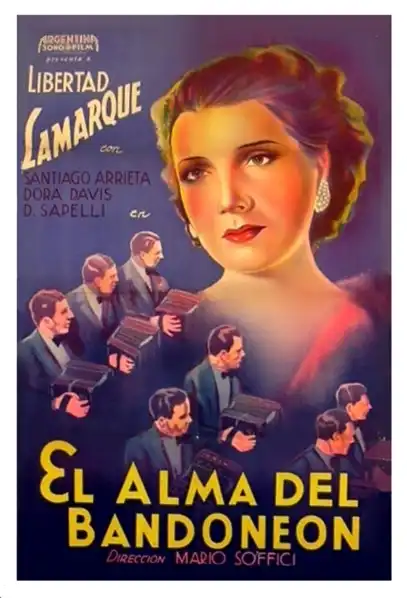
A definitive 6.8/10 rating for a film that redefined the boundaries of cult cinema. The Soul of the Accordion remains a cornerstone of transgressive art.
If you have a soft spot for grainy black-and-white movies where people express every emotion through a loud song, then yes. You should probably skip it if you can't stand old-school melodrama or if accordions give you a headache. 🎶
It’s a movie from 1935, so you have to go in with the right mindset. Everything is a bit extra, but that is part of the charm, I guess.
Fabian, played by Santiago Arrieta, is the lead guy who basically tells his rich dad to keep his cows. He wants to go to the big city and write tango lyrics, which is apparently the most rebellious thing a kid could do back then.
I liked the opening shots of the farm, even if they felt a bit long. You can really feel the dust and the heat in those scenes.
His dad is just... so mad about the music. He looks like he wants to punch a guitar every time he sees one.
Then we get to the city, and that’s where things actually start moving. Fabian meets Elda, played by the legendary Libertad Lamarque.
Honestly, she is the whole reason to watch this. Her voice is just incredible and it cuts right through the old audio hiss.
She supports his dreams, which is nice, but their romance feels a bit like it’s on fast-forward. One minute they’re meeting, and the next, they are the 'it' couple of the tango scene. 💃
Then there is Enrique. He is the classic 'bad guy' who is in love with Elda and decides that ruining Fabian’s life is his new full-time job.
Enrique Serrano plays him with this weirdly intense energy. He spends a lot of time lurking in the shadows of doorways, which made me laugh a couple of times. 😂
There’s a scene in a cafe where the tension is so high you’d think they were negotiating a war treaty, but they’re just talking about a song. It reminded me a bit of the heavy-handed drama in Cameo Kirby, where every look means a thousand things.
The pacing is kind of all over the place. Some scenes drag on forever, like when they are just sitting around talking about 'the soul of the music.'
I found myself checking my phone during a few of the long dialogue bits. But then a song would start, and I’d be right back in it.
The bandoneón (that’s the accordion thingy) is basically a character in this movie. They film it with so much respect, like it’s a piece of holy jewelry or something.
I noticed a weird thing in one of the club scenes where a background extra is just staring directly into the camera for like five seconds. It’s super distracting once you see it. 👁️
The lighting in the tango clubs is actually pretty cool. It’s all smoky and dark, very different from the bright, boring farm scenes at the start.
It has that theatrical feel, almost like Pierrot or some of those other early 1920s-30s films where the actors haven't quite figured out how to be natural on camera yet.
Everyone stands very stiffly. They use their hands a lot when they talk, like they’re trying to catch flies.
There is a subplot about Fabian struggling to make it as a musician that feels a bit like Wrong Direction, just in terms of that 'struggling artist' vibe. He’s poor, he’s hungry, but he has his art!
I think the movie gets much better when it stops trying to be a serious family drama and just lets Libertad Lamarque sing. She’s got this way of looking into the distance while she sings that makes you feel like she’s seeing a ghost.
The conflict with Enrique gets a bit silly toward the end. His plans to make Fabian fail are so complicated they almost don't make sense.
Like, just let the guy play his accordion, man. It’s not that deep.
But hey, that’s 1930s cinema for you. You need a villain, and Enrique is definitely villain-ing as hard as he can.
One thing that bothered me was the sound quality in a few spots. I know it’s an old movie, but sometimes the music is so much louder than the talking that I had to keep messing with the volume. 🔊
Also, Fabian is a bit of a wet blanket as a protagonist. He’s just kind of... there. Elda is the one with all the personality and drive.
I wish we saw more of the actual songwriting process. Instead, we just see him looking frustrated at a piece of paper for a second, and then suddenly he has a hit song.
The ending is exactly what you expect it to be. No big surprises here, folks. 🤷
But the final musical number is pretty great. It leaves you feeling good, even if the plot was a bit thin and the characters were mostly one-dimensional.
If you're into the history of tango or just want to see why Libertad Lamarque was such a massive star, give it a go. It’s a short watch anyway.
Just don't expect a masterpiece. It’s more like a cozy, slightly dusty musical postcard from 1930s Buenos Aires.
I’ll probably forget most of the plot by next week, but I’ll remember those songs for a while. 🎹
It’s definitely better than some of the other stuff from that era, like Fifth Avenue Models, which is just way too slow for its own good.
Overall, it’s a decent little film. Not life-changing, but charming in its own clunky way.
IMDb —
1926
Community
Log in to comment.