DbcultAccessing Vault...
3.3/10
Senior Film Conservator
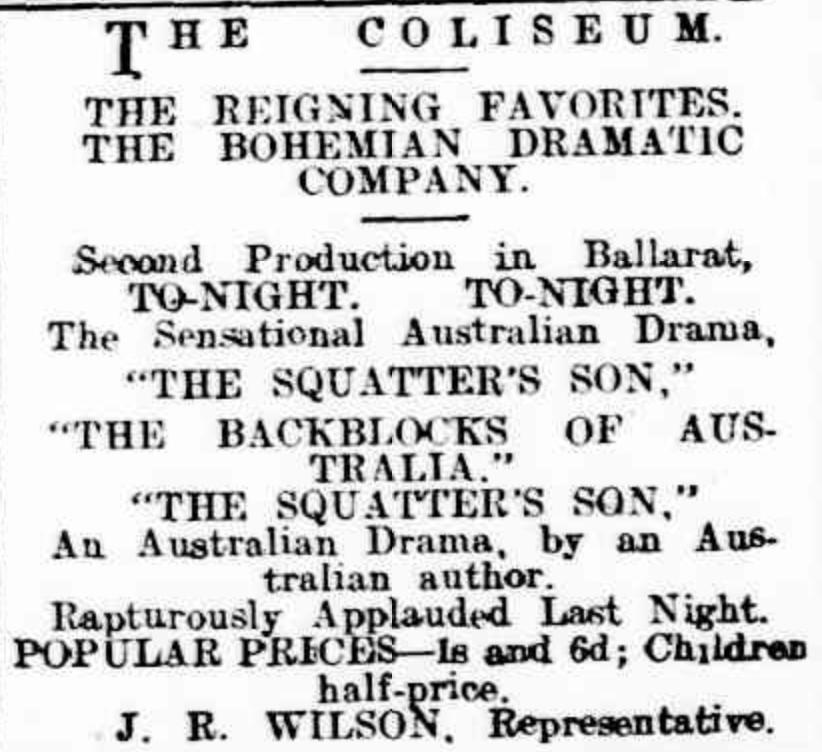
A definitive 3.3/10 rating for a film that redefined the boundaries of cult cinema. The Squatter's Son remains a cornerstone of transgressive art.
The year 1910 stands as a pivotal epoch in the annals of early motion pictures, particularly within the burgeoning landscape of Australian production. While the global stage was witnessing the refinement of narrative structure through works like The Life and Passion of Jesus Christ, the Australian continent was busy forging its own cinematic mythology. The Squatter's Son, a production by the legendary E.J. Cole and his Bohemian Dramatic Company, represents a critical juncture where the theatrical traditions of the traveling troupe met the innovative potential of the silver screen.
To understand the weight of this film, one must first appreciate the cultural hegemony of the 'squatter' narrative in early 20th-century Australia. Following the success of The Squatter's Daughter, this sequel-adjacent work sought to capitalize on a public appetite for stories of land, lineage, and the rugged individualism of the bush. The film does not merely depict a story; it captures the zeitgeist of a nation attempting to visualize its own frontier spirit. Unlike the gritty realism of The Story of the Kelly Gang, which leaned into the outlaw mystique, The Squatter's Son leans toward a pastoral nobility.
The visual composition, though rudimentary by modern standards, possesses a raw, documentary-like honesty. The use of natural light and actual outback locations provides a sense of verisimilitude that studio-bound productions of the era often lacked. There is a palpable texture to the gum trees and the dusty plains, a tactile quality that suggests the actors—members of a seasoned dramatic company—were truly grappling with the environment. This isn't the carefully curated artifice of Life and Passion of Christ; it is a visceral engagement with a landscape that was still being 'tamed' in the collective consciousness.
One cannot discuss The Squatter's Son without acknowledging the influence of E.J. Cole’s Bohemian Dramatic Company. These were performers trained in the art of reaching the back row of a crowded tent or theater. When translated to film, their gestures are large, their expressions emphatic, and their physical presence commanding. This style of 'histrionic' acting was the standard of the day, but here it serves a specific purpose: it clarifies the moral stakes in a world without synchronized sound. The hero’s upright posture and the villain’s surreptitious glances create a clear binary of good and evil, a necessary shorthand for a film that relied on visual storytelling and intertitles.
In comparison to the athletic dynamism seen in early sports films like The Corbett-Fitzsimmons Fight, the movement in The Squatter's Son is more orchestrated, more rhythmic. The sequences involving horse-riding and bushcraft are not merely filler; they are displays of a localized expertise that resonated deeply with contemporary audiences. The film celebrates the 'bushman' as a folk hero, much like Robbery Under Arms did, though with a focus on the legitimate heir rather than the bushranger.
Beneath the surface level of melodrama lies a fascinating subtext regarding land rights and class in colonial Australia. The 'squatter' was a figure of immense power, often occupying vast tracts of land with questionable legal standing, yet in the cinema, they were often portrayed as the rightful stewards of the soil. The Squatter's Son navigates this complexity by framing the conflict as an internal struggle for honor. The threat comes not from the disenfranchised, but from the corrupt elements within the higher social strata—those who would use the law to subvert justice.
This thematic preoccupation with inheritance and legitimacy is a recurring motif in early Australian works, such as A Tale of the Australian Bush. These films functioned as a form of cultural myth-making, establishing the 'rightful' order of the new world. When we look at the film through a modern lens, we see the shadows of a complicated history, but for the 1910 viewer, it was a stirring validation of their own societal structures. The film’s pacing, which alternates between domestic tension and outdoor action, mirrors the duality of the colonial experience: the attempt to maintain British social norms while surviving in an alien, often hostile, environment.
Technically, The Squatter's Son is a testament to the ingenuity of early filmmakers working with limited resources. The camera is often static, acting as a silent observer to the unfolding drama, yet there are moments where the framing feels surprisingly modern. The use of depth—placing characters in the foreground while action occurs in the distance—suggests a growing understanding of the three-dimensional space within a two-dimensional frame. While it may not have the experimental flair of At Break-Neck Speed, it possesses a steady, confident hand that guides the viewer through its narrative beats.
The editing, too, shows signs of evolution. The transitions between scenes, while sometimes abrupt, attempt to maintain a temporal logic that was still being refined in the global cinema. We can see parallels with the way The Life of Moses utilized episodic structure to tell a grander story. In The Squatter's Son, each 'chapter' builds upon the last, culminating in a climax that satisfied the audience's need for moral resolution. It is a work that understands its medium, even as it struggles with the limitations of the technology of its time.
E.J. Cole was more than just a producer; he was a visionary who understood that the future of entertainment lay in the fusion of the live and the recorded. His Bohemian Dramatic Company brought a level of professionalism and 'star power' to the Australian screen that helped legitimize the medium. By casting his seasoned stage actors in The Squatter's Son, he ensured that the film had a gravitational pull for audiences who were already fans of his theatrical tours. This cross-pollination was essential for the survival of early Australian cinema, providing a built-in audience and a reliable stable of talent.
When we compare this to the contemporary works coming out of Europe or America, such as Jane Eyre or Hamlet, we see that Australia was not merely imitating overseas trends. Instead, filmmakers like Cole were adapting universal narrative archetypes to a specifically local context. The Squatter's Son is uniquely Australian in its concerns, its setting, and its temperament. It eschews the gothic gloom of European drama in favor of a bright, sun-drenched resilience.
Tragically, like so many films from this era, much of the original footage of The Squatter's Son has been lost to the ravages of time and nitrate decay. What remains, however, allows us to reconstruct its importance. It serves as a bridge between the 'bushranger' films that dominated the early 1900s and the more sophisticated social dramas that would follow in the 1920s. It is a missing link in the evolution of the Australian voice on screen, a voice that was beginning to assert itself with confidence and clarity.
The film’s focus on the 'son'—the next generation—is particularly poignant. It suggests a forward-looking perspective, an interest in what the future of the country might hold. This theme of generational transition is also present in The Prodigal Son, yet in the Australian context, it carries the added weight of building a new society from the ground up. The Squatter's Son is not just a character; he is a symbol of the young nation itself—sturdy, principled, and deeply connected to the land.
In the grand tapestry of film history, The Squatter's Son may appear as a minor thread, but for the student of Australian culture, it is a vibrant and essential strand. It captures a moment before the 'talkies' changed everything, a time when the image was king and the landscape was the ultimate co-star. It reminds us that cinema has always been a tool for exploring our relationship with the world around us, whether through the lens of a boxing match in Jeffries-Johnson World's Championship or the dramatic struggle for a family farm.
As we look back at the work of the Bohemian Dramatic Company, we should recognize the audacity of their project. They were pioneers in every sense of the word, venturing into a new medium with the same courage their characters displayed in the bush. The Squatter's Son remains a fascinating artifact, a window into a world of grand gestures, sweeping vistas, and the timeless struggle for a place to call home. It is a foundational piece of the Australian cinematic mosaic, deserving of both our scrutiny and our respect.
Ultimately, the film succeeds because it touches on universal truths through a local lens. The battle for inheritance, the defense of one's honor, and the beauty of the natural world are themes that resonate across borders and centuries. While its techniques may be archaic, its heart is undeniably modern. It is a testament to the power of storytelling, proving that even in the silent era, the Australian spirit was loud, clear, and impossible to ignore. For anyone interested in the roots of the 'Ozploitation' or the 'Australian New Wave' of the 70s, the journey begins here, in the flickering light of 1910, with a squatter, his son, and a camera pointed at the horizon.
IMDb 4.9
1930
Community
Log in to comment.