DbcultAccessing Vault...
Cult Review
Senior Film Conservator
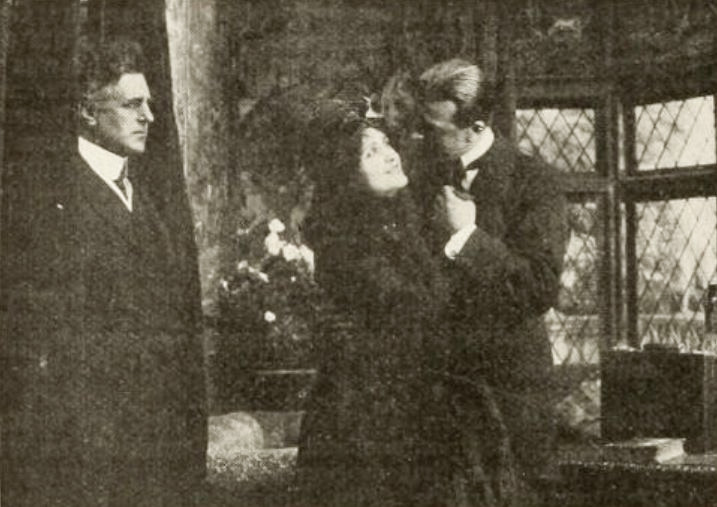
Laurence Trimble’s Through the Valley of Shadows lands in 1913 like a scalpel hurled across a ballroom—gleaming, illicit, unnervingly precise. While Griffith was busy cross-cutting to the Klan, this brisk four-reeler dives inside the skull of a woman who has murdered her paramour and emerges with a morality play that feels closer to Cronenberg than to the nickelodeon niceties of its year. The film’s very title, lifted from the psalm, becomes ironic: no shepherd comforts; the valley is the convoluted sulci of the mind, and the shadows are repressed desires projected huge against the bedroom wall.
James Lindsay’s Dr. Vale begins the story with the confident gait of a man who believes pathology ends at the bone. Trimble adores silhouetting him against oversized medical atlases—pages flapping like the wings of ravens—so that every diagnosis feels also a prophecy. When Vale discovers his wife’s affair via a smear of greasepaint on her collar, the close-up (as close as 1913 orthochromatic stock will allow) lingers until the audience feels the same arterial throb he does. It’s a master-class in minimalist revelation: no intertitle howls “betrayal,” only the tactile evidence of another man’s cosmetic mask.
Florence Turner, “the Vitagraph girl,” here graduates from plucky sweetheart to neurasthenic sphinx. Her descent is charted through costume: silk tea-gowns give way to a nightdress the color of old dishwater, sleeves heavy with the sediment of sleepless nights. Turner also co-authored the scenario, and you sense her fighting for a woman’s interiority decades before Leah Kleschna would sport a thief’s bravado or Traffic in Souls would parade the white-slavery panic. She refuses to let the adulteress become mere cautionary exhibit; instead, the character is a weather map of conflicting barometric pressures—lust, shame, relief, terror—all flickering across a face the camera adores.
Once the cuckolded doctor spirits his wife to the seaside asylum, the film pivots from drawing-room melodrama to something approaching Gothic sci-fi. Vale’s experimental surgery—rendered through a dissolving shot of a trepanation tool superimposed over crashing waves—feels like Frankenstein on a budget of cigar boxes. Yet the sequence’s power lies not in graphic display but in negative space: Trimble cuts from the wife’s pupils dilating beneath ether to a seagull smashing against the window, then to a nurse dropping a porcelain basin. The montage anticipates Eisenstein by a decade, proving you don’t need Soviet tractors to convey synaptic rupture.
Post-operation, the film’s tone grows eerily becalmed. Turner now drifts through the grounds like a refugee from The Shepherd of the Southern Cross, her memory cauterized, her guilt externalized onto flora. She presses white roses to her cheek only to find them bruised umber where blood from the murder night still clings—a visual rhyme with the original stabbing. Cinema rarely literalizes the ineradicability of sin so poetically; the stain is not on the conscience but on the world, a chromatic echo that refuses restorative editing.
Edward Lingard plays the slain matinee idol with Valentino-before-Valentino languor. In flashback fragments—tinted amber so they appear steeped in scotch—he and Turner share a kiss staged inside a photography darkroom. Red safety bulbs throb like warning beacons, and the chemical trays glisten like altars. The scene lasts maybe twelve seconds yet encapsulates the entire pre-Code ethos: desire developed in poisonous solutions, an image burning itself permanently onto celluloid and retinas alike.
Clifford Pembroke’s detective, a peripheral figure, provides the film’s only comic valve. Sporting a deerstalker out of Doyle and a habit of sniffing evidence like a sommelier, he wanders the third reel asking, “Where’s the weapon?” Unbeknownst to him, the sterling hair-pin now skewers the doctor’s laboratory corkboard, a butterfly of metal pinning down a parchment of neurology. The gag is subtle, but it underscores the picture’s preoccupation with displaced guilt: everyone fondles the relic of violence while pretending to hunt it.
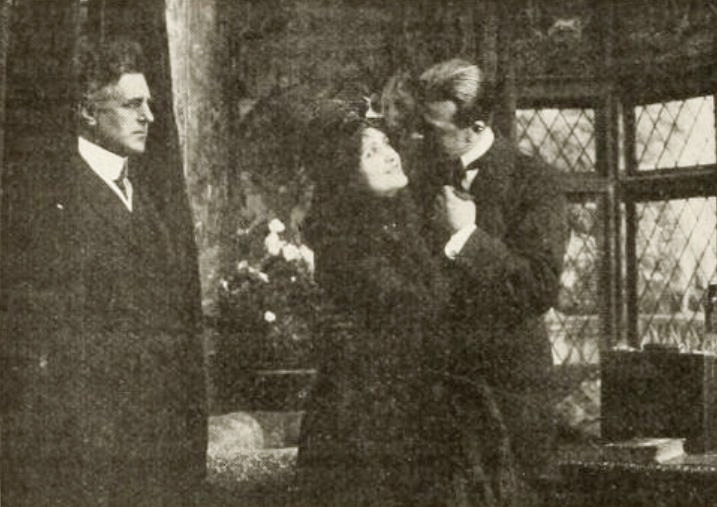
The finale, a two-shot tableau of husband and wife reflected in the conservatory glass, achieves a mirror-phase resonance worthy of Lacan. Vale’s face merges with hers until they form a Janus-head of complicity: he the enabler of amnesia, she the blank slate on which male mastery has been re-inscribed. Fade-out. No moral placard, no “crime does not pay” epigraph. Just the echo of sea-birds and the uncanny hum of a brain that no longer recognizes its own crimes.
Though shot orthochromatically, the film codes color metaphorically. Turner’s introductory gown is described in an intertitle as “moonlit-azure,” a hue we never see yet mentally supply. After the surgery, nurse uniforms are dubbed “chlorophyll green,” evoking both healing and the uncanny vegetable state of the patient. These chromatic prompts force the spectator to hallucinate pigment, turning black-and-white into a Rorschach test of subjective tinting. In that sense, Valley of Shadows anticipates the hand-painted nightmares of Father John; or, The Ragpicker of Paris while remaining tonally closer to the sooty chiaroscuro of The Criminal Path.
Contemporary exhibitors received a one-sheet advising a live trio to perform Saint-Saëns’ Danse Macabre during the operation scene, then switch to Debussy’s Clair de Lune for the garden epilogue. Such programming notes, now archivist treasure, reveal how early exhibitors curated cognitive dissonance: xylophones mimicking skull taps, violins sawing at moral fibers. If you’re screening a 16 mm print in your living room, try syncing Morton Feldman’s string drones—the resulting frisson bends time, collapsing 1913 and 2023 into a shared fever dream.
Unlike Jack—where the male lead’s mental disintegration is played for tragic nobility—Valley interrogates the doctor’s god-complex with proto-feminist skepticism. Vale doesn’t cure; he colonizes, turning his wife’s gray matter into contested property. Turner’s co-writing credit matters here: the script grants the female protagonist no voice in her own lobotomization, yet the camera’s prolonged close-ups of her bandaged head invite audience sympathy over medical triumph. It’s a sly subversion that makes the film feel closer to Charlotte Perkins Gilman than to the Edison Company’s usual fare.
For decades the picture slumbered in the BFI’s “wanted” list, presumed lost like two-thirds of pre-1920 cinema. Then a Dutch collector uncovered a 35 mm nitrate print mislabeled De Schaduw Vallei inside a chocolate tin. The George Easton Museum’s 2022 restoration employs optical flow algorithms to stabilize gate weave without scrubbing the photochemical soul. Grain clings like surgical lint; the image breathes. If you stream the 4K, watch on an OLED panel with the contrast pushed until the iris of every character becomes a black sun. Only then does the film reveal its occult heart.
Set it beside Beneath the Czar’s revolutionary bombast and you see how intimate scale can trump geopolitical spectacle. Pair it with Robin Hood’s pageantry and notice how both films weaponize foliage: Sherwood’s arboreal disguise versus the sanitarium’s roses of damnation. Finally, weigh it against Alone in New York; both hinge on urban isolation, yet Valley replaces city grids with neural corridors, proving the most claustrophobic landscape is the human mind.
Because every modern tale of unreliable memory—Memento, Eternal Sunshine, The Father—owes a debt to this compact one-hour miracle that dared to suggest identity is editable code. Because Turner’s ghostly smile, hovering between innocence and complicity, will follow you into your own dreams, asking whether any of us truly own the narrative of our past. Because the flicker of nitrate at 18 fps is the closest we can come to witnessing thought itself, a shadow play where every frame is both alive and already dying. Press play, lower the lights, and let the valley swallow you whole.
IMDb —
1919
Community
Log in to comment.