DbcultAccessing Vault...
5.8/10
Senior Film Conservator
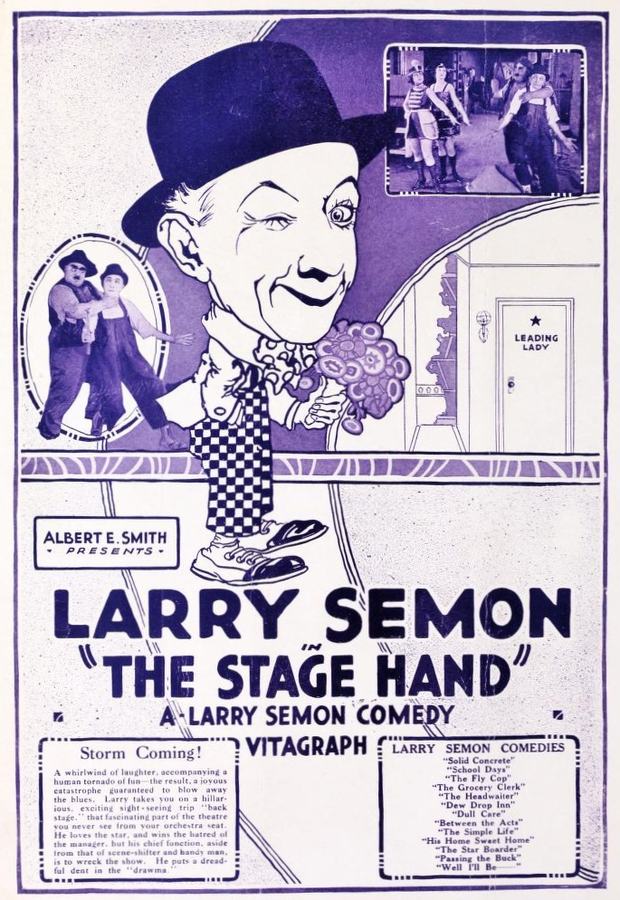
A definitive 5.8/10 rating for a film that redefined the boundaries of cult cinema. The Stage Hand remains a cornerstone of transgressive art.
There is a moment—roughly ninety seconds into The Stage Hand—when the celluloid itself seems to inhale. A rug snaps open like a predator’s jaw, Larry Semon catapults into frame, and the laws of backstage politesse detonate in a mushroom cloud of gunpowder and tweed. What follows is not so much a plot as a controlled demolition of vaudeville decorum, a twelve-reel sneeze that leaves the theatre’s architecture—both literal and metaphorical—sprawled across the orchestra pit in splinters.
Set in a second-tier playhouse whose rafters reek of gaslight and cheap greasepaint, the film distills the entire silent-era obsession with work, sabotage, and the fragile membrane separating order from entropy. Larry, nominally a stagehand, operates more like a prankish demiurge: present only when catastrophe requires a catalyst, absent whenever sober utility might restore equilibrium. The gag architecture is Euclidean in its symmetry—each setup repaid with compound interest, each innocent prop transmuted into an agent of chaos.
Consider the gunpowder canister: a MacGuffin that moonlights as Chekhov’s footnote. The moment it changes hands, the narrative fuses slapstick and suspense in a single fuse line. We know the match will fall; Semon insists we savor the exquisite interval between inevitability and ignition. When the seat of the manager’s trousers blossoms into a vermilion firework, the shock is less the blast than the casual elegance with which the film rewrites Newton: every farcical action deserves an unceremonious reaction.
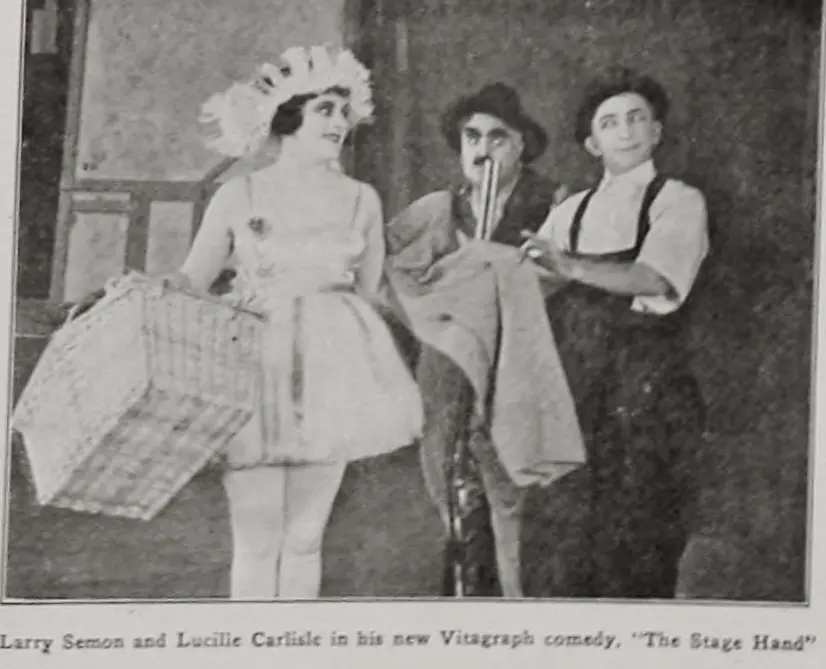
No sooner does the manager’s posterior smolder than the poor martyr must sprint, half-incinerated, through a gauntlet of chorus girls whose shrieks trill up the scale like piccolos in heat. The payoff—our tyrant hurled onto the boards in checkerboard underwear—feels almost merciless in its visual punchline, a tessellation of shame and geometric absurdity. It’s a striptease staged at gunpoint, one that anticipates the erotic clowning of Risky Business by six decades, yet retains the innocent cruelty of a childhood prank.
Scholars love to stack Semon beside Keaton, those two apostolic Johns of stone-face catastrophe. But where Keaton’s Great Stone Face courts physics like a wary dance partner, Semon rugby-tackles it into the orchestra pit. Keaton’s gags unfold with the precision of Swiss clockwork; Semon’s detonate like a bootleg firework stuffed into a marching tuba. The difference is temperament: Keaton wonders if the world can be survived, Semon assumes it must be dismantled.
Take the flying prima donna sequence—an operatic apotheosis that sends the diva beak-first into a vat of viscous obsidian. The stunt work here is reckless ballet: no under-cranked sleight-of-hand, just gravity plus pigment plus a soprano’s dignity. In comparison, The Love Thief offers rooftop pursuits that pirouette across Parisian skylines, yet never achieves the blunt visceral poetry of a woman swallowed by her own mise-en-scène.
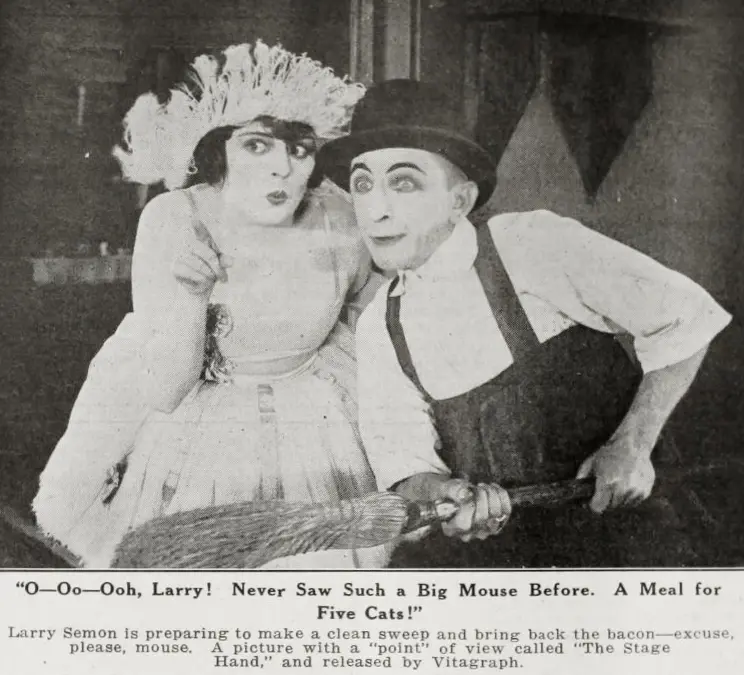
Exiled to the fly-loft, Larry becomes a giddy anti-deity, tugging ropes like Orpheus fiddling with reality’s wiring. Sandbags plummet, flats collapse, a cyclone of artificial fog engulfs the leading man—every intervention a referendum on thespian hubris. One thinks of Hilde Warren und der Tod, where Death stalks the footlights with metaphysical gravitas; Semon counters by weaponizing stagecraft itself, turning scenery into slapstick shrapnel.
Here lies the film’s sly Marxist undertow: Larry’s chronic truancy does not hinder production—it turbocharges it. The corollary is deliciously subversive: management only retains control when labor evaporates. Each time our hero clocks in, the surplus value of spectacle combusts. The narrative thus flirts with a utopian thesis: in a world ruled by imbecile authorities, the most radical act is to do nothing—then arrive late with a lit cigarette and a barrel of gunpowder.
Contemporary audiences, battered by Taylorist sermons on hustle culture, may find this fantasy perversely comforting. Semon intuited what later sitcoms would sterilize: the workplace is an absurdist theatre where the underling’s true power lies in orchestrated failure.
Trace the lineage forward and you’ll spot Semon’s fingerprints across Tex Avery’s sulfur-tinged fever dreams and even the workplace nihilism of The Office. The primordial DNA of Looney Tunes—the retractable dynamite, the bottomless portable holes, the anvils that obey only comic timing—owes more to this 1923 romp than to any Keatonian mechanism. When Daffy Duck screams "Mine mine mine!" while the scenery detonates, he’s channeling Larry’s guerrilla ontology: the world as mutable prop, ready to betray its owner at the first pratfall.
Most surviving prints swim in a chemical twilight of sepia and amber, yet even bleached tones cannot muffle Semon’s chromatic wit. The obsidian paint vat glistens like a tar pit in a Victorian diorama; the manager’s checkered lingerie pops with the sour vibrancy of lemon rind against coal. One wonders how Semon would have weaponized Technicolor had he survived the talkie transition—perhaps a fusillade of chartreuse sandbags, or a crimson fog that tastes of strawberry and shame.
Modern eyes may squint at the gender dynamics: women as shrieking tableaux, their dressing room a sanctum violated by male panic. Yet the film’s libidinal energy feels less predatory than pre-pubescent, a game of cooties played with live ammunition. Compare The Woman in the Case, where female agency is a legal argument; here it is a centrifugal force—girls who eject the manager with the indifferent efficiency of stagehands shoving a flat.
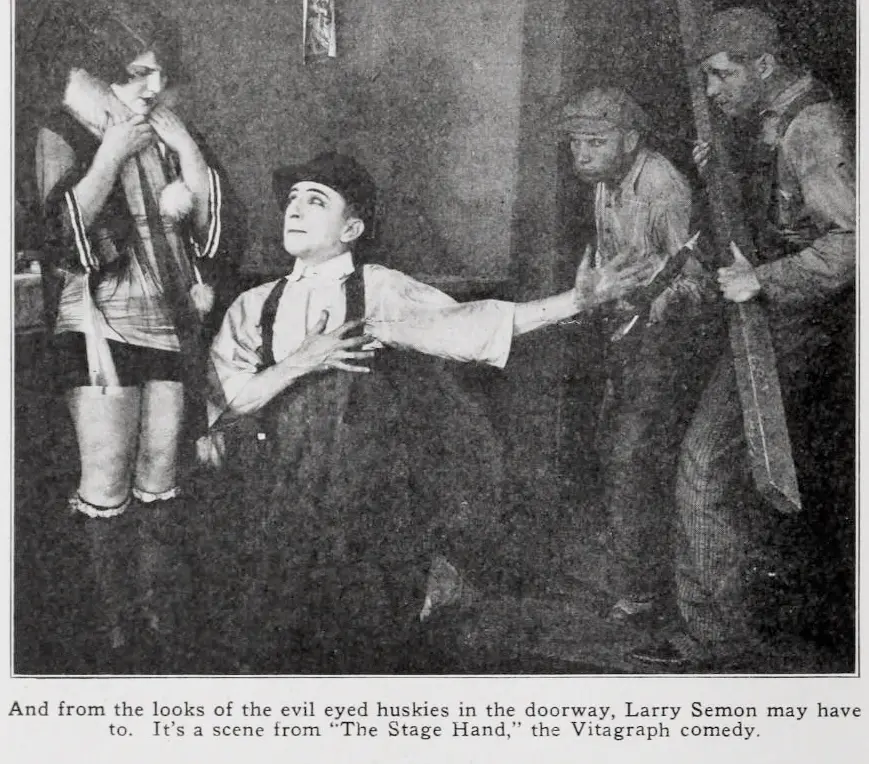
In the climactic chase, the ensemble converges like a lynch mob of archetypes: the wounded narcissist, the scandalized ingénue, the proletarian trickster. Larry scampers skyward, the camera tilting up until human forms shrink to marionette silhouettes. He wins not by confrontation but by ascent—ascending into the rafters where gravity itself becomes accomplice. The iris closes on a grin suspended in liminal space, a ghost who has sabotaged spectacle so thoroughly that only the audience remains, blinking at the afterimage of a world unfastened from consequence.
"To vanish is the last avant-garde; to return with gunpowder, the first."
That maxim, scrawled on a surviving lobby card, distills Semon’s gospel. A century on, when blockbuster franchises detonate cities for quarterly earnings, his modest black-and-white blast feels almost pure—an insurrection staged with pocket change and a lit cigarette. Watch The Stage Hand not as nostalgia but as insurgency: a reminder that every rigged system contains a trapdoor, every tyrant a vulnerable seam waiting for the match to drop.
Is the film perfect? Hardly. The racial caricatures in a cutaway gag, the scattershot pacing of reel four, the occasional blunt recycling of gags from Semon’s earlier two-reelers—all blemishes worth acknowledging under the harsh bulb of 2024 scrutiny. Yet perfection is a bourgeois yardstick; the film’s true currency is combustion. For every moment that creaks, three others detonate with the reckless joy of a child discovering matches.
In an era when silent comedy is too often reduced to GIF-able memes of Keaton’s stoicism or Chaplin’s pathos, The Stage Hand demands resurrection—not as footnote, but as firebrand. Stream it on a night when the world feels hermetically sealed, when bosses bleat about synergy and deliverables. Watch the rug unfurl, the fuse spark, the trousers blaze. Then, when the smoke clears, ask yourself: if Larry can topple a kingdom with a cigarette and a smirk, what’s stopping us?
Rating: 9/10 — A nitrate grenade disguised as a trifle, still capable of blowing the seat off your expectations.
IMDb —
1919
Community
Log in to comment.