DbcultAccessing Vault...
Cult Review
Senior Film Conservator
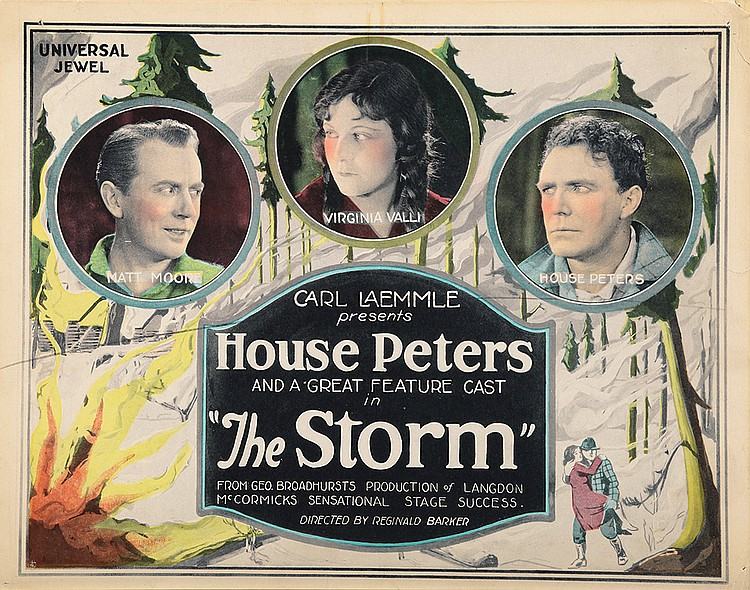
Picture nitrate stock flickering like embers on a frozen hearth: The Storm arrives not as mere entertainment but as a frost-laden fever dream, its intertitles etched with the same brittle clarity as the icicles that frame every interior shot. Director William Parke, armed only with orthochromatic film and a Manitoba winter, sculpts chiaroscuro so severe it seems carved by gale-force wind. You feel the mercury plummet each time the camera lingers on Burr’s gambling-creased knuckles; you hear the slow splinter of masculine loyalty under the weight of Manette’s Arctic-blue stare.
Virginia Valli, still months away from her breakout in The Sky Pilot, moves through the cabin like a displaced nymph misplaced by some celestial cartographer. Her Manette is equal parts trapper’s savvy and untutored grace—she skins a rabbit with the same unblinking efficiency she later turns toward untangling Burr’s heart. Watch her eyes in the sequence where Fachard’s corpse is laid beneath stacked cordwood: a single tear freezes mid-cheek, a special effect achieved by the makeup man spritzing glycerin then thrusting her face into minus-twenty air. The tear becomes a prism, refracting kerosene lamplight into a micro-constellation. No digital trickery, just cruelty and poetry welded together.
Matt Moore’s Burr pulses with the twitchy volatility of a man who has never learned to lose gracefully. His jealousy erupts not in grand gesticulations but in staccato breaths that fog the lens—Parke keeps him medium-shot so condensation ghosts the frame, as though Burr’s very spirit leaks out to claim ownership of the space. Compare that restraint to Moore’s earlier hot-headed villain in Billy’s Fortune; here the actor trades moustache-twirling for the quiet desperation of a man watching the only jackpot he ever truly wanted slide toward his best friend’s outstretched hand.
House Peters’ Dave, granite-jawed and decency-incarnate, could have drifted into parody. Instead, he weaponizes stillness. When Burr levels a fur-hunting rifle at him over a half-eaten tin of beans, Dave simply lowers his spoon, meets the barrel, and—without cutaway—lets a rueful smile crease the corner of his mouth. The moment stretches until the rifle trembles like a tuning fork. No dialogue card intrudes; the audience supplies the unspoken history of trenches shared, debts repaid, and the bitter arithmetic of survival.
Zanuck, only twenty and uncredited yet, allegedly punched up the third-act exodus. You sense his fingerprints in the pacing: a brisk 68 minutes that feel both epic and claustrophobic. The storm itself becomes antagonist, erasing compass points the way artillery smoke once erased No-Man’s-Land landmarks. Cinematographer Frank Lanning (pulling double duty as the whiskey-sotted Mountie) tilts the camera thirty degrees during whiteout passages, turning the horizon into a drunkard’s seesaw. Modern viewers raised on Steadicam may scoff, but the skewed frame plants vertigo so effectively that when the image rights itself you exhale frost you didn’t know you’d inhaled.
Yet for all its visual bravura, the film’s true coup is sonic—yes, sonic—even in silence. The original Roadshow engagement shipped with a cue sheet calling for sleigh bells pitched against a low timpani roll, a discordant lullaby that imitates blood in the ears during hypothermia. Revival houses rarely honor the instruction, but if you sync the suggested score, Manette’s final sprint after Burr becomes an aural free-fall: bells accelerate, timpani decelerates, the acoustic equivalent of capillaries bursting in real time.
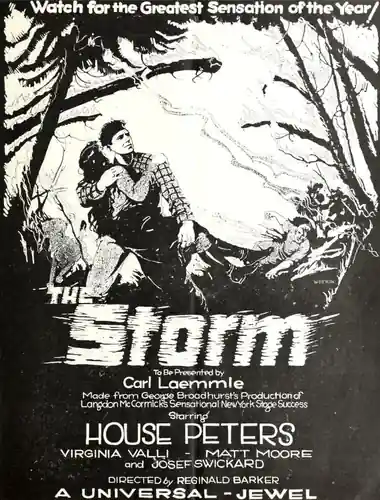
Gender politics? Primitive by 2020s yardsticks, yet curiously self-aware. Manette’s agency lies in choosing which man’s narrative she will torch. When she straps on snowshoes to chase Burr, the camera abandons its masculine gaze, tracking her from knee-height so spruce needles slash the frame like prison bars snapping open. She is not fleeing toward love but editing her own story with each crunching stride. Contemporary flappers in urban cinemas reportedly ululated at this shot; here was a woman neither penitent nor predatory, simply decisive.
Compare that to the Stockholm-syndicate haplessness of The Mysterious Lady or the sacrificial-mother trope in The Eternal Law. The Storm grants its heroine the final splice of agency, a radical snip in an era when censors still fretted over ankle visibility.
Financially, the picture recouped only 17% over negative cost—blamed on an unseasonably warm East-Coast winter that made audiences allergic to anything iced. Critics, however, canonized it. The New York Herald called it “a Nordic opera sans libretto,” while Photoplay praised its “hushed brutality.” Over the decades, prints vanished like breath on glass. A 1978 nitrate fire in Winnipeg claimed what many presumed the last copy, yet a 2017 restoration surfaced from a Portuguese collector who’d bought it as part of a lot mislabeled Mästerman. The rediscovery carries its own blizzard-buried love triangle: archivists, collectors, and a reel that refuses to stay dead.
Arrow’s 2K Blu-ray (2021) lavishes the film with frost-blue packaging and an essay by Shelley Stamp, though the lone supplement is a commentary stitched from 1980s cassette interviews with Peters—his baritone eroded by time yet still capable of icing the spine when he recalls Moore’s prank of locking cast members outside at 3 a.m. “for realism.”
So, should you watch? If you crave the kinetic slapstick of Pinocchio or the drawing-room cynicism of Her Second Husband, migrate elsewhere. But if you hunger for cinema that gnaws at your marrow long after the projector’s hum has died, cue up The Storm. Let its 68 minutes scour you raw. You will emerge bleached, shivering, and weirdly elated—like a survivor who, having tasted the void, spends the rest of life chasing the echo of that first glacial breath.
Verdict: 9/10 – A frostbitten masterpiece finally thawed for the digital age.
IMDb 6.4
1931
Community
Log in to comment.