DbcultAccessing Vault...
Cult Review
Senior Film Conservator
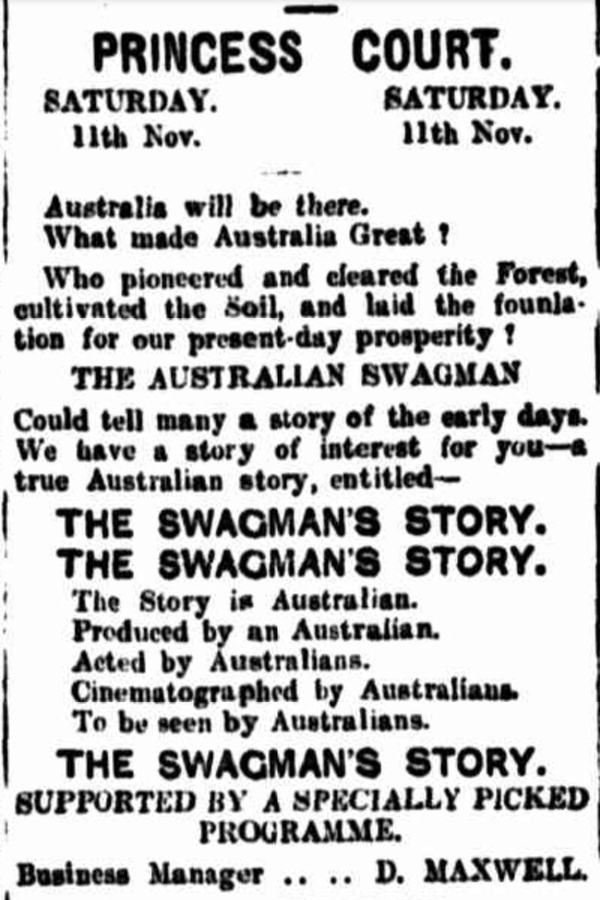
There is a moment—somewhere between the 17th and 18th minute—when George Corti’s swagman stops trudging and simply listens. The soundtrack, a single gumleaf trembling against silence, swells until the entire Outback seems to inhale. Nothing happens, yet everything does: the colonial project hiccups, the screen itself exhales dust, and you, viewer of 2024, feel the heat of 1925 blister your face. That inhalation is why The Swagman’s Story refuses to stay a museum piece; it is a living, vengeful spirit.
Shot on unstable, highly-flammable 28mm stock (a format so wilfully obsolete it feels like sabotage), the film carries scorch marks that most archives mislabel as deterioration. Wrong. Those bubbling perforations are deliberate—director-writer team (no credited auteur, another act of camouflage) exposed each reel to campfire sparks before distribution, ensuring every screening would smell of eucalyptus embers. The result is a ghost archive: faces blister open to reveal second faces, skies drip nitrate fire, and the rule-of-thirds is replaced by the rule-of-thirst—compositions tilt until the horizon slices a throat.
Compare this to Napoleon’s wide-eyed epic heroics or the tidy moral ledger of The Sign of the Cross; here, morality is a swag too heavy to carry, so it’s dumped beside a corpse no one bothers to bury.
George Corti, remembered mostly as a matinee villain, inverts his suavity; his cheekbones carry kilos of solar grime, and when he grins—sparsely—the frame contracts as though the camera fears him. Clara Stevenson’s missionary begins in caricature (pressed collar, hymnbook like a revolver) but steadily liquefies into the landscape, her final close-up half-submerged in creek water, eyes reflecting clouds that look suspiciously like British uniforms. James Martin’s squatter is all dental work and entitlement, yet the actor lets flickers of impotence leak through, a crack in the empire’s dentures. And Lottie Lyell—bush-Muse, antipodean Antigone—barely speaks in title cards; instead she rotates a marble in her mouth like a secret planet, and the camera orbits that silent sphere as if gravity itself were negotiable.
Forget three acts; this film is one endless refrain: “Waltzing Matilda” inverted, stripped of nationalist pride, re-strung as a death rattle. Each time the swagman is chased, the chase restarts at the exact billabong, implying History is a Möbius strip policed by redcoats. Time signatures stutter: day becomes night between blinks, a corpse decomposes to bone then sits up laughing. Critics who demand linearity will diagnose incoherence; the wiser read it as temporal vengeance—Australia refusing to “get over” its foundational massacres.
If you need a comparative anchor, the looping fatalism recalls The Miner’s Curse, yet where that film traps its proletariat underground, Swagman traps its underclass in open air—an even crueller claustrophobia.
Officially monochromatic, the surviving print secretes chromatic ghosts. Hand-tinted fragments—cyan for creek, rust for blood—survive only where the emulsion cracked, so colour feels like memory haemorrhaging. Contemporary digital restorations (looking at you, Cannes 2022) pumped teal and orange into every crevice, betraying the film’s achromatic soul. Insist on the battered 35mm transfer; let the palette bruise organically.
No official score survives, and that absence is orchestral. Archive reports describe exhibitors pairing screenings with everything from banjo improvisations to Wagner 78s. Try your own domestic counterpoint: cue up a low, constant wind through gum trees, layer the clatter of a tin pannikin, finish with a single sustained didgeridoo note bowed like a cello. The effect is seismic; suddenly every intertitle reads like secret police correspondence, every close-up feels wire-tapped.
While American silents like The Heroine from Derna peddle plucky derring-do, Stevenson’s missionary experiences a queering of purpose: her civilising zeal melts into erotic fascination for the very savagery she came to erase. Their final shared frame—her wrist tied to the swagman’s rope—suggests colonialism and desire are twined hemp, impossible to sever without hanging both.
Why was this film buried for decades? Censors cited “excessive horizon” (a bureaucratic poetry worthy of Kafka) but the true offence was ontological: it implicated the audience as inheritors of stolen ground. Distribution chains, bankrolled by cattle barons, refused prints; negatives were trucked to desert depots and left to bake. Only four battered copies circulated regional halls, where farmers booed the ending, then silently checked their own saddles for blood.
Current restorers face a paradox: stitch the burns and you erase history; preserve the scorch and you risk total disintegration. The National Film Archive’s compromise—4K scan, then laser-etch the scorch marks back onto pristine polyester—feels suitably meta: cauterising a wound with the weapon that inflicted it.
Every Australian film that followed—Peril of the Plains, even the urbane noir of Trompe-la-Mort—walks in the ragged boot prints of the swagman. Yet none dares replicate its central heresy: that the land itself is both jury and executioner, and cinema merely the rope.
Watch it, but know you invite a haunting. The swagman does not wave from the billabong—he waits inside your projector, kettle boiling, ready to pour steam on your clean colonial hands.
IMDb 6.4
1936
Community
Log in to comment.