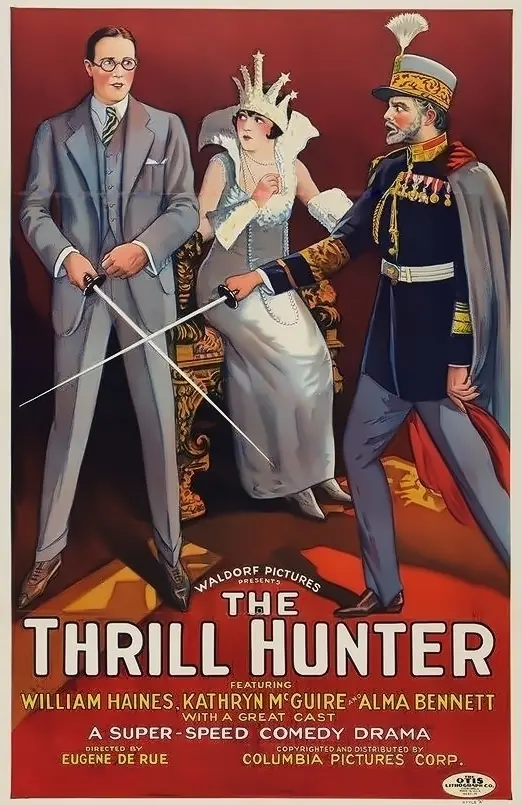
Is 'The Thrill Hunter' a film worth unearthing from the annals of cinematic history in 2024? Short answer: yes, but with significant caveats. This silent-era comedy, with its farcical plot and charming lead, offers a unique glimpse into the humor and storytelling conventions of its time, though it demands a certain patience from modern viewers. It's a film best suited for dedicated cinephiles, enthusiasts of early Hollywood, or anyone with a keen interest in the career of William Haines, but it will likely disappoint those seeking a tightly paced, universally hilarious experience.
Why It Works, Fails, and Who It's For
This film works because... it fully commits to its absurd premise, leveraging William Haines's natural charisma and a series of progressively outlandish situations to create moments of genuine, if dated, comedic charm. The sheer audacity of the plot, coupled with some surprisingly effective physical gags, keeps it from becoming entirely forgettable.
This film fails because... its pacing often drags, and the comedic beats, while occasionally landing, are inconsistent. The narrative logic, even for a farce, can be stretched thin, and certain character motivations remain frustratingly underdeveloped. Its silent film conventions, while part of its historical appeal, can also be a barrier for contemporary audiences accustomed to faster cuts and dialogue-driven humor.
You should watch it if... you appreciate silent comedies, are a fan of William Haines or the broader history of early cinema, and don't mind a film that prioritizes whimsical silliness over narrative coherence or sophisticated wit. It’s an interesting artifact.
A Royal Case of Mistaken Identity
The premise of 'The Thrill Hunter' is pure, unadulterated farce, a staple of early cinematic comedy that often leaned into exaggerated scenarios to elicit laughs. We are introduced to Peter J. Smith, a novelist portrayed by the era's 'flaming youth' icon, William Haines. Smith is not a man seeking adventure; rather, he’s a writer on assignment, a seemingly innocuous traveler in the fictional Kingdom of Grecovia. This immediate contrast between his prosaic profession and the extraordinary events that befall him sets the stage for the film’s comedic engine.
The film swiftly plunges Peter into a labyrinth of mistaken identity. A cabal of delightfully inept castle plotters, presumably driven by a desire for power or wealth, misidentify Peter as the young Boy King. This is where the film's suspension of disbelief is tested most rigorously, as the physical differences between a youthful monarch and a grown man like Haines are significant. Yet, this is the very engine of the farce, demanding that the audience accept the absurdity for the sake of the ensuing chaos.
The conspirators, in their infinite lack of wisdom, decide to consolidate their power by forcing Peter, whom they believe to be the Boy King, into a marriage with Princess Zola. This plot point is a classic comedic device, creating instant dramatic irony and placing our protagonist in an increasingly uncomfortable and ludicrous situation. Peter's attempts to navigate this forced engagement, escape his captors, and prove his true identity form the core of the film's narrative drive.
What follows is a series of escalating comedic mishaps. Peter’s escape is less a daring feat of heroism and more a bumbling stumble through the castle, facilitated by the plotters' own incompetence. The film’s climax, where the antagonists inadvertently dynamite themselves out of existence, is a testament to the era’s penchant for exaggerated, almost cartoonish resolutions. It’s a clean, if implausible, sweep that clears the board for the rightful order to be restored.
Ultimately, the true Boy King takes his place, the forced marriage is annulled, and Princess Zola finds her rightful partner. Peter, having inadvertently played a pivotal role in this royal upheaval, returns to his own world, finding a more grounded and conventional happy ending with Alice Maynard. The plot, while thin, serves its purpose: to provide a framework for Haines to exercise his particular brand of energetic, somewhat cheeky charm.
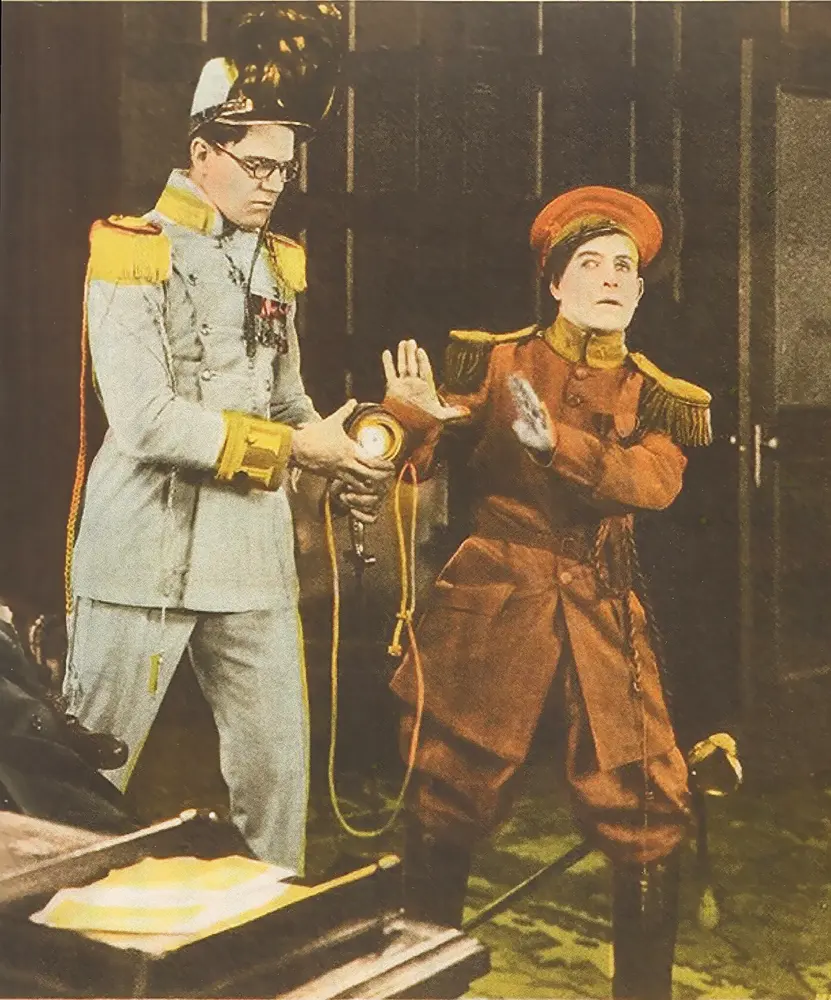
Scene from The Thrill Hunter
Cinematic perspective: Exploring the visual vocabulary of The Thrill Hunter (1926) through its definitive frames.
William Haines: The Charmer or the Caricature?
William Haines, as Peter J. Smith, is undoubtedly the gravitational center of 'The Thrill Hunter'. Haines was a unique screen presence in the silent and early sound eras, known for his brash, often impudent persona that resonated with the rebellious spirit of the Jazz Age. Here, he channels that energy into a character who is less a rebel and more a bewildered everyman caught in extraordinary circumstances. His performance relies heavily on physical comedy and exaggerated reactions, typical of the period.
There’s a certain undeniable charm to Haines’s exasperated glances and frantic attempts to communicate his predicament. He manages to convey Peter's mounting frustration without uttering a single word, relying on expressive facial contortions and animated body language. For instance, the scenes where he’s being fitted for royal attire or forced into the marriage ceremony are particularly effective in showcasing his ability to project discomfort and resistance through purely visual means. It works. But it’s flawed.
However, one could argue that Haines's performance, while energetic, occasionally veers into caricature rather than genuine characterization. His Peter J. Smith is more of a template for comedic scenarios than a fully fleshed-out individual. This isn't necessarily a criticism of Haines himself, but rather a reflection of the era's comedic style, which often prioritized broad strokes over nuanced portrayals. Alma Bennett as Princess Zola and Kathryn McGuire as Alice Maynard deliver serviceable performances, largely functioning as plot devices or romantic interests rather than fully developed characters. Frankie Darro, as the actual Boy King, has limited screen time but adds a touch of youthful innocence that contrasts sharply with the adult machinations.
Haines’s ability to project a certain 'boyish rogue' quality, even when playing the victim of circumstance, is what ultimately makes Peter J. Smith endearing, despite the flimsy plot. He's not a hero in the traditional sense, but a relatable figure whose primary goal is merely to extricate himself from an increasingly absurd situation. His comedic timing, while sometimes broad, is often precise, particularly in moments of physical slapstick. One could compare his energetic, almost frantic presence to some of the earlier works of Buster Keaton, though with a different flavor, less deadpan and more overtly expressive. While not on the same level as a Sherlock Jr., it shares a spirit of comedic ambition.
The Direction and Pacing of a Farce
The direction in 'The Thrill Hunter', credited to an era where directorial authorship was sometimes diffused, is functional rather than groundbreaking. The film effectively uses close-ups to capture Haines's reactions and wider shots to establish the comedic chaos of the royal court. The camera work is straightforward, serving the narrative without drawing undue attention to itself. This is a film that prioritizes clarity of action over stylistic flair, a common approach in silent comedies where visual storytelling was paramount.
Pacing, however, is where the film occasionally stumbles. While the initial setup of Peter's mistaken identity is handled with reasonable speed, there are segments, particularly during Peter's captivity and the machinations of the plotters, where the narrative momentum flags. Silent films, by their nature, often had a different rhythm than modern cinema, relying on intertitles to convey dialogue and exposition, which can inherently slow down the visual flow. 'The Thrill Hunter' isn't immune to this, and there are moments where a tighter edit could have enhanced the comedic impact.
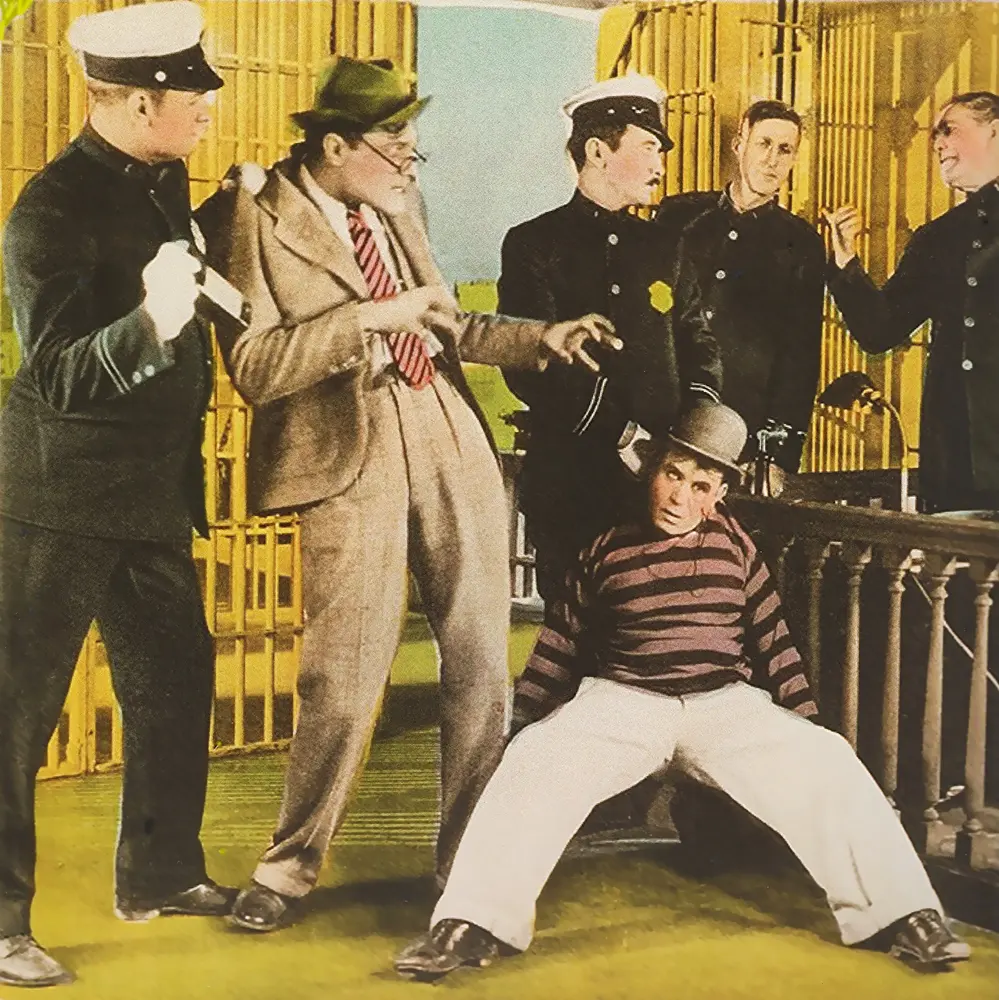
Scene from The Thrill Hunter
Cinematic perspective: Exploring the visual vocabulary of The Thrill Hunter (1926) through its definitive frames.
For example, the prolonged sequences of Peter attempting to communicate his true identity, only to be misunderstood or ignored, become somewhat repetitive. While designed for comedic effect, they often overstay their welcome. The film excels in its more dynamic sequences, such as Peter's escape attempts or the final, explosive demise of the villains. These moments, characterized by faster cutting and more frantic action, demonstrate a clearer understanding of comedic timing within the silent film framework. It reminds me a little of the chaotic energy in Dinty, though less refined.
Visuals and Tone: A Kingdom of Paper-Thin Intrigue
The visual aesthetic of 'The Thrill Hunter' is typical of its era: serviceable sets, functional costumes, and straightforward cinematography. The Kingdom of Grecovia is rendered with just enough detail to establish it as a vaguely European, somewhat exotic locale, but never so much that it distracts from the comedic focus. The castle interiors are suitably grand, yet a keen eye will notice the theatricality of the backdrops, a charming hallmark of early studio productions.
The tone is consistently lighthearted and farcical. There's never a moment where the audience genuinely fears for Peter's safety or believes the plotters pose a serious threat. The villains are portrayed as inherently clumsy and ineffectual, more objects of ridicule than genuine antagonists. This ensures that the film remains firmly in the realm of comedy, even when dealing with themes of kidnapping and forced marriage. The humor is broad, leaning into slapstick and situational absurdity rather than sharp wit or character-driven comedy.
One unconventional observation is how effortlessly the film treats the overthrow of a kingdom and the forced marriage of a princess as mere inconveniences to be resolved through comedic contrivance. This speaks to a certain innocence or perhaps a deliberate lack of gravitas in early Hollywood's approach to foreign politics, viewing them through a purely escapist, fantastical lens. It's a stark contrast to films like A Prince of India, which, despite its own exoticism, often aimed for a more dramatic, if still romanticized, portrayal of foreign lands.
The Craft of Comedy in 'The Thrill Hunter'
The comedy in 'The Thrill Hunter' is a fascinating blend of physical gags and situational irony. Much of the humor derives from Peter's constant struggle against circumstances entirely beyond his control, and the sheer incompetence of his captors. The plotters are a highlight, their plans consistently backfiring in amusing ways. Their final, self-inflicted demise by dynamite is a prime example of the film's commitment to over-the-top, almost cartoonish humor. It’s a moment that, while utterly implausible, elicits a laugh due to its sheer audacity and finality.
Another comedic strength lies in the visual gags related to Peter's predicament. Imagine a sophisticated novelist, accustomed to the comforts of American society, being forced into regal attire, complete with an oversized crown that keeps slipping, or attempting to eat a foreign meal with exaggerated disdain. These small, character-driven moments of physical comedy are where Haines truly shines, proving his capability as a silent comedian. His reactions are always legible, his exasperation palpable, even without dialogue.
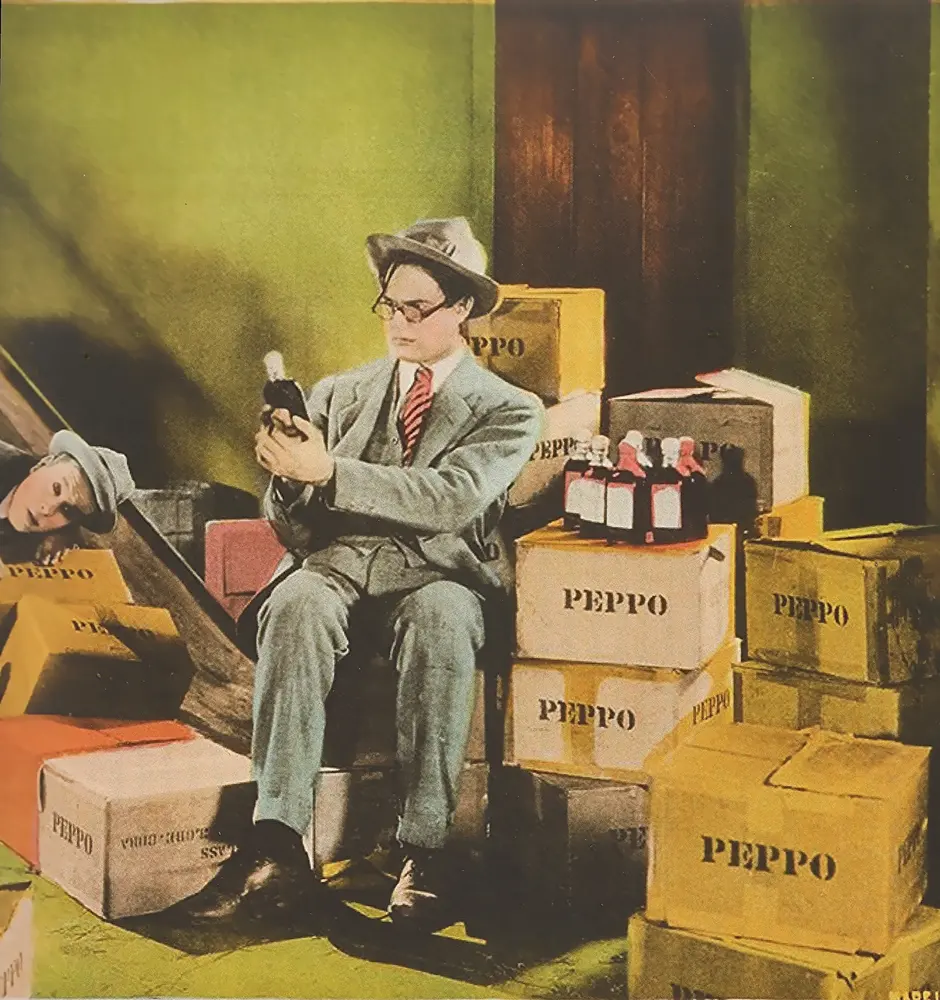
Scene from The Thrill Hunter
Cinematic perspective: Exploring the visual vocabulary of The Thrill Hunter (1926) through its definitive frames.
However, the film’s comedic craft is not without its limitations. Some of the gags feel repetitive, and the reliance on Peter's perpetual bewilderment can wear thin over the runtime. The humor is very much of its time, and modern audiences might find some of the comedic setups predictable or less impactful than they once were. It lacks the sophisticated layering of humor found in later screwball comedies or the timeless physical genius of a Chaplin or Keaton.
Beyond the Laughter: What Does It Say?
On a deeper level, 'The Thrill Hunter' doesn't aim for profound social commentary or philosophical introspection. It is, first and foremost, an escapist entertainment designed to provide laughter and a brief respite from reality. Any themes that emerge are largely accidental or superficial.
One could argue it lightly touches on themes of identity and perception – Peter is only a king because others believe him to be. But the film never delves into the psychological implications of this mistaken identity; it simply uses it as a springboard for comedic action. The film’s resolution, with the rightful order restored and Peter finding his ‘true’ love, reinforces a conservative, comforting worldview where chaos is temporary and normalcy always prevails.
My unconventional observation here is that the film, perhaps inadvertently, highlights the emerging global interconnectedness of the 1920s, even if comically exaggerated. An American novelist casually traveling to a fictional European kingdom speaks to a world that was shrinking, where cross-cultural encounters, however absurd, were becoming more common, even if depicted with a heavy dose of exoticism and caricature. It’s a snapshot of how America viewed the 'old world' – as a place of quaint traditions and easily solvable political intrigues.
Pros and Cons
Pros:
William Haines's energetic and charismatic performance carries much of the film's comedic weight.
The commitment to its farcical premise leads to genuinely amusing, if dated, moments.
Provides a valuable historical artifact for understanding silent film comedy conventions.
The sheer absurdity of the plot, particularly the villains' self-destruction, is memorable.
Cons:
Pacing issues, with some scenes feeling drawn out and repetitive.
The humor, while occasionally effective, is inconsistent and often relies on broad slapstick that may not resonate with modern audiences.
Thin character development for most of the supporting cast.
The narrative logic is often stretched beyond reasonable limits, even for a farce.
Key Takeaways
Best for: Silent film enthusiasts, William Haines admirers, and those curious about 1920s comedic sensibilities.
Not for: Viewers seeking fast-paced, sophisticated humor or deeply nuanced characters.
Standout element: William Haines’s indefatigable screen presence and physical comedy.
Biggest flaw: Inconsistent pacing and a tendency for comedic beats to overstay their welcome.
Verdict
'The Thrill Hunter' is a curious beast of a film. It’s undeniably a product of its time, carrying both the charm and the narrative quirks of the silent era. William Haines, as ever, is a lively presence, skillfully navigating the ridiculous situations with a blend of exasperation and comedic flair. While the film’s plot is as flimsy as paper maché and its pacing often meanders, there are flashes of genuine fun to be found within its farcical framework. It’s not a lost classic, nor is it a cinematic revelation. It is, however, a decent representation of a particular brand of silent comedy, showcasing a star who, for a brief period, perfectly encapsulated the youthful spirit of his age.
For those willing to approach it with an open mind and an appreciation for film history, 'The Thrill Hunter' offers a mildly entertaining diversion. It’s not going to redefine your understanding of comedy, but it might provide a few chuckles and a valuable insight into the kind of escapism audiences craved a century ago. It's a film that exists, and for certain viewers, that's enough to make it worth a watch. Just don’t expect any profound thrills. It offers light amusement. Nothing more.