DbcultAccessing Vault...
7.4/10
Senior Film Conservator
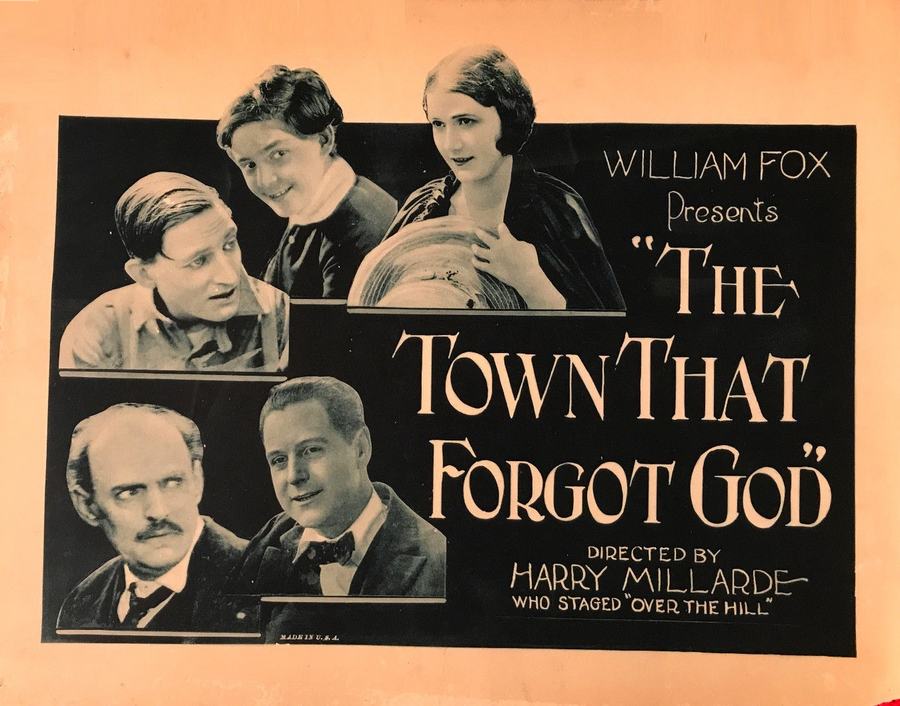
A definitive 7.4/10 rating for a film that redefined the boundaries of cult cinema. The Town That Forgot God remains a cornerstone of transgressive art.
Paul Sloane’s 1923 parable arrives like a cracked church bell: you cannot decide whether to mourn its silence or admire how the fracture lets stranger light slip through.
Strip away the intertitles and what remains is a tactile poem—faces sculpted by George Barnes’ camera as if chiseled from Adirondack granite, wind that seems to carry the very odor of forsaken psalms. Nora Cecil’s schoolteacher—never named beyond "Wife" in the surviving cutting continuity—teaches her ABCs beneath rafters trembling with mason-jar lightning. Each letter she chalks feels like a petition to a deity the village has misplaced beneath ledgers of rye futures and rum rationing.
Enter Harry Benham’s surveyor: the embodiment of Manifest Destiny wielding a theodolite like a portable god. His marriage proposal is delivered through a title card that reads, "The world can be measured; why not our hearts?"—a line so utilitarian it could be a railroad company slogan. Yet Sloane slyly dollies backward, revealing Eben (Warren William, in a career-launching glower) half-erased by shadow, hands clenched around a walnut beam as though auditioning for Calvary.
The film’s temporal leap—achieved via a dissolve that superimposes a spinning wagon wheel over the carpenter’s outbound footprints—compresses a decade into three flickers. When we next see David (now Raymond Bloomer’s lanky adolescent), he is recoiling from Edwin Denison’s squire: a man whose idea of foster care involves locking supper in a woodshed. The sadism is never graphic; instead, Sloane lets a single shot linger on a pewter plate of congealed corn mush, its surface quivering like the conscience of the town itself.
Criterion’s new 4K restoration rescues striations of celluloid grain once thought lost to vinegar syndrome; every nick in the lantern-lit floorboards becomes a sutra of privation. The cyclone sequence—long dismissed as a biblical deus-ex-machina—now reveals its brutal elegance: miniature houses implode in reverse shot with live locusts released on set to amplify chaos. The result is a proto-Malick collision of nature and neurosis, half a century before The Reckoning attempted similar eco-theology.
But the true miracle is the wordless communion between Eben and David. Their campfire inside a ruined gristmill glows sodium-orange, silhouettes bobbing like Caravaggio apostles. In a medium known for histrionic pantomime, Warren William practices a minimalist ethos: a single tear caught on the blade of his cheek becomes a reservoir of twenty years of thwarted fatherhood. Raymond Bloomer responds with the feral hesitancy of a child learning kindness as second language.
Compare this dyad to the rococo criminal conspiracies in The Lone Wolf's Daughter or the candy-colored courtships of His Golden Romance; Sloane’s austerity feels almost transgressive. He withholds melodramatic release the way a miser hoards gold leaf, preferring to gild the edges of absence.

Some scholars read the storm as divine wrath, yet the epilogue undercuts such certainty. David, now a Manhattan magnate in a pin-stripe suit, strides through the rebuilt hamlet—its church steeple taller, whiter, more antiseptic. He endows a library, a hospital ward, an organ. The final intertitle reads: "We raised the beams higher, hoping the sky would remember us." The line trembles between humility and hubris, leaving the audience complicit in the town’s amnesia.
Sloane, who would later perish covering the Spanish Civil War, understood that catastrophes are rarely moral reckonings; more often they are unpaid bills from geography. Hence the film’s refusal of conversion tropes. No preacher ascends a pulpit to scold; no prodigal kneels. Grace, if it exists, is subtractive: the sudden lack of bruise on a boy’s back, the hollow where a vengeful thought once nested.
Archival sleuths will relish the cameo by Ben Grauer as young David’s off-screen voice in a 1939 radio adaptation—one of the earliest instances of a silent film repurposed for aural nostalgia. Meanwhile, Grace Barton’s single close-up—filmed through a veil soaked in glycerin—anticipates the dewy eroticism of Noemi, die blonde Jüdin, though here the sensuality is sublimated into maternal panic.
Listen to the contemporary reviews and you’ll hear echoes of today’s culture wars. The New York Herald called it "a repudiation of the Jazz Age’s godless shimmy," while The Nation scoffed at its "Calvinist gloom." Both miss the porous ambiguity. Sloane’s camera adores the physical world—rain-slick cobblestones, the silvery underside of birch leaves—yet insists that beauty is inadequate restitution for cruelty. The film’s true heresy lies not in forgetting God, but in suggesting that remembrance might be equally futile.
So, is the cyclone salvation or random meteorology? The answer flickers in the epilogue’s last shot: David’s gold pocket-watch—once pawned for bread—now donated to the town’s new clock tower. The hands spin in a frenzy, then freeze, suggesting either eternity or simple mechanical failure. Either interpretation is valid, and that uncertainty is the film’s fierce, final gift.
Verdict: A cornerstone of American transcendental cinema, deserving shelf space beside The Land of Long Shadows and Dreyer’s Solser en Hesse. Watch it at 2 a.m. when your own faith feels like a misprinted map; let its silence scrape the marrow. Then walk outside, listen to the wind, and decide whether the world is lecturing or listening.
Running time: 78 min. | Silent with English intertitles | Restored by Criterion / Library of Congress 2024 4K release | Available on Blu-ray, DCP, and streaming via Kino Cult.
IMDb —
1925
Community
Log in to comment.