DbcultAccessing Vault...
Cult Review
Senior Film Conservator
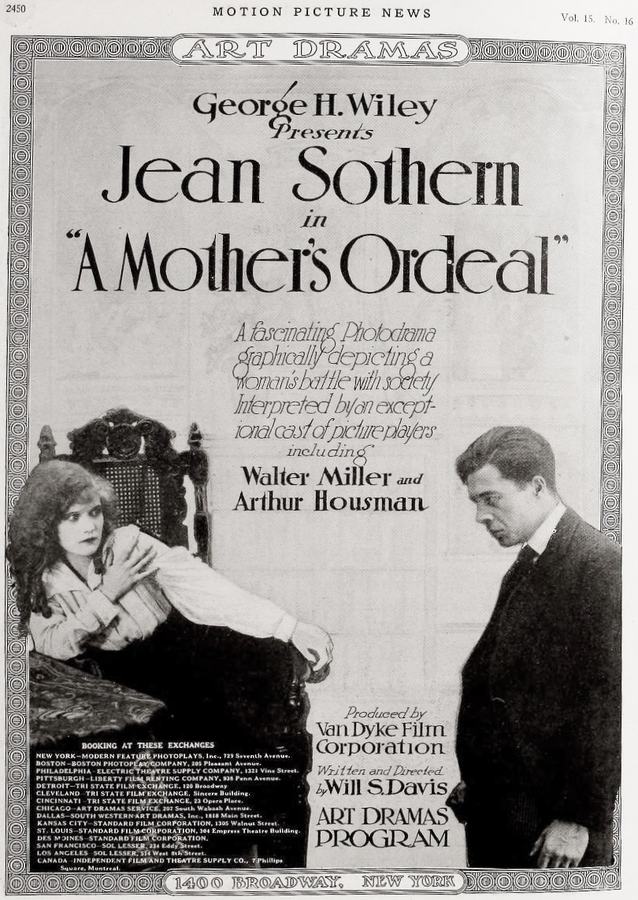
There is a moment, roughly seven minutes into A Mother's Ordeal, when Alice May’s face fills the entire frame and the film’s flicker dissolves into something perilously close to life. Her pupils—inky, cavernous—tremble as if the camera itself has accused her. No intertitle intrudes; the silence is the sentence. In that hush, the nickelodeon becomes confessional, and we—urban voyeurs clutching bags of roasted peanuts—discover we are not here for plot. We are here for penance.
Will S. Davis’s screenplay, compacted into a caffeinated fifteen minutes, could be scrawled on the back of a ferry ticket: woman loses infant, woman searches, woman finds, woman forfeits. Yet the compression ignites rather than suffocates. Every cut feels like a slammed gate; every iris-in behaves like a thumb over a candle—oxygen withheld, light gasping. The film doesn’t narrate adoption trauma; it brandishes it like a lantern, swinging shadows across the walls of our own family myths.
Boyd, doubling as cinematographer, shoots Manhattan like a fever dream of soot. Rooftops leak steam; clotheslines sag under the weight of second-hand grief. Note the repeated motif of vertical lines—elevated rails, prison bars, tenement banisters—carving the frame into cellblocks. When the action hops a freight to New Mexico, the aspect itself exhales: mesas sprawl horizontally, sky razors the top third of the screen, offering the illusion of escape. But Boyd sabotages relief by staging the climactic recognition on a narrow trestle—horizontal hope snapped back into vertical peril—where mother and son balance above a gorge like apostrophes in a sentence the cosmos may delete at whim.
Compare this spatial anxiety with Seventeen where boisterous sidewalks swallow adolescence whole, or with The Diamond from the Sky whose iris-outs pirouette like a flapper certain tomorrow will never end. Ordeal refuses such fizz; its compositions bruise.
Silent-film acting often ages into mime; May eludes that curse by underplaying. She performs bereavement not with arms flung to heaven but with the subtle collapse of posture—clavicles folding like a broken umbrella. Watch her hands: they start the picture clasped in pietà, end it splayed against glass, always trembling as if the air itself were guilty. The performance is so interior you swear you can smell the laundry soap gone stale on her skin.
In the foundling-hospital scene, she signs relinquishment papers. The quill pauses mid-air, ink bead quivering. Boyd jump-cuts to a close-up of that bead—black, pregnant—then to the infant’s waving fist. Edit as synapse: one neuron firing, guilt traveling at the speed of spliced celluloid. No subtitle could rival the eloquence of that juxtapositional jolt.
Known for soused buffoonery, Housman here weaponizes his repertoire of hiccups. His lawyer staggers into frame clutching a flask shaped like justice—blind, round, perpetually half-empty. But the performance curdles into pathos when he recognizes the grown boy’s birthmark, a strawberry smear shaped like the state of Vermont. Housman’s eyes—red-rimmed, haunted—do a slow pan from child to mother, registering the arithmetic of years. In that look, comic sidekick transmutes into Greek chorus, announcing that no statute of limitations outruns blood.
Trains in early cinema usually spell modernity, liberation, the promise of elsewhere. Davis inverts the trope: here the iron horse is abductor, ledger-keeper, judge. When the rail-boss purchases the boy from the hospital, coins clink into a tin box whose lid slams like a gavel. The transaction is filmed in a single take—no cutaways to moralizing clerics or title cards about the evils of child labor—just the blunt thud of metal on metal, commerce unmasked.
Contrast this with If My Country Should Call, where locomotives surge with patriotic vim, or The Busy Inn whose chuffing engines merely backdrop farce. In Ordeal, every piston stroke tallies profit extracted from a child’s clavicles.
Notice how public interiors—courtrooms, saloons, station platforms—swallow women whole, yet private spaces—nurseries, kitchens, church vestries—deny the mother entry. She is perpetually in the threshold, half inside the narrative economy, half expelled. When she finally confronts the rail-boss in his office, the camera positions her in a doorway, silhouette flattened, while he occupies voluminous chair-and-desk real estate, a monarch of paperwork. The power imbalance needs no title card; it is drafted in architecture.
This spatial misogyny rhymes with Should a Mother Tell, yet that film grants its protagonist the solace of speech. May’s widow must articulate grief through eyebrow lifts and shoulder twitches, language amputated into gesture.
Though the cast is white, the picture’s subtext is racial capitalism: Irish laborers, Italian stokers, and Black porters flicker at frame edges, feeding the rails that devour the white child. The foundling hospital’s ledger lists infants as “cargo”; the rail-boss refers to the boy as “my investment.” Davis indicts not merely individual rapacity but the scaffolding—legal, industrial, racial—that converts flesh into freight. One intertitle, flashed for a single second, reads: “Value increases with bone density.” The line is easy to miss, impossible to forget.
The average shot length clocks under four seconds, frenetic even by 1915 standards. Yet the montage obeys emotional, not temporal, logic. Witness the ellipsis between the mother signing papers and the boy’s first day shoveling coal: Davis cuts from inkwell to coal shovel, both black, both swallowing light, implying years collapsed into the space between two objects. Soviet theorists would later call this intellectual montage; Davis simply calls it heartbreak.
Original exhibitors likely cued a medley of parlour ballads—“Rocked in the Cradle of the Deep,” perhaps—performed on out-of-tune pianos. Modern revivals sometimes commission minimalist scores. I saw it last year at Brooklyn’s Morbid Anatomy Museum with a trio wielding bowed saw and breathy accordion. Each sustained note stretched the mother’s silence until it vibrated like a wire. When the boy finally mouths “Mother,” the accordion exhaled a chord that felt like a bruise blooming. I have never heard an audience so collectively allergic to breathing.
Only two 35mm prints survive: one at UCLA’s Powell Library, another in a private Dutch collection. Both are incomplete—missing the penultimate intertitle where the rail-boss demands hush money. A 4K restoration funded by the Women Film Pioneers Project is rumored for 2026. Until then, bootlegs circulate among silent-film forums like samizdat. If you attend a rare screening, bring tissues woven from steel; you will need both absorbency and scaffolding.
The Three Godfathers also toys with adoption tropes, yet its biblical whimsy sands the edges off abandonment. Charity aestheticizes poverty into picturesque squalor. Ordeal refuses both redemption and prettification; it ends with separation, the mother’s face smeared on train glass like snowfall that will never settle.
Weeks after my last viewing, I rode the subway at dusk. Across the aisle, a boy sold candy bars, his voice still pitched with baby-egg softness. I saw Alice May’s eyes in his—embered, alert. I wanted to ask if he had a mother somewhere tracing his commute on a creased map. Instead, I bought three chocolate bars and bit through foil, tasting metal, history, the iron tang of every train that ever swallowed a child. That is the lingering gift of A Mother's Ordeal: it converts passengers into participants, spectators into co-conspirators of a century-old theft still amortized in today’s market of bodies. No closing title card assures us the wound heals. The film simply jams the shard deeper, then hands us the broken mirror, whispering: “Recognize yourself yet?”
IMDb —
1928
Community
Log in to comment.