DbcultAccessing Vault...
Cult Review
Senior Film Conservator
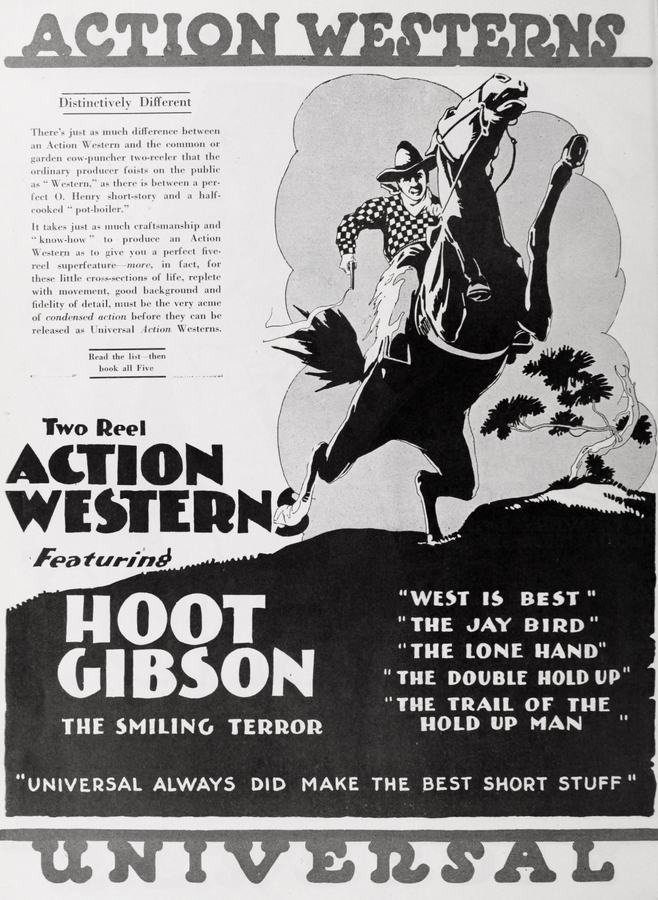
In the annals of silent cinema, where narratives often clung to well-trodden paths of heroics, melodrama, and frontier justice, there occasionally emerges a film that dares to deviate, to playfully twist the established tropes into something remarkably fresh. Such is the case with 'The Trail of the Holdup Man,' a peculiar, yet utterly fascinating, Western that transcends its genre confines to offer a proto-meditation on publicity, spectacle, and the very construction of celebrity. It posits a world where the line between genuine outlaw and calculated showman blurs, where the wild west becomes an unwitting stage for an audacious marketing gambit. This isn't just a story about a cowboy; it's a prescient commentary on the power of perceived danger and manufactured excitement.
The genius of Jack Jevne's screenplay lies in its audacious premise: a cowboy, not driven by malice or greed, but by an almost avant-garde understanding of public relations, orchestrates a series of 'holdups' near a prominent hotel. These aren't crimes in the traditional sense; they are theatrical events, carefully staged to generate buzz, to imbue the establishment with an aura of thrilling adventure, thereby attracting clientele. The protagonist is, in essence, a 'bandit press agent,' a pioneer of experiential marketing long before the term existed. This conceptual audacity alone elevates the film beyond its contemporaries, inviting viewers to ponder the ethics and efficacy of manufactured excitement. It’s a narrative that, even today, feels remarkably modern in its critique of media manipulation and the commodification of experience.
At the heart of this unconventional narrative is Hoot Gibson, whose performance is nothing short of captivating. Gibson, a true rodeo champion turned screen idol, brought an authentic, rugged charm to his roles, but here, he imbues his character with an additional layer of cunning intelligence and playful mischief. He isn't merely portraying a cowboy; he's embodying an artist of illusion, a performer whose stage is the open range and whose audience is the unsuspecting public. Gibson’s expressive face, a hallmark of silent era acting, conveys both the thrill of his charade and the underlying strategic brilliance. He navigates the tightrope between convincing menace and underlying good intentions with admirable dexterity, ensuring that the audience remains complicit in his delightful deception rather than condemning his actions. His portrayal is a masterclass in subtlety, allowing us to see the wheels turning behind the cowboy's eyes, calculating each staged encounter for maximum impact.
The success of the film hinges on Gibson's ability to sell the premise, and he does so with an understated charisma that is utterly disarming. He doesn't chew the scenery; rather, he inhabits the role with a convincing blend of cowboy grit and sophisticated theatricality. One can almost imagine the twinkle in his eye as he plans his next 'raid,' a mischievous grin hidden beneath the brim of his Stetson. This nuanced performance is what prevents the film from descending into mere farce, grounding its outlandish concept in a believable, albeit highly unconventional, character study. Gibson’s cowboy is not just a man on a horse; he is a visionary, albeit one operating on the fringes of legality, whose medium is the thrill of the chase and the spectacle of the staged confrontation.
While Gibson undoubtedly commands the screen, the supporting cast plays a crucial role in grounding the film's eccentric premise. Magda Lane, whose presence often brought a captivating blend of vulnerability and strength to her roles, likely serves as a pivotal figure in the narrative, perhaps as the hotel owner's daughter, a skeptical local, or even an unwitting participant in the cowboy's grand scheme. Her reactions, whether of fear, bewilderment, or eventual understanding, would have provided the necessary emotional anchor for the audience, reflecting their own journey of discovery as the plot unfolds. Without such grounded performances, the film's unique concept might have drifted into pure absurdity.
Edward Burns and Roy Watson, seasoned actors of the era, would have contributed their reliable talents to flesh out the world surrounding Gibson's character. Whether portraying law enforcement, concerned citizens, or rival hoteliers, their performances would have added texture and realism to the reactions to the 'holdups,' thereby amplifying the perceived threat and the eventual revelation of the cowboy's true intentions. The ensemble's collective ability to react convincingly to the staged events is what sells the illusion to the audience, making the eventual twist all the more satisfying. Each actor, in their own way, becomes a cog in the larger machinery of this cinematic performance, contributing to the delicate balance between suspense and comedic irony that defines the film's unique tone.
'The Trail of the Holdup Man' is, at its core, a fascinating exploration of manufactured reality. It’s a film that, decades before the advent of reality television or viral marketing campaigns, understood the intrinsic human desire for excitement, for narrative, even when that narrative is carefully constructed. The cowboy's actions serve as a commentary on the burgeoning media landscape of the early 20th century, where newspapers and nascent film newsreels were increasingly shaping public perception. He is not merely robbing a stagecoach; he is crafting headlines, generating gossip, and essentially creating a local legend through calculated, repeated actions. This meta-narrative layer is what gives the film its enduring resonance, making it feel less like a historical curiosity and more like a surprisingly relevant piece of social commentary.
The film subtly critiques the very notion of heroism and villainy, suggesting that these roles can be donned and shed like costumes, dependent entirely on perception and presentation. Is the cowboy a villain for 'robbing' innocent travelers, or a hero for saving a struggling business? The ambiguity is intentional and thought-provoking. This dynamic is not unlike the performative aspects seen in films such as The Adventures of Buffalo Bill, where the legend of a frontiersman was carefully cultivated and presented as entertainment, blurring the lines between historical fact and staged spectacle. Both films, in their own ways, examine the construction of public image and the appeal of the dramatic narrative.
Jack Jevne, the writer behind this audacious concept, deserves significant credit for his originality. In an era often characterized by formulaic storytelling, Jevne dared to imagine a Western protagonist driven by motives far more complex and modern than simple revenge or justice. His script for 'The Trail of the Holdup Man' is a testament to the creative spirit of early Hollywood, demonstrating that even within established genres, there was room for profound innovation. Jevne’s ability to weave a compelling narrative around such an unconventional premise speaks volumes about his storytelling prowess. He doesn't just present the idea; he meticulously builds a world where such a scheme could plausibly unfold, complete with characters who react authentically to the fabricated chaos.
The screenplay cleverly uses the familiar tropes of the Western – the dusty roads, the isolated hotel, the brave cowboy – only to turn them on their head. It's a delightful deconstruction of the genre, using its very conventions to highlight a new kind of 'con artist' – one who trades in thrilling experiences rather than stolen gold. This intellectual playfulness sets Jevne's work apart and makes the film a compelling watch for anyone interested in the evolution of cinematic storytelling. It’s a narrative that, in its own way, feels as subversive and thought-provoking as the more introspective character studies found in films like Body and Soul, albeit through a vastly different genre lens. While 'Body and Soul' delves into internal moral conflicts, 'The Trail of the Holdup Man' explores the external, performative conflicts of public perception.
While specific directorial credits and detailed cinematographic techniques of silent films can sometimes be elusive, one can infer much from the narrative's execution. The pacing would have been crucial, balancing the suspense of the 'holdups' with the comedic timing of their reveal. The visual storytelling, characteristic of the silent era, would have relied heavily on clear action, evocative settings, and exaggerated expressions to convey the nuances of the plot. The choice of location – a grand hotel in the midst of a seemingly wild landscape – itself provides a visual metaphor for the clash between civilization and frontier, and the film's central theme of bringing 'excitement' to the mundane.
The film also serves as a fascinating snapshot of its time. The early 20th century was a period of rapid industrialization, urbanization, and the rise of mass media. People were increasingly seeking entertainment and novelty, and the idea of a 'thrilling' experience, even a manufactured one, would have held considerable appeal. The film taps into this zeitgeist, reflecting a society eager for spectacle and easily swayed by sensationalism. It’s a stark contrast to the more straightforward dramatic appeals of films like Salvation Nell, which focused on gritty realism and moral redemption, highlighting the diverse range of cinematic expressions available even in the nascent days of the medium.
In an age saturated with influencer marketing, viral stunts, and the constant blurring of reality and performance, 'The Trail of the Holdup Man' feels uncannily prophetic. It foresaw a future where perception could be more valuable than truth, and where the spectacle itself could become the product. This silent Western, with its ingenious plot and charismatic lead, stands as a testament to the early film industry's capacity for innovation and its surprising ability to comment on societal trends that would only fully materialize decades later.
While it might not enjoy the widespread recognition of some other silent classics, its unique premise and Hoot Gibson's compelling performance make it a hidden gem, deserving of re-evaluation. It challenges us to reconsider what constitutes a 'Western' and to appreciate the subtle ways in which early filmmakers experimented with genre, character, and thematic depth. For those who appreciate films that dare to be different, that offer a sly wink to the audience while delivering an engaging story, 'The Trail of the Holdup Man' is an unexpected delight. It's a reminder that even in the seemingly straightforward world of silent Westerns, there was room for profound and playful subversion, a cinematic Don Quixote of the range, tilting at the windmills of public apathy with staged theatrics rather than a lance.
The film's impact, though perhaps not immediately evident in direct cinematic lineages, lies in its foundational exploration of themes that would become central to modern media studies. It's a narrative that, by its very nature, invites intellectual engagement, prompting viewers to question the authenticity of what they see and to appreciate the artistry involved in crafting a compelling illusion. Its lighthearted approach to serious ideas makes it accessible, yet its underlying intelligence ensures its lasting relevance. This is a film that offers more than just cowboy action; it offers a glimpse into the future of communication and spectacle, wrapped in the charming package of a silent Western.
Ultimately, 'The Trail of the Holdup Man' is a delightful anomaly, a film that uses the familiar canvas of the American West to paint a surprisingly sophisticated portrait of human ingenuity, the power of perception, and the timeless allure of a good story – even when that story is meticulously, and hilariously, fabricated. It's a compelling argument for revisiting the often-overlooked corners of cinematic history, where true innovation often lies.
IMDb 7
1933
Community
Log in to comment.