DbcultAccessing Vault...
Cult Review
Senior Film Conservator
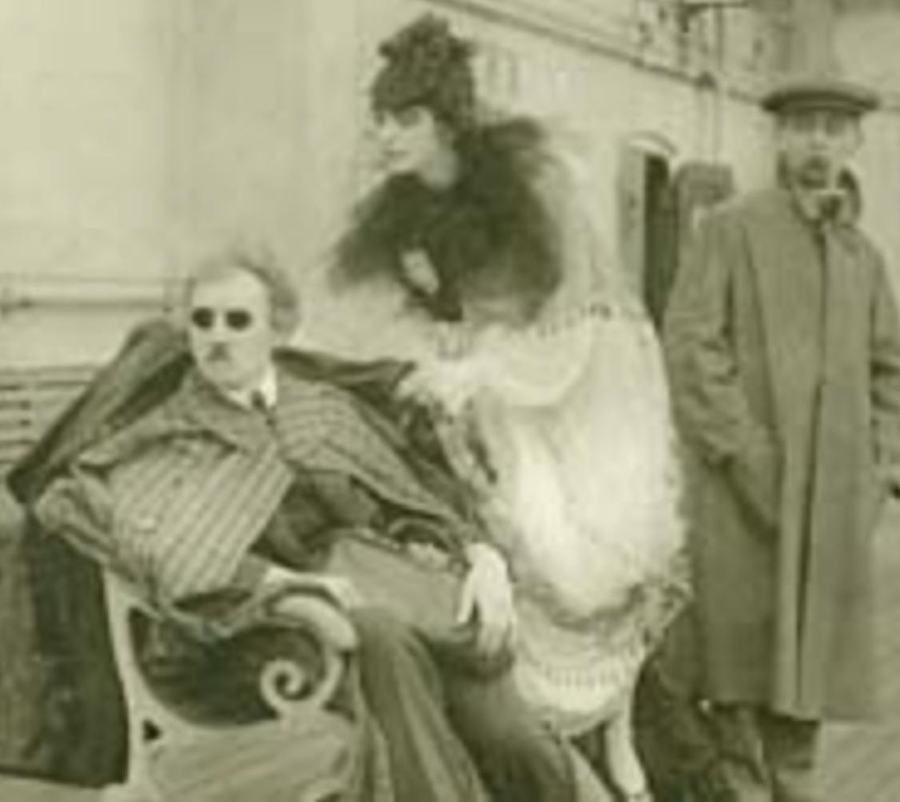
The 1919 silent film *Madame d’Ora* is a ghostly relic of early cinema’s capacity to entwine scientific ambition with personal decay. Directed with a brooding sensibility by an anonymous hand (credited to Erna Morena and Johannes V. Jensen), the film presents a taut psychological study of a marriage corroded by intellectual arrogance and spiritualist delusions. Its lead characters—Edmund Hall, the tormented scientist, and his wife, Madame D’Ora—are not merely archetypes but fully realized specters of a bygone era, their struggles rendered with the stark minimalism characteristic of post-WWI German cinema.
Edmund Hall, portrayed with icy detachment by Friedrich Kühne, is a figure who evokes both admiration and revulsion. His pursuit of the "element of life"—a phrase that echoes the alchemical quests of earlier centuries—positions him as a modern Prometheus, seeking to usurp divine authority. Yet, unlike the noble tragic heroes of classical drama, Hall’s ambition is personal and destructive. His laboratory, a dimly lit chamber of glass vials and arcane apparatus, becomes a metaphor for emotional isolation. The film’s early scenes emphasize his single-mindedness: close-ups of his gaunt face, the rhythmic ticking of a clock, and the flicker of a Bunsen burner create a claustrophobic atmosphere where curiosity is both a torch and a blade.
Hall’s obsession is not purely intellectual. His interactions with young women drawn to spiritualism—mediums who channel voices from beyond the veil—reveal a sordid undercurrent of desire. These women, played with spectral poise by Ellen Johnson and Tzwetta Tzatschewa, are less characters than avatars of temptation. Their presence in the film is both literal and symbolic, their whispered incantations and veiled glances representing the allure of the unknown. Yet, they also function as a mirror, reflecting Madame D’Ora’s own spiraling into jealousy and spiritualist fervor.
Erna Morena’s performance as Madame D’Ora is the emotional nucleus of the film. Her character begins as a poised, almost statuesque figure, her grief over the loss of their child (never explicitly shown) lingering like a shadow. As Hall’s infatuation with the spiritualist world deepens, so too does her unraveling. Morena’s acting is a masterclass in silent cinema techniques: a downward glance here, a clenched fist there, and the audience feels the weight of her despair. The film’s visual language—high-contrast lighting and angular compositions—echoes her internal disintegration. One particularly striking sequence shows her staring into a mirror, her reflection fragmented by shadows, a literalization of her psychological fracture.
The dynamic between the couple is reminiscent of the power struggles in *Herod* (1914), where familial bonds are similarly strained by ambition and moral ambiguity. Yet *Madame d’Ora* diverges by focusing on the domestic sphere as a battleground for existential questions. The spiritualist séances, which Hall hosts with a mix of scientific rigor and occult curiosity, are staged with a theatricality that recalls *Queen X* (1916). These scenes, however, are less about mysticism than about the characters’ need to impose meaning on chaos—a theme that resonates with *The Courage of Silence* (1919), where silence itself becomes a form of protest.
The cinematography in *Madame d’Ora* is deliberately austere, favoring deep blacks and piercing whites to evoke a sense of moral ambiguity. One recurring motif is the use of mirrors and reflections, symbolizing the characters’ fractured identities. In a pivotal scene, Hall’s reflection in a beveled glass window appears distorted, his face half-illuminated by a flickering candle—a visual metaphor for his split between scientific rationality and spiritualist seduction. The camera lingers on these details, allowing the audience to infer the emotional subtext without dialogue.
The production design further enhances the film’s oppressive atmosphere. Hall’s laboratory is a labyrinth of cluttered workbenches and ominous machinery, while the D’Ora household is sparsely furnished, its emptiness underscoring the emotional void between the couple. This visual dichotomy mirrors the thematic tension between scientific progress and spiritual decay. The use of shadows is particularly effective in scenes where Madame D’Ora wanders the house at night, her silhouette dwarfed by the looming furniture—a silent scream of isolation.
While *Madame d’Ora* shares thematic DNA with other pre-Code era films, its uniqueness lies in its restraint. Unlike the over-the-top melodrama of *Salambo, a $100,000 Spectacle* (1915), this film avoids histrionics in favor of a more subdued, almost clinical examination of its characters. Its exploration of spiritualism also invites comparison to *The Last Days of Pompeii* (1913), where ancient rituals are depicted with a similar reverence for the mystical. Yet *Madame d’Ora*’s focus on personal rather than historical tragedy sets it apart.
In terms of acting, the film’s ensemble is a testament to the artistry of silent cinema. Werner Krauss, who later gained fame for his role in *The Cabinet of Dr. Caligari* (1920), appears in a supporting role as a skeptical professor, his presence adding gravitas to the film’s intellectual themes. His exchanges with Hall are charged with a tension that suggests a deeper rivalry—one that hints at the broader societal conflict between traditional academia and emerging scientific paradigms.
*Madame d’Ora* exists in a liminal space between the German Expressionist movement and the more conventional dramatic films of the 1910s. Its visual style anticipates the stark minimalism of *The Outlaw’s Revenge* (1919), yet its narrative structure is more linear, eschewing the abstract symbolism that would define later Expressionist works. This duality makes it a fascinating artifact for film historians, offering a glimpse into the transitional phase of early 20th-century cinema.
Thematically, the film resonates with the post-WWI disillusionment that permeated German culture. Hall’s scientific pursuits can be read as a metaphor for the hubris of technological progress, while Madame D’Ora’s spiritualism reflects a yearning for meaning in a world stripped of traditional values. These themes are echoed in *Marionetten* (1919), though that film’s surrealist approach contrasts sharply with *Madame d’Ora*’s realism.
*Madame d’Ora* is a film that demands patience and attention, its power lying not in spectacle but in the quiet devastation of its characters. The absence of intertitles (a rarity even in silent cinema) forces the audience to read between the lines, drawing meaning from glances, gestures, and the interplay of light and shadow. This is a film that understands the poetry of stillness, where every pause is a punctuation mark in a larger existential narrative.
For modern viewers, *Madame d’Ora* offers a window into the anxieties of an era grappling with rapid scientific and spiritual transformation. It is a film that asks whether the pursuit of knowledge can ever satisfy the human soul—or if, like Madame D’Ora herself, we are doomed to wander the corridors of our own despair, searching for a light that may not exist.
IMDb —
1927
Community
Log in to comment.