DbcultAccessing Vault...
Cult Review
Senior Film Conservator
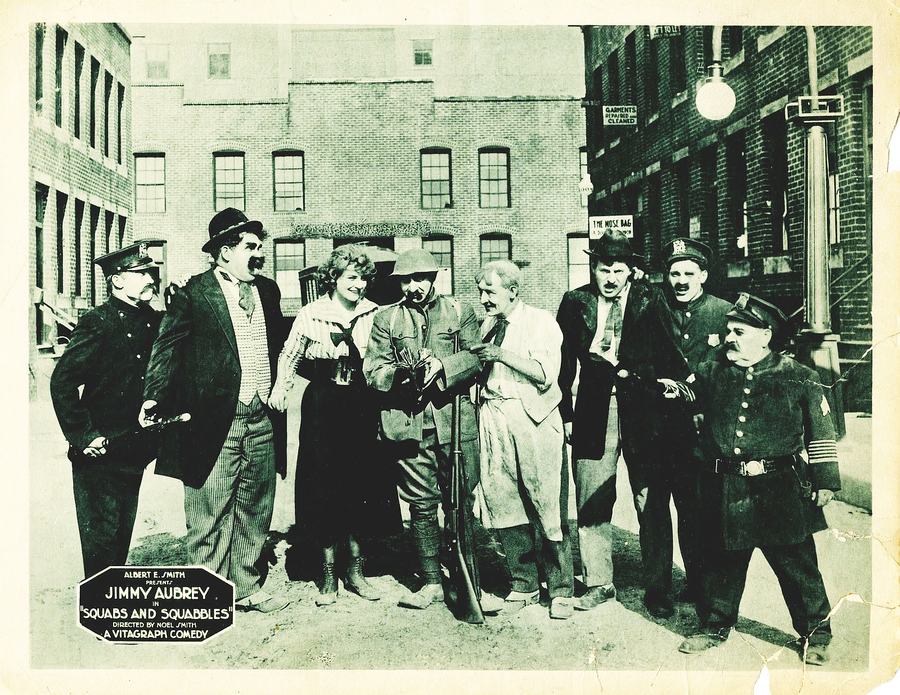
Step back in time to an era of unbridled physical comedy, a period when the flicker of celluloid and the exaggerated gestures of performers communicated more than a thousand words. We're delving into the uproarious world of Squabs and Squabbles (squabs-and-squabbles), a delightful silent-era romp from a time when cinematic storytelling was still finding its voice, but its laughter was already deafening. Released in the nascent years of the 1920s, this film, penned by the prolific Anthony Coldeway, offers a fascinating glimpse into the foundations of slapstick and the burgeoning careers of comedic talents like Jimmy Aubrey and the legendary Oliver Hardy.
The film unfolds in the aptly named Paradise Alley, a street that is anything but paradisiacal. It's a crucible of perpetual discord, a veritable battleground where every inhabitant harbors a festering grudge against their neighbor. The street is a constant, boisterous spectacle of brawling and flung produce, a testament to humanity's less harmonious instincts. This chaotic symphony, however, is periodically interrupted by the formidable figure of the 'Big Boss,' portrayed with characteristic heft and authority by Oliver Hardy. His booming command, echoing from the doorway of his abode, instantly clears the street, a momentary truce enforced by sheer intimidation. This early role for Hardy, while not yet showcasing the nuanced partnership that would define his later career with Stan Laurel, already hints at his masterful command of physical presence and a certain exasperated gravitas that would become his trademark.
The initial setup of Paradise Alley is a brilliant stroke of comedic world-building. It establishes an environment where chaos is the norm, making any semblance of order a source of inherent humor. The 'Big Boss' functions as a temporary, almost reluctant, deus ex machina, his power deriving purely from his imposing demeanor. His subsequent visits to a local beanery, where a 'beautiful girl' presides over the cash register, introduce a touch of narrative progression, a hint of potential romance or aspiration beyond the street's incessant squabbles. Meanwhile, a cop, oblivious to the constant fighting, slumbers around the corner – a classic comedic trope highlighting the ineffectiveness of official authority in the face of ingrained anarchy, a theme often explored in silent comedies where the common man's ingenuity (or lack thereof) often triumphs over institutional order.
The plot thickens with the introduction of a 'Man of Mystery,' a character whose very anonymity allows him to become a catalyst for further pandemonium. After inadvertently becoming a target for the street's airborne projectiles, he determines to emulate the Boss's calming influence. His method? A daring, almost audacious, act of sartorial subterfuge. He borrows – or perhaps, more accurately, pilfers – the Boss's distinctive hat from the beanery. Donning this emblem of authority, he steps onto the street, where he is immediately mistaken for the Big Boss himself. The fighters, recognizing the hat and associating it with the commanding presence, again vanish into thin air. This sequence is a masterclass in mistaken identity, a trope that would become a cornerstone of comedic storytelling for decades to come. The absurdity of a mere hat conferring such power is inherently funny, and it perfectly sets the stage for the escalating farcical events that follow. The Man of Mystery, having achieved his goal, returns the hat, but not before adding insult to injury by stealing the Boss's cigar, a small act of defiance that underscores the film's playful irreverence towards authority figures.
Enter James, our ostensible hero, portrayed by the versatile Jimmy Aubrey. His introduction is nothing short of brilliant in its subversion of expectations. We find him in a mission, seemingly a devout congregant, his eyes wide with an almost unsettling intensity. The minister grows nervous under his unwavering gaze, and the other congregants become restless. The reveal – that James has painted eyes on his eyelids to appear awake while sound asleep – is a stroke of comedic genius, perfectly encapsulating his character: resourceful, opportunistic, and utterly unconventional. This visual gag is not just funny; it immediately establishes James as an anti-hero of sorts, a character who operates on the fringes of societal norms, driven by a blend of laziness and cunning. This kind of subversive humor, where piety is a mere façade for personal convenience, was a common thread in early silent comedies, allowing filmmakers to gently poke fun at established institutions.
His subsequent actions further cement this characterization. Upon waking, James, with a casual disregard for sacred spaces, steals from the poor-box. However, fate, or perhaps the narrative's need for a moral compass, intervenes. Outside, he witnesses the Big Boss administering a beating to two crooks for their own thievery. This sight, coupled with the presence of the pretty cashier from the beanery, who observes his hurried return to replace the poor-box, instigates a moment of nascent conscience. Her extended sympathy, a silent acknowledgment of his conflicted nature, becomes a powerful motivating force for James. This interaction is pivotal; it transforms James from a mere prankster or petty thief into a character with a potential for redemption, albeit one that will be achieved through a series of utterly chaotic and accidental heroics. It's a classic underdog narrative, where the protagonist, initially flawed and self-serving, is gradually nudged towards benevolence.
The beanery, already a hub of activity, becomes the next stage for James's misadventures. After a 'fat man' is unceremoniously ejected from the establishment, James and the Man of Mystery hatch an ingenious, if ill-conceived, plan. They 'borrow' the fat man's clothes, with James hiding inside the voluminous suit while the Man of Mystery wears it, attempting to pass off the combined duo as a single, unusually large patron. This gag, a staple of early physical comedy, relies on the visual absurdity of two people trying to convincingly portray one. The Man of Mystery attempts to feed James surreptitiously, leading to a series of increasingly frantic and comical movements as they try to maintain the illusion. The discovery of their ruse is inevitable and perfectly executed, culminating in James being put to work in the kitchen – a classic comedic punishment that promises further chaos.
And chaos he delivers. James in the kitchen is like a bull in a china shop, or perhaps more accurately, a tornado in a pantry. He manages to 'almost wreck the place,' a testament to his unique brand of ineptitude and his uncanny ability to turn any situation into a disaster. This sequence is pure slapstick gold, relying on exaggerated movements, flying props, and the utter destruction of a meticulously organized space. It's a prime example of the kind of physical comedy that defined the silent era, where visual gags and the sheer energy of the performers carried the humor. One might draw parallels to the early, more anarchic shorts of Buster Keaton or even some of the early Keystone Kops films, where the destruction of property was often a central punchline. The humor isn't just in the destruction itself, but in James's wide-eyed innocence and complete lack of self-awareness as he brings the kitchen to its knees.
The narrative takes another twist as the Big Boss, ever the opportunist, conspires with the Man of Mystery to rob the very restaurant that has become James's temporary workplace. This plot element adds a layer of genuine peril, albeit filtered through the lens of farce. The Boss, with characteristic confidence, begins to pass money from the cash register to his accomplice. However, in a stroke of narrative serendipity – or perhaps, simply James's magnetic pull towards trouble – James accidentally intercepts the stolen funds. This accidental acquisition of the loot is a pivotal moment, shifting the film's focus from mere slapstick to a more structured comedic narrative where James, through no intentional effort of his own, becomes central to the resolution of the conflict. The proprietor's subsequent discovery of the loss and his pursuit of the Man of Mystery further complicates matters, creating a frantic chase sequence that is a hallmark of silent comedy.
Amidst this unfolding pandemonium, James is presented with yet another seemingly insurmountable task: to 'still the noise of a German street band.' This seemingly simple request transforms into another vehicle for physical comedy. James, attempting to quiet the boisterous musicians, becomes an instant magnet for all the vegetables previously thrown at the band. He's pelted mercilessly, transforming into a human target, a visual gag that elicits laughter through sheer absurdity and the protagonist's helpless plight. This scene is a brilliant example of how silent films could build humor through escalating physical discomfort and the protagonist's valiant, yet futile, attempts to control an uncontrollable situation. It recalls the chaotic street scenes often depicted in films like The Chauffeur or even the early, more aggressive comedic shorts of Mack Sennett, where public humiliation was a common source of mirth.
The climax sees James acquire a soldier's uniform – another instance of mistaken identity or perhaps a symbolic donning of authority – which he uses to 'put them all to rout.' The uniform, much like the Boss's hat, confers an instant, almost magical, power upon him, transforming the bumbling kitchen worker into an unlikely figure of command. This sudden shift in power dynamics, brought about by a simple change of attire, is a delightful comment on the superficiality of appearances and the power of perception. More importantly, James also plays a crucial role in helping to regain the proprietor's stolen money. This act, however accidental or unintentional in its genesis, solidifies his status as a hero. He has, through a series of utterly unplanned and often calamitous events, managed to restore order, albeit a chaotic one, and bring about a semblance of justice. This accidental heroism, culminating in him proving himself a 'hit with the girl,' provides a satisfying, if predictable, resolution to his character arc. It's a classic underdog triumph, where the least likely candidate stumbles into success and wins the affection of the romantic interest, a narrative trope that resonates across countless comedic tales, from Sporting Blood's underdog narratives to the romantic entanglements of My Wife.
Squabs and Squabbles, while perhaps not as widely known as the masterpieces of Chaplin or Keaton, is a testament to the vibrant and innovative spirit of early silent comedy. Jimmy Aubrey, as James, delivers a performance brimming with physical energy and a wonderfully expressive face. His character's blend of feigned innocence and underlying roguishness is captivating. Oliver Hardy, even in this relatively early role, demonstrates the imposing yet subtly comedic presence that would later make him a global icon. His 'Big Boss' is a fascinating precursor to the 'Ollie' persona, characterized by a certain exasperated authority and a penchant for physical comedy that, even when menacing, retains a touch of the absurd.
The film's direction and editing, characteristic of the era, prioritize clear visual storytelling and rapid-fire gags. The pacing is brisk, moving from one chaotic scenario to the next without lingering, ensuring that the audience is constantly engaged by the escalating absurdity. The use of simple, effective visual cues – like the hat or the uniform – to denote shifts in power or identity is a hallmark of silent film craftsmanship. The writers, particularly Anthony Coldeway, understood the mechanics of comedic escalation and the power of mistaken identity and accidental triumph. It’s in these foundational works that we see the building blocks of narrative comedy being laid, influencing generations of filmmakers who would follow.
In an age dominated by sound and spectacle, revisiting a film like Squabs and Squabbles is a refreshing reminder of the enduring power of pure visual comedy. It’s a film that speaks a universal language of laughter, transcending the barriers of time and technology. Its depiction of a perpetually squabbling community, ultimately brought to a semblance of order by the most unlikely and accidental of heroes, remains as charming and amusing today as it must have been a century ago. It's a delightful piece of cinematic history, offering insights into the comedic sensibilities of its time and showcasing the burgeoning talents of its cast. For enthusiasts of silent cinema and the foundational elements of comedy, Squabs and Squabbles is more than just a historical curiosity; it's a testament to the timeless appeal of a good, old-fashioned laugh.
IMDb 6.8
1925
Community
Log in to comment.