DbcultAccessing Vault...
5.9/10
Senior Film Conservator
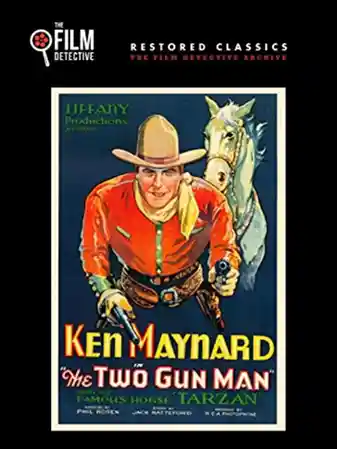
A definitive 5.9/10 rating for a film that redefined the boundaries of cult cinema. The Two Gun Man remains a cornerstone of transgressive art.
Alright, if you're sitting down hoping for something like "Unforgiven" or even a classic John Wayne epic, you're in the wrong saloon. The Two Gun Man is for those who dig deep into early Westerns, the ones where the plot is straight as an arrow and the hero always wears the white hat. If you're into the history of the genre, or just really like Ken Maynard and his horse, Tarzan, then *maybe* give it a whirl. Otherwise, folks looking for anything remotely modern in pacing or character depth will likely find themselves tapping their feet. 🤠
The basic setup is pretty familiar for the era: hired guns, a real nasty bunch, are giving honest ranchers a hard time. Ken Maynard, playing himself essentially, rides in to sort things out. He’s got that signature two-gun style. It’s impressive to watch him handle those pistols, even if the gunplay itself often feels a bit... *choreographed* for the camera. You can see they’re trying to make it look cool. ✨
What really shines here, surprisingly, is Tarzan, Ken's horse. The horse gets so much screen time. Honestly, Tarzan often feels like the most dynamic actor in the whole picture. He performs tricks, follows commands perfectly, and it's clear Maynard had a genuine, strong bond with the animal. It’s not just a prop; Tarzan is a real co-star. This really stood out to me. You don't always get that level of animal performance, especially back then.
The "hired guns" themselves are a pretty generic bunch. Jim Corey is there, looking suitably grumpy, but there isn't much depth to any of them. Their motivation is simple: they want the ranchers' land. No complex backstory, no grand evil plan, just plain bad guys being bad. And that’s fine. For 1931, you don't need much more than that for a villain.
The action is mostly made up of horse chases across wide-open spaces and quick shootouts. The sound quality, which is common for early talkies, means the dialogue can be a bit all over the place. One minute it's muffled, the next it’s surprisingly loud. You end up riding the volume knob a lot. It adds a certain antique charm, but you definitely miss a line or two here and there. The hand-to-hand fights are very rudimentary. Lots of flailing. No fancy martial arts here. 😅
There's a specific moment where Ken Maynard is just *twirling his guns* in both hands, and it goes on for what feels like an eternity. It's not advancing the plot or anything. It's just a pure, unadulterated "look what our star can do" moment. It's kind of endearing in its earnestness. Like the director really wanted to make sure you saw his trick. It sticks in your mind.
Lucille Powers plays the rancher's daughter, the main female character. Her job is mostly to look worried and eventually be rescued. She doesn't have much to do beyond that. Her performance isn't bad, but the role itself is pretty limited. She does manage a pretty convincing scream, though, when danger calls!
The pacing is generally brisk. No long, drawn-out emotional scenes or scenic panoramas. It's all about pushing the story forward, getting from one confrontation to the next. The movie actually gets noticeably better once it settles into its rhythm of action and stops trying to explain *why* the bad guys are bad. Once Maynard is just doing his thing, it really picks up. It just flows better.
I found myself noticing the minimal sets and the overall "clean" look of everything. Even out in the dusty West, the costumes, while appropriate, don't feel particularly *worn*. It gives the film an almost theatrical quality, like a play translated to the screen. Not super realistic, but it has its own aesthetic. 🎭
There's a scene where the camera zooms in on a character's face during a tense discussion. You can almost feel the film trying to convince you this particular moment *really* matters. It's a bit clunky, the way they execute it. But you can see the ambition, the effort to create drama. For an early sound film, those little attempts at visual storytelling are interesting.
And the background extras! During a town square scene, some of them look genuinely unsure of where to stand or what their purpose is. Like they're just waiting for direction, even while the scene is happening. It lends a certain raw, unpolished charm to the whole thing. This isn't polished Hollywood; it's a bit more... *real* in its imperfections. It feels like a moment you'd only catch if you were really paying attention, not just passively watching.
The ending is, predictably, a satisfying wrap-up. Good guys win, bad guys get their comeuppance. No real surprises there. It's a classic Western formula, executed with the technology and budget of its time. It’s a good example of what a programmer Western from this era would look like. No more, no less.
Overall, The Two Gun Man is a neat little time capsule of early Western cinema. It has its share of quirks and limitations, but also a certain rustic charm. It’s a straightforward story, simply told, featuring a charismatic hero and his truly amazing horse. Don't go in expecting a cinematic masterpiece. But if you're a fan of old Westerns, or just curious about the roots of the genre, it’s worth watching for its historical value and some genuinely fun Ken Maynard moments. It's a piece of film history. 🎬
IMDb —
1919
Community
Log in to comment.