DbcultAccessing Vault...
Cult Review
Senior Film Conservator
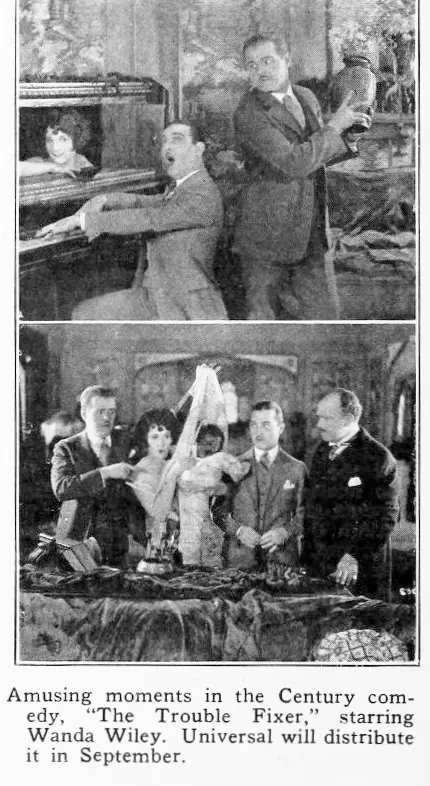
The silent era’s fascination with the volatility of the nuclear family finds a dizzying, almost hallucinatory expression in The Trouble Fixer. Directed by the prolific Albert Herman, this 1924 romp serves as a definitive showcase for Wanda Wiley, an actress whose comedic timing possessed the precision of a Swiss watch and the explosive unpredictability of a loose firework. Unlike the more grounded domesticity found in The Price of Her Soul, Herman’s work here opts for a surrealist escalation, where the very concept of 'home' is treated as a mutable, often collapsible, construct.
The film commences not with the serene glow of marital bliss, but with a logistical nightmare that sets the pace for the subsequent sixty minutes. The accidental kidnapping of a baby during a honeymoon getaway is a trope that could, in less capable hands, veer into the macabre. However, Wiley and her onscreen 'Hubby' transform this frantic chase into a rhythmic exploration of panic. The cinematography captures the velocity of 1920s transit with a fervor reminiscent of Double Speed, emphasizing the fragility of social order when transposed onto the open road. This initial sequence establishes the film’s central thesis: that the protagonist is a magnet for circumstantial catastrophe, a 'fixer' whose solutions invariably catalyze further complications.
When the narrative shifts to the Californian 'tent city' setting, the film adopts a satirical stance on the housing anxieties of the era. Living under a tent is presented not as a romanticized frontier experience, but as a flimsy barrier between the private self and public scrutiny. This setting echoes the rugged, often unforgiving environments seen in Canyon of the Fools, yet Herman utilizes the transparency of the tent to heighten the farcical elements. Every movement is shadowed, every whisper amplified, creating a claustrophobic stage for Wiley’s increasingly desperate histrionics. The tent is a metaphor for the precariousness of Wanda’s social standing—one gust of truth away from total collapse.
The core of the film’s second act involves a labyrinthine series of impersonations that would make the protagonists of El rompecabezas de Juanillo dizzy. Wanda’s agreement to pose as her neighbor’s wife to appease a visiting father-in-law introduces a sharp commentary on the performative nature of 1920s marriage. Wiley navigates this duplicity with a frantic grace, shifting her persona with a flick of her eyes. The arrival of her own parents necessitates a 'double-down' on the deception, requiring the 'borrowing' of another infant. This cycle of borrowing—first a husband, then a child—highlights a thematic obsession with the commodification of family roles. While Tess of the D'Urbervilles treats the deception of lineage with tragic weight, The Trouble Fixer finds the comedy in the sheer exhaustion of maintaining a lie.
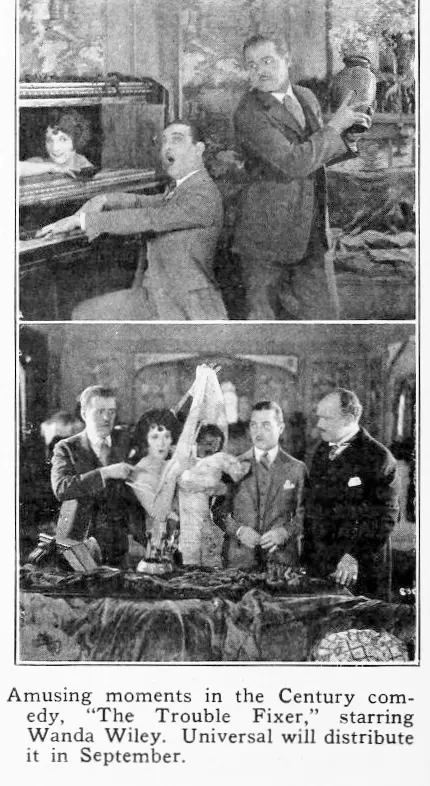
The film reaches its zenith when Wanda is forced to play the role of twins to satisfy the simultaneous presence of her various 'families.' This sequence is a masterclass in blocking and physical comedy. Wiley’s ability to differentiate two identical versions of herself through subtle shifts in posture and gesture is nothing short of miraculous. It brings to mind the uncanny doubles and strange apparitions found in Capitan Groog and Other Strange Creatures, though Herman keeps the mechanics firmly rooted in the physical world. The editing here is razor-sharp, maintaining the illusion of two Wileys while the narrative tension reaches a fever pitch. She is no longer just a character; she is a human gears-and-pulleys system, desperately trying to keep the machinery of her life from grinding to a halt.
The reintroduction of the 'borrowed' baby’s actual mother provides the film’s most grounded conflict. The mother’s irate pursuit of Wanda adds a layer of genuine peril to the comedy, similar to the tension found in Flirting with Terror. This isn't merely a misunderstanding; it is a primal reclamation. The confrontation between the two women—one representing the chaos of the 'fixer' and the other representing the righteous stability of motherhood—creates a friction that propels the film toward its resolution. Unlike the heavy-handed moralizing of Damaged Goods, Herman allows the resolution to be messy, loud, and ultimately joyful.
Albert Herman’s direction is characterized by an aversion to static frames. He understands that a comedy of this nature requires a constant sense of kinesis. The camera often feels like an uninvited guest, scurrying around the tent and the dusty California streets to keep up with Wiley’s peripatetic movements. There is a raw, almost documentary-like quality to the outdoor scenes that contrasts sharply with the choreographed madness of the interior ruses. This visual duality mirrors the film’s thematic split: the reality of the struggling honeymooners versus the fantasy of the successful socialites they are pretending to be. In this regard, it shares a certain DNA with the atmospheric tension of Havsgamar, though the tone remains resolutely light.
In the broader pantheon of silent comedy, The Trouble Fixer stands as a testament to the versatility of the female lead. While contemporaries were often relegated to the role of the 'ingenue' or the 'shrew,' Wanda Wiley occupies a space of pure agency—even if that agency is directed toward fixing problems she herself created. The film lacks the cynical edge of Die Verführten or the predatory undertones of The Tiger. Instead, it celebrates a specifically American brand of frantic ingenuity. It is a picaresque journey through the anxieties of the jazz age, where the 'trouble' being fixed is nothing less than the inherent absurdity of being alive and married in a rapidly changing world.
The film concludes with a restoration of order that feels earned precisely because the preceding chaos was so total. The 'happy ending' is not a return to a boring status quo, but a hard-won peace between the characters and the audience. We leave the theater (or the screen) with the sense that while the trouble has been fixed, the next catastrophe is likely just around the corner, and as long as Wanda Wiley is there to meet it, we are in for a spectacular show. It is a work of high-octane whimsy, a cinematic caffeine jolt that remains as potent today as it was in 1924. For those seeking the roots of the modern screwball comedy, look no further than this tent in California, where a woman pretended to be her own twin to keep the world from falling apart. It is as essential as The Ranch Romeo for understanding the evolution of the genre, and far more inventive than the standard sleuth fare like Sleepy Sam, the Sleuth. It is, quite simply, Thrills (Thrills) and spills in their purest form.
IMDb —
1922
Community
Log in to comment.