DbcultAccessing Vault...
Cult Review
Senior Film Conservator
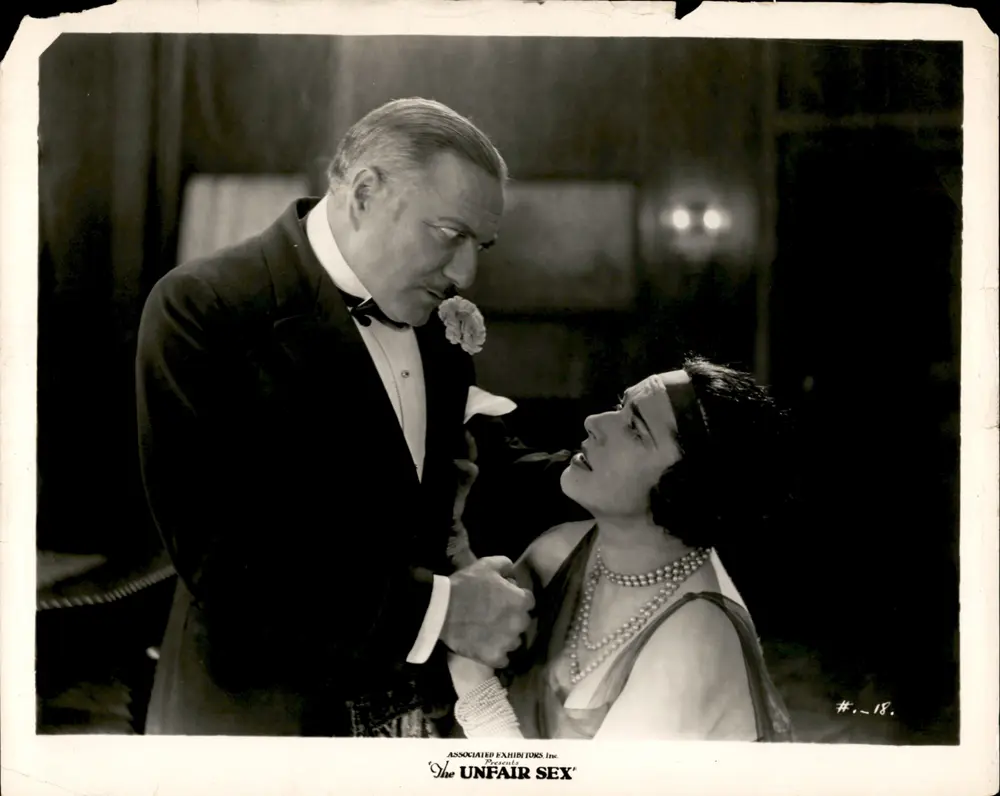
Is "The Unfair Sex" worth watching today? Short answer: yes, but with significant caveats. This early 20th-century drama offers a fascinating, albeit flawed, glimpse into the anxieties of its era, making it essential viewing for silent film enthusiasts and those interested in the social commentary hidden within melodrama. However, casual viewers accustomed to modern narrative pacing or nuanced character development might find its conventions challenging to embrace.
At its core, the film is a stark morality play, a cautionary tale about innocence colliding with urban cynicism. It’s a compelling, if sometimes heavy-handed, exploration of manipulation and societal expectations. It works. But it’s fundamentally flawed.
This film works because of its audacious plot, driven by a truly despicable villain whose machinations are both compelling and disturbing. It also provides an invaluable window into early cinematic portrayals of gender dynamics and urban corruption.
This film fails because its narrative contrivances occasionally stretch credulity, and some character motivations, particularly Billy's, feel underdeveloped, relying heavily on silent film tropes rather than deep psychological insight.
You should watch it if you appreciate the historical context of cinema, enjoy melodramatic tales of manipulation, and are keen to witness the raw, expressive power of silent-era acting, especially from its antagonist.
The undeniable gravitational center of "The Unfair Sex" is Holbrook Blinn as Don Calvert. Blinn doesn't just play a villain; he embodies a force of nature, a man whose very presence corrupts. His performance is a masterclass in silent film villainy, relying on subtle shifts in expression, a predatory gaze, and deliberate, almost theatrical, gestures to convey his insidious intent. We watch him not just scheme, but relish the process, a chilling quality that elevates the film beyond simple melodrama.
From his initial appearance at the engagement party, a stranger observing with unsettling intensity, Blinn establishes Calvert as an outsider, a serpent in a pastoral garden. His eyes, even through the flickering nitrate, convey a calculating intelligence, a man who sees people as pawns in his elaborate game. The way he manipulates Billy Emerson (Walter Miller) into leaving for New York, a seemingly benevolent act, is laced with a barely perceptible smirk that speaks volumes without a single intertitle. It's truly disturbing.
In contrast, Hope Hampton, as Shirley Chamberlain, delivers a performance that oscillates between naive sweetness and a surprising, if sometimes overwrought, defiance. Her transformation from the innocent country girl, bathed in soft focus, to the bewildered, then feigned sophisticated, woman navigating New York's harsh realities is palpable. Her wide-eyed wonder at the city quickly gives way to confusion and a desperate attempt to fit into a world she doesn't understand. The scene where she attempts to appear 'gay and frivolous' at the nightclub, a brittle mask over genuine pain, is one of her strongest moments, showcasing a character trying to survive in a hostile environment.
Walter Miller's Billy Emerson, unfortunately, is the weakest link in the primary cast. His character is designed to be gullible, a blank slate for Calvert's machinations, but he often comes across as simply dim-witted. His infatuation with Blanchita D'Acosta (Nita Naldi) feels less like a genuine emotional connection and more like a narrative requirement. Frankly, Billy Emerson is one of the most frustratingly passive protagonists in silent cinema, almost deserving of the manipulation he endures. His eventual 'rescue' of Shirley feels less like heroic agency and more like a belated, almost accidental, awakening.
Nita Naldi, on the other hand, brings a sultry, dangerous allure to Blanchita. Her screen presence is magnetic, a stark contrast to Hampton's wholesome beauty. Naldi's performance, particularly her violent jealousy when Calvert turns his attention to Shirley, is a highlight. However, her character is criminally underutilized, reduced to a plot device of passion and rivalry rather than a fully realized individual with her own motivations beyond Calvert's immediate influence. One can't help but feel a more complex subplot for Blanchita would have enriched the film considerably, moving her beyond the 'other woman' trope.
Directed by Eugene Walter, who also co-wrote the screenplay with Arthur Hoerl, "The Unfair Sex" employs the visual language of silent cinema with competence, if not groundbreaking innovation. The early scenes in the countryside are often shot with a pastoral softness, emphasizing Shirley's innocence through natural light and gentle compositions. This visual tranquility sharply contrasts with the jagged, often darker, aesthetic of the New York sequences.
The cinematography effectively uses lighting to delineate character and mood. Calvert is frequently framed in stark, almost chiaroscuro lighting, or emerges from shadows, visually reinforcing his manipulative nature. The nightclub scenes, with their frenetic energy and artificial glow, are well-staged, capturing the dizzying, disorienting atmosphere of urban nightlife that overwhelms Shirley. Close-ups are judiciously used to convey intense emotion, particularly during moments of shock, betrayal, or defiant realization.
Pacing is a mixed bag. The initial setup of Calvert's scheme feels deliberate, almost methodical, allowing the audience to fully grasp the intricate web he's weaving. Once the action shifts to New York, the pace quickens, reflecting the chaotic environment. However, some transitions can feel abrupt, and certain plot points, like Billy's rapid infatuation, are conveyed with a speed that sacrifices psychological depth for narrative propulsion. This is a common characteristic of silent-era melodrama, where emotional shorthand often took precedence over nuanced development.
The use of intertitles, while necessary, sometimes over-explains emotions that could have been conveyed purely through acting and visual storytelling. There are moments when the film trusts its actors less than it should, resulting in a slight redundancy. Yet, for a film of its era, it largely succeeds in maintaining a consistent tone of melodramatic tension, building effectively to its dramatic climax in Calvert's apartment. The final confrontation, though reliant on silent film conventions, is genuinely gripping, demonstrating the power of visual storytelling when it matters most.
At its heart, "The Unfair Sex" is a profound exploration of societal anxieties prevalent in the early 20th century. The central theme revolves around the clash between rural innocence and urban corruption. Shirley Chamberlain embodies the purity of the countryside, a world of clear moral lines and simple affections. New York City, personified by Don Calvert, represents a labyrinth of deceit, artifice, and moral ambiguity, where personal gain trumps ethical considerations.
The film's title itself, "The Unfair Sex," speaks volumes about the gender dynamics at play. Shirley's position is inherently vulnerable. She is a woman whose fate is dictated by the machinations of men – first, her father's announcement of her engagement, then Billy's ambition, and ultimately Calvert's predatory schemes. The 'unfairness' lies in her limited agency, her struggle to navigate a world engineered by male desires and manipulations. Her attempt to adopt a 'gay and frivolous' persona is a heartbreaking testament to this, a desperate performance to reclaim some semblance of control or understanding in a world she doesn't belong to.
Manipulation is another dominant theme. Calvert is not merely a villain; he is a master puppeteer. His actions are not random acts of malice but carefully calculated steps to achieve a perverse sense of power and control. He thrives on disrupting lives, on proving his intellectual superiority through psychological torment. This makes him a more complex antagonist than a simple robber or brute; his weapon is the mind, and his battlefield is the human heart.
The film also touches upon the allure and dangers of ambition. Billy's desire to 'establish himself' in the city is the initial hook Calvert uses. This ambition, while seemingly noble, blinds Billy to the true nature of his new environment and the people within it. It's a cautionary tale for anyone chasing success without considering the moral cost. The narrative doesn't shy away from depicting the devastating consequences when personal aspirations are exploited by those with nefarious intentions. It's a brutal observation.
For contemporary audiences, approaching "The Unfair Sex" requires a certain degree of historical appreciation. It is not a film that will resonate with everyone, especially those unfamiliar with the conventions and rhythms of silent cinema. The melodrama can feel heightened, the character motivations occasionally simplistic, and the pacing, by modern standards, sometimes uneven.
However, for film scholars, silent film aficionados, or anyone curious about the evolution of storytelling, it offers considerable value. Holbrook Blinn's performance alone is worth the price of admission, a chilling portrayal that transcends the limitations of its era. The film serves as an excellent case study for understanding early cinematic portrayals of gender dynamics, urban/rural divides, and the moral anxieties of the Jazz Age. It's a window into a bygone era, offering insights into the social fabric and fears of the time.
It might not be a 'masterpiece' in the modern sense, but it is a significant piece of cinematic history. Its relevance today lies not just in its plot, but in its ability to spark discussion about how societal pressures and manipulation have been depicted on screen for over a century. It reminds us that some themes are timeless, even if their presentation evolves.
Like any film from this nascent period of cinema, "The Unfair Sex" comes with its own set of strengths and weaknesses that define its viewing experience.
"The Unfair Sex" is a compelling, if imperfect, relic of the silent era. It shines brightest when Holbrook Blinn's villainy is allowed to dominate the screen, offering a chilling glimpse into the darker side of human nature. While its narrative can occasionally falter under the weight of its own melodrama and some characterizations feel thin, its thematic explorations of innocence lost and the corrupting influence of urban life remain potent.
It's a film that demands patience and an appreciation for its historical context, but rewards those who engage with it. For students of cinema, it's an invaluable artifact. For casual viewers, it’s a curiosity, perhaps a challenging one, but ultimately a rewarding dive into a pivotal moment in film history. It may be 'unfair' to Shirley, but it’s a fascinating, if flawed, piece of cinematic history worth rediscovering.
IMDb 5
1935
Community
Log in to comment.