DbcultAccessing Vault...
Cult Review
Senior Film Conservator
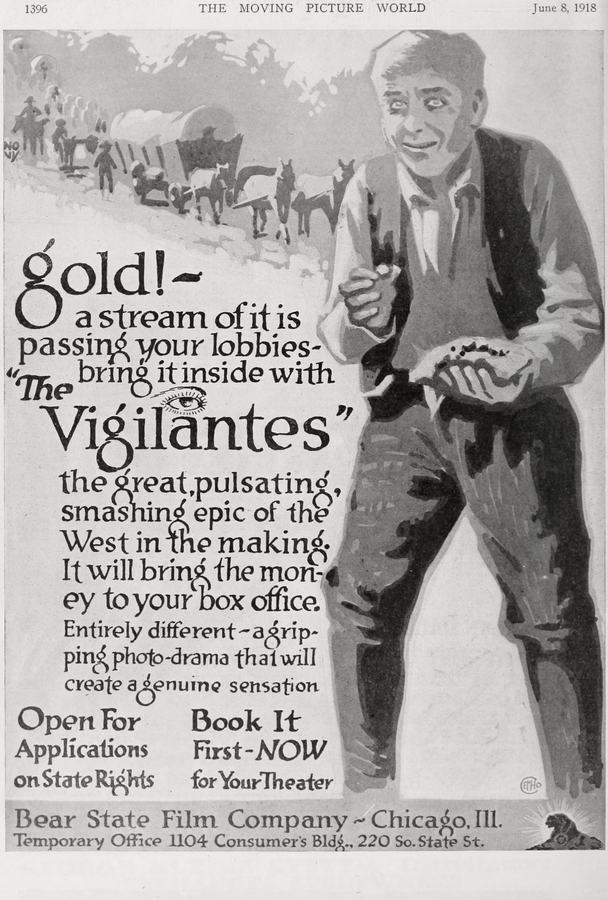
A yellow flake no wider than a communion wafer upends the cosmic order in The Vigilantes, and the reverberations feel closer to biblical plague than to textbook history.
Director C. Sanford Harrison, armed with a shoestring budget and a cast of barnstormers, somehow stages the entire California gold rush inside a single moral spasm: lust for metal curdling into lust for order, both addictions equally ruinous. The film is only reels long—some prints lop off the prologue—but its compression works like a tourniquet, trapping every venal impulse in flickering close-up.
Shot largely in available Californian daylight, the picture’s contrast between blinding Sierra sun and nitrate gloom predicts the chiaroscuro that would later become film-noir grammar. Notice how cinematographer Grant Churchill frames the first gold discovery: a low angle that makes the sawmill’s waterwheel resemble a crucifix, water spattering like liquid coinage. Within the same sequence, a jump-cut to a San Francisco roulette wheel collapses a continent and a conscience into five feet of celluloid. The moral free-fall is so abrupt you can practically hear the vertebrae snap.
There is a moment—easy to miss—when Amos Fenton (Robert Cecil) washes ore in a tin pan, his reflection fractured by gravel. The shot dissolves to Mary reading his letter by candle back east; the two faces share the frame in superimposition, separated not merely by geography but by competing aspect ratios. The west is widescreen promise; the east, boxy propriety. The splice predicts their reunion will be anything but square.
What distinguishes The Vigilantes from contemporaneous westerns like Half Breed or The Three Godfathers is its queasy awareness that mob rule is not a necessary evil but a civic steroid. The committee’s charter is recited like liturgy while the camera pans across black-robed merchants clutching Bible and blunderbuss alike. These aren’t Coopersian frontiersmen; they’re accountants who’ve weaponized double-entry bookkeeping, balancing ledgers with lynching ropes.
When Fenton intones, ‘We must cleanse the city so law may flourish,’ the line lands with Trumpian self-dealing, all the more chilling for its 1925 innocence. Harrison is not endorsing; he’s autopsying. Close-ups of onlookers—women clutching parasols, a boy sucking a stick of rock—reveal the spectacle for what it is: the birth of American true-crime entertainment, admission free with every hanging.
Yes, Mary (Gale Brooks) ends up bound atop a supply crate in a Barbary Coast warehouse, but observe how she got there: she disembarks from a clipper wearing a bustle sharp enough to slice cable, interviews dockworkers like a proto-Nellie Bly, and refuses a chaperone. Her kidnappers need chlorform and five ruffians because she fights back with a reticule stuffed with gold nuggets—turning the film’s MacGuffin into improvised brass knuckles.
During captivity she trades theological barbs with her captor, a Dickensian fop named Silas Crane (William Parsons channeling Feathertop’s scarecrow flamboyance). Their debate on predestination vs. manifest destiny is truncated in most extant prints, yet enough survives to show Brooks spitting out Calvin like a sunflower husk. The performance is silent, but her eyes—wide, unblinking—shame the men into momentary paralysis, a glitch in the patriarchal matrix.
When vigilantes storm the warehouse, Harrison abandons continuity editing for stroboscopic inserts: a torch, a musket muzzle, a woman’s corset lacings, all intercut at diminishing intervals. The effect is less Keystone chaos than epileptic hallucination. Smoke from blank cartridges thickens until characters become silhouettes, their outlines jerking like broken marionettes. You stop rooting for heroes; you simply pray the editor splices the next frame before the whole city combusts.
In the melee, Fenton’s law books tumble from a saddlebag, pages riffling in the mud—a visual footnote that jurisprudence has literally hit the dirt. The showdown between Fenton and Crane transpires on a gantry above the wharf, planks groaning like a ship in high seas. Cecil and Parsons choreograph a brutal waltz: every thrust and parry sends wood shavings into the fog, as though the set itself hemorrhages. When Crane plummets into the bay, the splash is never shown; instead, Harrison cuts to Mary’s hand clutching a railing, knuckles blanching, implying death through the reflex of another body—Hitchcock before Hitchcock.
The epilogue, often missing from festival prints, shows the wedding inside Fenton’s new wood-paneled office. Sunlight slants through red-curtained windows, dyeing the bride’s dress the color of dried blood. As the couple exchanges rings, a lynch-mob dirge drifts from the street—townsfolk still stringing up stragglers. The contrapuntal sound design (achieved by on-set organ) layers Mendelssohn over minor-key moans, a duet of sanctity and savagery. Brooks’ final close-up is devastating: her smile trembles, eyes glassy, as if she already senses that the gold band is just another shackle forged in the mines of ambition.
Robert Cecil, remembered only by stills in trade papers, gives Fenton a granite jaw softened by stammering guilt; you believe both the courtroom rhetoric and the midnight self-loathing. Gale Brooks—no relation to Louise—possesses a face that registers micro-tremors: a nostril flare, a freckle that seems to migrate with her mood. Among the supporting brigade, Vera Lewis as a brothel madam supplies sardonic asides via title cards that read like Dorothy Parker outtakes: ‘Morals are like corsets—best tightened by professionals.’
Child actress Grace Bunny appears only in the Hangtown prologue, panning for gold with a doll tucked under arm. Her cutaway glance—half hope, half suspicion—serves as the film’s moral barometer. When she reappears in the final montage, now orphaned and clutching the same doll, the cyclical cruelty lands harder than any statistic.
Modern viewers will flinch at the vigilantes’ rhetoric—‘We are the wall against anarchy’—which mirrors present-day vigilante forums. Yet Harrison’s film is also a relic of pre-Hays libertinism: brothels operate in daylight, racial mixing is acknowledged if not condoned, and cocaine is sold as ‘tonic.’ Compare that to The Conspiracy (1925), released the same year, where vice occurs off-screen and every misdeed is punished by narrative fiat. The Vigilantes lets the guilty prosper so long as they bankroll the committee, a cynicism that feels almost twenty-first century.
Financially, the picture was a footnote, grossing under half a million against its modest $112,000 budget. Critics of the era dismissed it as ‘oater with sermons.’ Yet its DNA snakes through later westerns: the torch-lit raiding party anticipates The Searchers; the moral ambiguity of the hero informs High Noon; the warehouse shootout is a dry-run for Taxi Driver’s brothel siege. Even the gold-pan reflection prefigures the mirror motifs in La signora delle camelie, where self-regard becomes self-revulsion.
Only two incomplete 35 mm nitrate prints survive: one at the Library of Congress (missing reels 3 and 5), the other in a private San Francisco collection. A 2K restoration premiered at the 2019 Pordenone Silent Film Festival, cobbling together Dutch and Italian distribution copies; the resulting tinting alternates between amber and cobalt, approximating the original nitrates’ glow. Kino Lorber has hinted at a Blu-ray, but rights entanglements with the Harrison estate keep shelving the project.
For the streaming savvy, a 480p rip with Dutch intertitles circulates on niche forums; toggle contrast to 80 and saturation to 15 for a semblance of the intended palette. Be warned: every version carries the same organ score—arranged in 1925 by Sheldon Johnson—that some find monotonous. I recommend syncing a playlist of dark-Americana: a dash of Ghosts of the Great Highway under the wharf fight lends the scene the maritime fatalism it deserves.
The Vigilantes is neither a crowd-pleasing western nor a moralistic pamphlet; it is celluloid contraband smuggled out of America’s guilty conscience. Its kinetic montage, brooding performances, and refusal of catharsis make it the missing link between Griffith’s moral absolutism and Peckinpah’s blood opera. Watch it not for historical closure but for the vertigo of recognition: the moment you realize the lynch mob outside the frame might be us, armed not with rifles but with retweets.
Rating: 8.7/10 – A ferocious, flawed artifact that gnaws at the myth of manifest destiny long after the last reel flickers to black.
IMDb —
1924
Community
Log in to comment.