DbcultAccessing Vault...
Cult Review
Senior Film Conservator
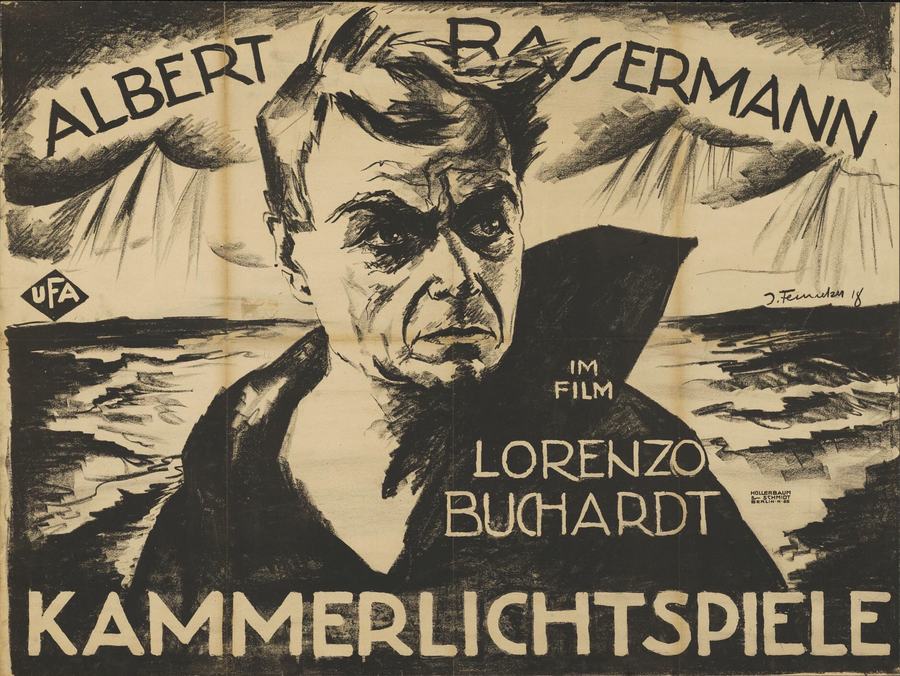
To watch Lorenzo Burghardt in the modern era is to engage in a form of cinematic archaeology that unearths the very foundations of psychological realism. Long before the camera learned to move with the fluid grace of the late silent era, Albert Bassermann was already utilizing the frame as a confessional. His portrayal of Lorenzo is not merely a performance; it is a manifestation of early 20th-century existential dread. Unlike the broad, pantomimic gestures often found in contemporary works like The Social Buccaneer, Bassermann employs a restrained vocabulary of micro-expressions that suggests a world of internal turmoil. He occupies the screen with a heavy, almost gravitational presence, making the air around him feel thick with the unsaid.
The film operates within a visual grammar that is strikingly austere. While American productions of the same year, such as The Winding Trail, were beginning to experiment with more expansive outdoor photography, Lorenzo Burghardt remains resolutely interior. This claustrophobia is intentional. The rooms are not just settings; they are the physical manifestations of Lorenzo’s social cage. The lighting, though primitive by modern standards, occasionally hints at the chiaroscuro that would later define German Expressionism. There is a sense of impending gloom that rivals the atmospheric weight of The Mystic Hour, though here the ghosts are not supernatural, but rather the lingering shadows of a dying class system.
One cannot discuss this film without centering the contribution of Elsa Bassermann. As the writer, she crafts a narrative that is deceptively simple yet layered with socioeconomic critique. The dialogue—conveyed through sparse, poetic intertitles—functions as a series of rhythmic punctuations in a story told primarily through the eyes. Where a film like Damaged Goods might lean heavily on didacticism to deliver its moral message, Elsa’s script allows the ambiguity of Lorenzo’s choices to fester. There is a palpable tension between the characters that feels surprisingly modern, a psychological sparring that reminds me of the intricate deceptions found in A Wife by Proxy.
The supporting cast, particularly Käthe Haack and Emilie Croll, provide the necessary friction to Lorenzo’s static despair. Haack, even at this early stage of her illustrious career, exhibits a luminosity that cuts through the film’s pervasive melancholy. Her interactions with Bassermann are the film’s emotional anchor, providing a counterpoint to the protagonist’s increasingly erratic behavior. This isn't the heroic stoicism of Scotland Forever; it is a messy, human struggle for relevance in a world that is rapidly moving on.
In the broader context of 1916, Lorenzo Burghardt stands as a fascinating outlier. It lacks the populist energy of Mr. Dolan of New York, opting instead for a somber, intellectual tone. While The Shielding Shadow was captivating audiences with serial thrills, this film was asking them to contemplate the erosion of the patriarchal soul. It shares some thematic DNA with The Sin Woman in its exploration of social transgression, but it handles its subject matter with a far more clinical, almost detached eye.
The pacing of the film is deliberate, perhaps even glacial to the uninitiated viewer. However, for those willing to surrender to its rhythm, there is a profound reward in the incremental build-up of tension. It lacks the overt villainy of Anton the Terrible, choosing instead to find conflict in the mundane—a misplaced letter, a lingering glance, a moment of hesitation. This focus on the minute details of human interaction places the film in a lineage that would eventually lead to the Kammerspielfilm. It’s a work of quiet desperation, much like the thematic core of The Courage of Silence.
"Lorenzo Burghardt is a masterclass in the economy of emotion, where every shadow cast across Albert Bassermann’s face tells a story of a thousand unuttered grievances."
Produced in the midst of the Great War, though not explicitly about the conflict, the film is saturated with the anxiety of its time. Lorenzo’s struggle to maintain a facade of control reflects the larger European crisis of the era. The film doesn't offer the escapism found in The Dictator; rather, it forces the viewer to confront the instability of the status quo. The economic pressures that haunt the periphery of the story are reminiscent of the struggles depicted in The Girl and the Crisis, yet here they are filtered through the lens of fallen grace rather than working-class survival.
The theatricality of the production is undeniable—a hallmark of the Bassermanns' stage roots—but it is a theatricality that has been successfully translated for the lens. There is a stylized elegance to the movements that occasionally approaches the operatic quality of Carnevalesca. Yet, beneath the polished surface lies a raw, pulsing nerve. The film’s climax is not a grand explosion of action, but a quiet, devastating realization. It lacks the physical grit of Big Jim Garrity, but it possesses a far more enduring psychological impact.
Technically, the film is a testament to the ingenuity of the early UFA era. The set design is rich with period detail, creating an environment that feels lived-in and heavy with history. The use of depth within the frame is particularly noteworthy; often, characters in the background are used to comment silently on the action in the foreground, a technique that adds a layer of voyeuristic complexity to the viewing experience. This visual layering is a far cry from the flat, stage-like compositions of many of its contemporaries.
In conclusion, though I avoid such definitive labels, Lorenzo Burghardt remains a vital piece of the silent cinema puzzle. It is a film that demands much from its audience—patience, empathy, and a keen eye for detail—but it gives back in equal measure. It is a haunting portrait of a man drowning in the shallow waters of his own life, a theme that remains as resonant today as it was in 1916. It is a somber, beautiful, and ultimately heartbreaking work that deserves to be remembered alongside the great psychological dramas of the century. The interplay between the Bassermanns creates a synergy that is rarely captured on celluloid, turning a simple story of social decline into a timeless epic of the human condition.
Final Verdict: A seminal achievement in silent character study, Lorenzo Burghardt is essential viewing for anyone interested in the evolution of performance art and the early psychological contours of German cinema.

IMDb 4.8
1936
Community
Log in to comment.