DbcultAccessing Vault...
6.2/10
Senior Film Conservator
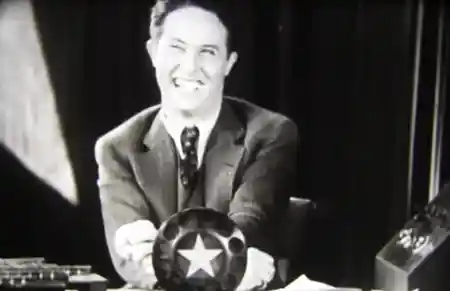
A definitive 6.2/10 rating for a film that redefined the boundaries of cult cinema. The Voice of Hollywood No. 9 remains a cornerstone of transgressive art.
If you have about ten minutes and want to feel like you’ve been transported into a very specific, slightly awkward corner of 1930, this is for you. It isn't really a movie in the way we think of them now; it’s more like a collection of clips that someone found in a basement and stitched together with a radio theme.
I’d say watch it if you’re a total nerd for early talkies or if you just like seeing actors look a little bit uncomfortable without a script. You’ll probably hate it if you want things like plots or character arcs because there aren't any here.
The whole thing is framed around this fictional radio station, S-T-A-R. It’s funny because the microphone they use looks like it could double as a kitchen appliance.
Bert Wheeler shows up and he’s doing his usual bit. He has that hair that looks like he just woke up from a very long nap, which always makes me laugh for some reason.
He’s got this nervous energy that feels very real, or maybe the lights were just too hot in the studio that day. The Voice of Hollywood No. 9 is part of a series, but you don’t need to see the first eight to get what’s going on here.
It’s just people coming in, saying hi to the 'radio audience,' and doing a little trick or a song. It reminds me a bit of the random cameos you see in The Office Scandal, where the plot just stops so you can look at a famous face.
Ken Maynard shows up with his horse, Tarzan. It’s a very handsome horse, honestly.
There is something inherently funny about bringing a full-sized horse into what is clearly a cramped indoor set meant to look like a radio booth. You can tell everyone is slightly worried the horse might decide to kick the expensive equipment.
Ken looks exactly like you’d expect a cowboy star from that era to look. He’s got the big hat and the 'aw shucks' vibe that feels a bit more natural than some of the other actors who seem terrified of the microphones.
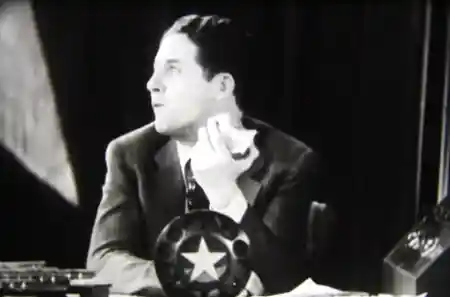
The audio quality is pretty rough, which is expected for something this old. You have to strain your ears through the hiss and crackle to hear what they’re actually saying.
It makes the whole experience feel like you’re eavesdropping on a party from ninety years ago. Sometimes the sound just cuts out for a second, or the levels jump so high that the voices get all distorted.
Marceline Day is in this too, looking very glamorous. She was also in The Man Hunt around this time, and she has that classic silent-film-star face that was still trying to figure out how to act with her voice.
She doesn't have much to do here, but she’s nice to look at. A lot of these shorts felt like they were just trying to prove that these stars could actually talk without ruining their careers.
Then things get truly weird because Aimee Semple McPherson shows up. If you don't know who she is, she was this massive celebrity evangelist who had her own mega-church and a very colorful personal life.
Seeing her in a Hollywood variety short is like seeing a modern televangelist show up in a Marvel post-credits scene. It’s just bizarre and doesn't quite fit the mood of the rest of the show.
She talks about her message, and everyone kind of nods along. It’s one of those moments where you realize how different the culture was back then, where religion and show business were weirdly tangled up together.
The pacing is all over the place. One minute you’re watching a comedy bit, and the next you’re getting a lecture or a song that goes on a little too long.
It doesn't have the polish of something like Easy Come, Easy Go. It feels much more 'run and gun,' like they filmed it all in one afternoon and didn't bother with second takes.
There is a shot of a girl dancing that lingers for a few seconds too long. You can see her looking off-camera, probably waiting for someone to tell her she can stop now.
I love those little mistakes. They make these old films feel more human and less like museum pieces.
The 'radio' host guy tries really hard to keep the energy up. He has that fast-talking 1930s announcer voice that makes everything sound like a life-or-death emergency.
"And now! For our next guest!" he shouts, even though the guest is standing two feet away from him. It’s all very theatrical and loud.
If you're looking for a deep cinematic experience, you are in the wrong place. This is just a snack. A dusty, black-and-white snack that tastes a bit like old paper.
But there’s a charm to it. You get to see Wesley Barry and Dorothy Jordan just being themselves for a minute.
It’s better than reading a history book. You get to see the way they moved and the way they looked at each other when they thought the camera might be off.
I wonder if they knew people would be watching this on computers nearly a century later. They probably thought it would be shown once in a theater and then thrown in the trash.
Anyway, it’s a short watch. If you get bored, you can always just look at the horse. 🐴
It’s not 'good' in the traditional sense, but it is interesting. Sometimes that’s enough when you’re tired of modern movies that are polished until they’re boring.
IMDb 7.6
1932
Community
Log in to comment.