DbcultAccessing Vault...
Cult Review
Senior Film Conservator
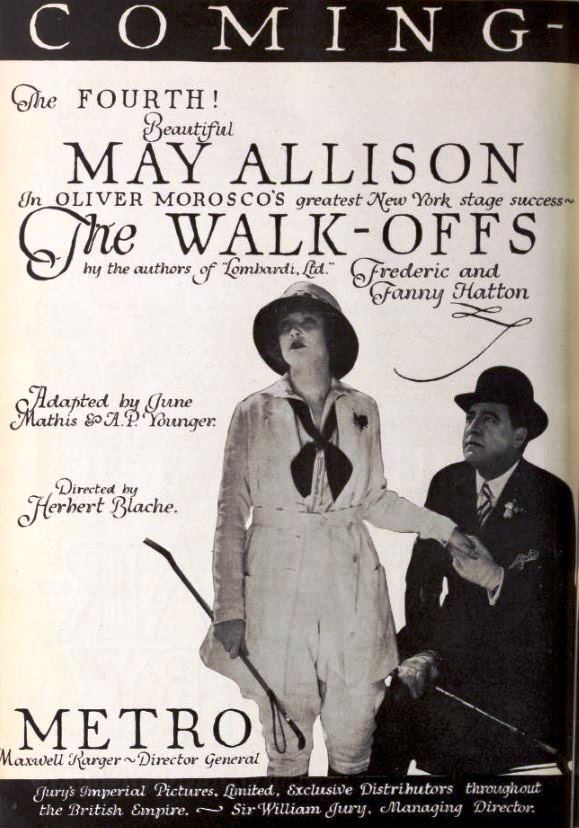
There is a moment—wordless, razor-thin—when May Allison’s Kathleen tilts her chin toward the camera, the courthouse pillars behind her yawning like the maw of respectability itself. Divorce papers flutter downward in lazy spirals, black ink wings against white marble. In that sliver of celluloid, director William C. deMille crystallizes the entire Jazz-Age terror of being found out. The Walk-Offs is not merely a confection of thwarted love; it is a surgical dissection of how liquidity—emotional, financial—determines one’s right to occupy space in the gilt drawing rooms of Manhattan.
Silent-era audiences, jaded by flapper caricatures, were startled to meet a heroine whose rebellion is forged in the crucible of public humiliation. Kathleen’s brother Schuyler has served as matrimonial appetizer to Caroline Rutherford’s fortune; once the marriage snaps like over-taut violin gut, the sister’s parasitic dependence is exposed under the klieg lights of subpoenas and tittering journalists. Cinematographer L. William O’Connell floods the courtroom in over-exposed whites, so that every face becomes a bleached moon, every whisper an etched scar. The film’s grammar is established: visibility itself is violence.
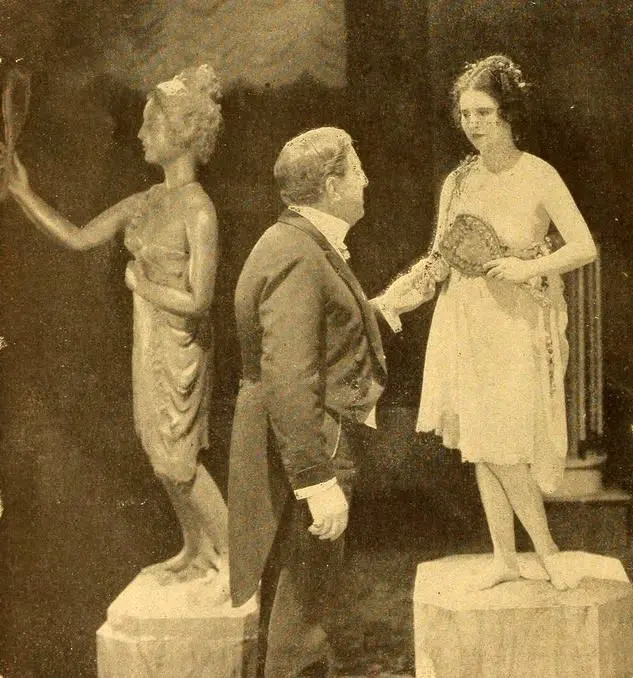
Salvation, or its mirage, arrives in Mary Carter’s atelier—a cathedral of dust-flecked sunbeams where half-finished torsos loom like jurors. Claire Du Brey’s Mary is the rare working woman allowed competence without spinster caricature; her hands, clay-stained and gentle, offer Kathleen a secretary’s wage, not alms. The sculptural motif is no accident: each chisel strike is a reminder that identity can be re-sculpted, that marble—like reputation—yields to those who dare risk ugly fissures. Note the axial cut as Kathleen first lifts the fountain pen: the camera dollies past a life-size Venus minus arms, an irony not lost on a woman who feels limbless before the world.
Robert Winston’s skyscraper office is staged like a basilica of capital: bronze doors, a desk the size of a small ice floe, ticker-tape murmur bleeding through mahogany. Darrell Foss plays Robert with the unshowy magnetism of a man who signs contracts the way poets sign couplets. When he lambastes “girls who angle for a ring like fishermen harpooning swordfish,” the line—delivered in a medium shot that lets us study the pulse in Kathleen’s throat—ignites the film’s central wager. Hatton and Younger’s screenplay cannily reverses the Factory Magdalen paradigm: here, the heroine chooses the factory floor of emotional espionage, weaponizing her own objectification.
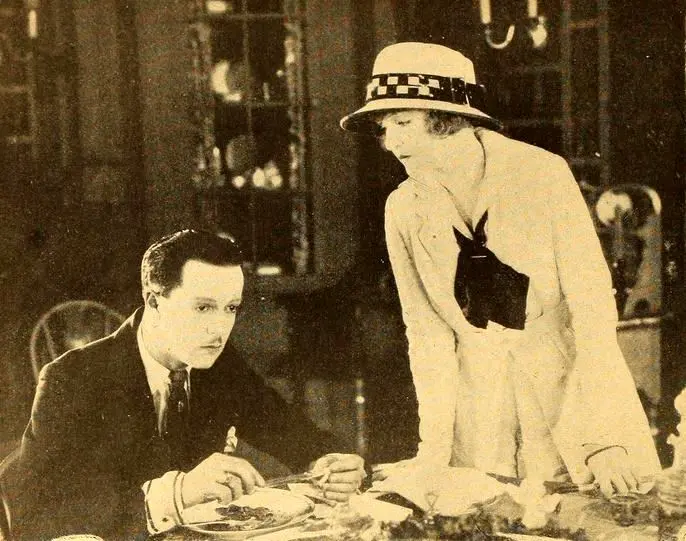
Thus begins the masquerade. Kathleen re-enters under the nom de guerre ‘Katherine Cole,’ hair coiled tighter, voice pitched half an octave lower, a sartorial chameleon whose charcoal skirt-suits absorb the office’s nicotine gloom. The secretarial pool becomes a chorus of rustling papers and sideways glances; the film relishes the proto-noir pleasure of watching a woman infiltrate masculine space by hiding in plain sight. Close-ups of her gloved fingers correcting Robert’s ledger errors serve as micro-flirtations; each graphite slash is a love-letter masquerading as efficiency.
Color tinting in the 35mm prints is deployed with symphonic precision. The rebounding courtship between Kathleen and Robert is bathed in amber—an ironic hue that nods to both opulence and infection. When she finally accepts Murray Van Allan’s ostentatious diamond, the film cuts to a society gala swathed in canary-yellow nitrate, the shade of old newspaper clippings. Yellow becomes the film’s shorthand for the performative: it is the color of ballrooms, of publicity flashes, of the lie Kathleen wears like a second skin.
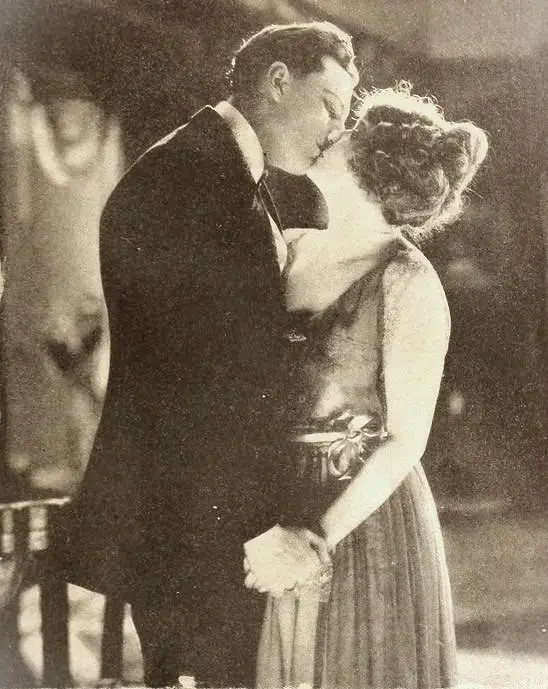
Contrast this with the penultimate reel’s moonlit terrace sequence, tinted in cyanotype blues. Kathleen’s tulle gown—previously a frothy cloud—now looks aqueous, as though she were a figure glimpsed through ocean glass. Robert’s confession of love is shot in profile, two shadows merging on balustrades. The blue signals not serenity but the vertigo of truth: the moment when masks dissolve and one must confront the raw, trembling organism underneath.
May Allison’s acting style—often dismissed as “appropriately restrained” by historians more besotted with Swanson’s histrionics—here operates like a palimpsest. Watch the incremental shifts in her gait: early reels see her shoulders angled inward, conserving space, a body apologizing for its own existence. By the time she commands Robert’s boardroom as ‘Cole,’ her spine elongates, neck a swan’s question mark. Yet the brilliance lies in the micro-shivers: a blink that lingers half a second too long, fingers that flutter to the clavicle before catching themselves. These tics are not signs of incompetence but hieroglyphs of a woman performing power while swallowing panic.
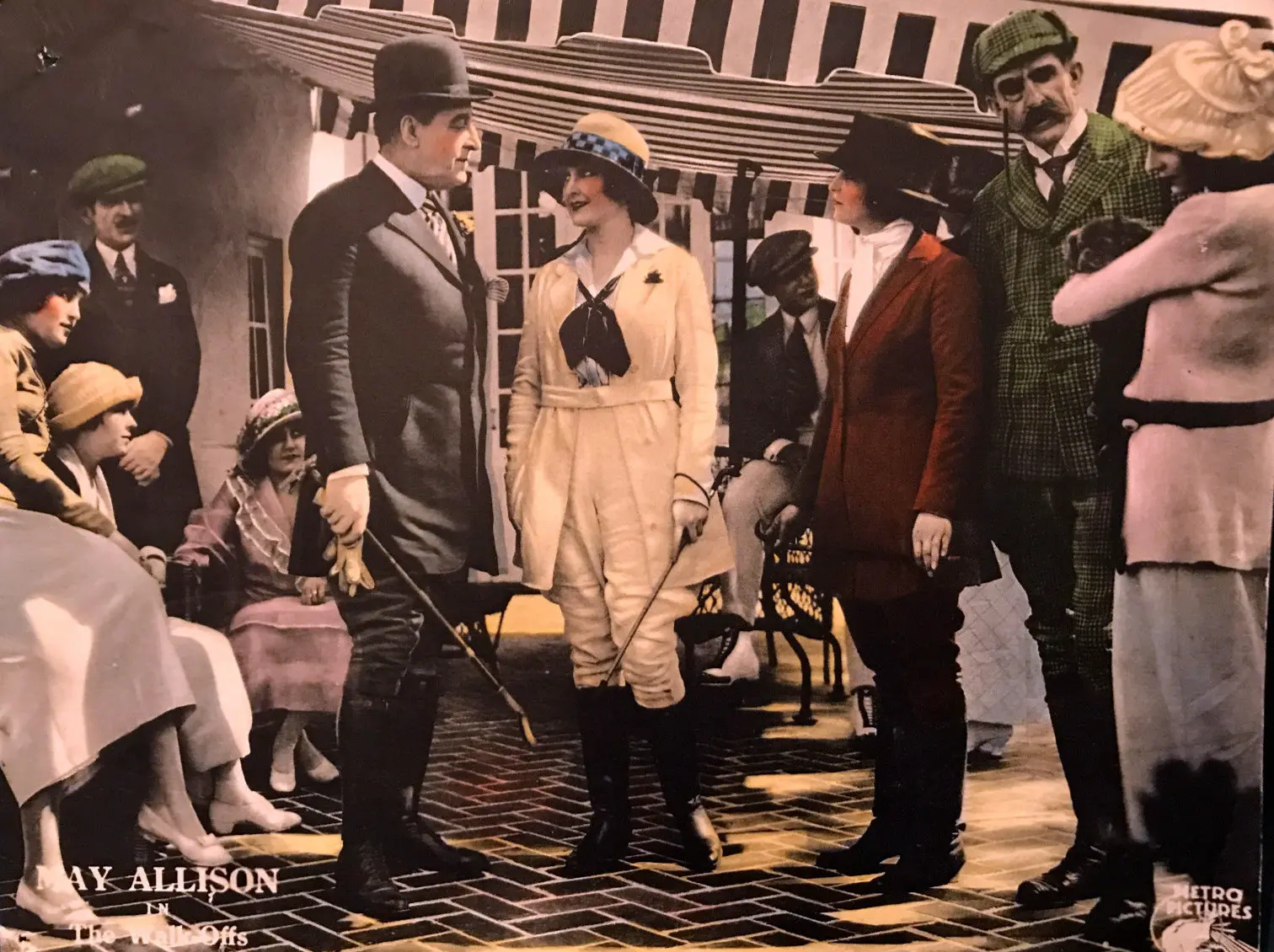
Darrell Foss complements her with a different rhythm: his Robert is stillness weaponized. In an era when leading men often out-emoted the women, Foss opts for minimalist modulation—eyebrows that narrow a millimeter, a voice lowered to the register of confidential ledgers. Their chemistry is less embrace than magnetic repulsion, two planets orbiting in precarious equilibrium until gravity demands collision.
The screenplay, adapted from a Hatton–Mathis short story, is unabashed in its Marxian undercurrent. Caroline Rutherford’s alimony victory is portrayed not as feminist comeuppance but as the market correcting a bad investment; her laughter outside the courthouse is indistinguishable from a broker’s cheer at surging stock. Kathleen’s revenge fantasy—making Robert love her, then jilting him—uncannily anticipates the 1929 crash: a wager that appetite can be weaponized, that hearts are as short-sellable as railroad shares. When she ultimately pivots from vengeance to vulnerable reciprocity, the film lands on a curiously utopian note: that empathy might yet outbid speculation.
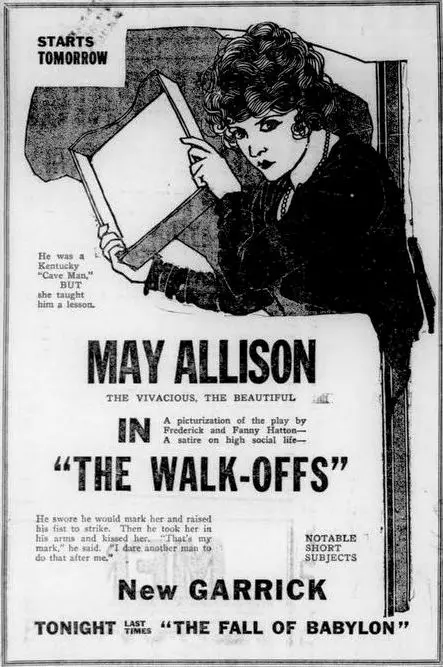
DeMille’s film exists in conversation with contemporaries that probed women’s economic precarity. Where Berlin via America staged exile as tragedy, and The Witness for the Defense framed sacrifice as noble, The Walk-Offs offers something more subversive: a woman who nearly weaponizes marriage into a hostile takeover. The closest tonal cousin is Passers-by, where street anonymity doubles as liberation; yet while that film lingers on the poetics of drifting, Walk-Offs hurtles toward the vertigo of landing—of choosing to stay when flight remains possible.
Art direction by Wilfred Buckland deserves worshipful study. Note the repeated visual rhyming between sculpture fragments and architectural columns: every broken limb in Mary’s studio foreshadows the emotional amputations soon to occur. The climactic walk-off—Robert and Kathleen descending the marble courthouse steps now bathed in dawn’s ivory—quotes the opening but reverses its meaning. Initially the staircase was an ascent into shame; here it becomes a descent into possibility, a secular altar where two reconstructed adults gamble on mutual transparency.
Though originally accompanied by a compiled score, most extant prints circulate with Timothy Brock’s 1998 chamber suite. Brock’s cue sheet times the entrance of Van Allan’s limousine to a tango in D-minor—an inspired choice, as the tango’s push-pull syncopation mirrors Kathleen’s emotional shuffle. Listen for the celesta that sneaks in under the engagement-acceptance scene: its glassy arpeggios feel like frost forming on a contract, prefiguring the imminent fracture of the betrothal.
In an age when personal branding is our newest alimony, the film’s interrogation of transactional intimacy feels prophetic. Kathleen’s false LinkedIn profile a century before LinkedIn reminds us that identity curation is hardly novel; only the platform has migrated from typewriter ribbons to fiber-optic cables. Yet the film’s optimism—that two people might yet elect to drop their respective ledgers and risk insolvency of the heart—offers a radical hope sorely lacking in swipe-right fatalism.
Watch The Walk-Offs for Allison’s masterclass in micro-acting, for the amber-cyan duel of tinting, for a denouement that refuses to punish its heroine for wanting more. Then watch it again to notice the extras: stenographers who chew pencils, a janitor polishing the same patch of terrazzo thrice, a world bustling with lives that, like yours, hinge on whether love can be audited—or merely confessed.
IMDb 5.4
1933
Community
Log in to comment.