DbcultAccessing Vault...
3.8/10
Senior Film Conservator
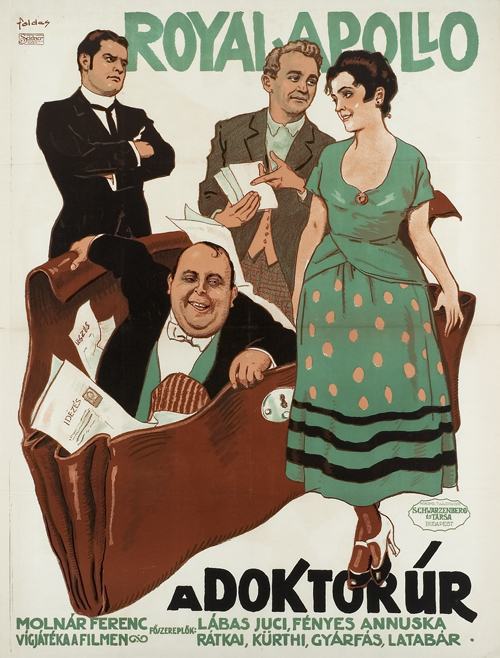
A definitive 3.8/10 rating for a film that redefined the boundaries of cult cinema. Doktor úr remains a cornerstone of transgressive art.
If you crumple the parchment of a Molnár play and let the ink bleed into celluloid, you get something that crackles like dry champagne: Doktor úr, a 1915 Hungarian silent that most cineastes have misplaced somewhere between the collapse of the Habsburgs and the rise of Lubitsch. Yet here it is, resurrected in a 4K scan whose grain feels almost carnal, a reminder that satire once wore white gloves and still left fingerprints on the throat.
The plot, deceptively boulevard, follows Dr. Péter Pongrácz, a village medic whose dexterity with a scalpel is matched only by his incompetence at reading the room. When he saves a general’s tubercular son, he is swept from dusty surgery to Budapest’s chandeliered drawing rooms, a vertical migration that director Sándor Incze stages like a fever dream in top-hat and tails. With each upward shunt—army consultant, privy councillor, eventual member of the House—the camera itself seems to ascend, craning over marble staircases until the city below resembles a necropolis of obsolete virtues.
Dezsõ Gyárfás, hawk-nosed and mercury-eyed, plays the doctor with the elastic physicality of a man who has learned that posture is currency. Watch the way he straightens his spine the instant a titled patient enters: vertebrae clicking into moral curvature. His smile—half lancet, half lullaby—promises salvation while calculating interest.
Opposite him, Annuska Fényes is Terka, the apothecary’s daughter, whose eyes carry the bruised optimism of someone still naive enough to equate love with loyalty. She haunts the periphery of scenes, a ghost of ungenteel origins, clutching a wilted bouquet of violets that were once purple but now read ashen under orthochromatic stock. When Pongrácz betroths himself to the general’s monocle-flashing niece, Terka’s single tear—caught in a beads-of-dew close-up—becomes the film’s ethical lightning rod, a silent indictment louder than any title card.
Incze’s visual grammar predates the cosmopolitan shimmer of A Girl of Yesterday yet already toys with the irony that Lubitsch would export to Hollywood. Consider the sequence where the doctor, freshly ennobled, purchases a Rococo mirror: the camera watches him watch himself until the silvered surface fragments into a kaleidoscope of self-adoration, each shard refracting a different mask—healer, charlatan, lover, predator. The edit rhymes with the later, more famous mirror gags of Captain Courtesy, but here the humor is caustic enough to blister.
Márton Rátkai, as the foppish Count Lázár, supplies the film’s metronomic pulse of frivolity, forever arriving in a whirlwind of capes and unpaid gambling debts. His duel with the doctor—fought not with sabres but with champagne flutes across a ballroom floor—parodies the militarized masculinity on display in The Lion’s Bride, yet the stakes feel nastier; the loser must drink the contents of a glass that may or may not contain prussic acid, a gag that anticipates the poisoned banter of La cattiva stella.
Budapest itself is a protagonist, photographed through apricot-tinted day-for-night filters that turn streetlamps into halos of tarnished gold. Cinematographer Gusztáv Vándory (pulling double duty as the general) favors wide-angle lenses that balloon corridors into opera sets; the city’s new parliament building, still wet with plaster, looms like a freshly iced wedding cake in the background of a shot where Terka sells her engagement ring to a usurious jeweler. The spatial irony—monumental statecraft versus pawn-shop intimacy—could teach The Lone Star Rush a lesson in class juxtaposition.
The screenplay, co-credited to Molnár, condenses his three-act play without amputating its moral gangrene. Intertitles arrive in rhyming couplets that flicker like epigrams on a cigarette case: “A diploma is a keyhole—peep through and see what the world hides.” The translator’s English is peppered with Habsburg slang; when Pongrácz is called a “knee-breeches pirate,” the insult stings because it acknowledges that upward mobility in the Monarchy was indistinguishable from licensed brigandage.
Musically, the restoration tethers a contemporary score by the Hungarian Folk Ensemble—cimbalom, tárogató, and a lone, mournful violin—to the image track. The violin reappears whenever the doctor signs a death certificate for his better angels, its tremolo so taut you fear the bow might saw through the nitrate. Listen for the moment when the general’s son recovers: the cimbalom erupts into a reckless csárdás, yet underneath, the violin holds a single minor chord, like conscience tapping its foot to a tune it can’t forget.
Comparative cinephiles will catch echoes of Gretchen the Greenhorn’s moral absolutism, yet Doktor úr refuses the balm of redemption. When the final curtain falls, the doctor has everything—title, villa, a wife whose dowry could bankroll a regiment—but the camera dollies back to reveal Terka standing in the snow outside his wrought-iron gate, her breath crystallizing into the film’s truest title card: “You have cured everyone but yourself.” The fade-out is not tragic; it is surgical, coldly satisfied that the infection of vanity has metastasized beyond amputation.
Restoration-wise, the print survives via a 1923 Czech distribution negative discovered in a Bratislava cellar, water-logged but legible. The 4K harvest reveals hairline cracks in the pancake makeup, beads of glycerin sweat on Gyárfás’ upper lip, and—most deliciously—a shadow on Terka’s neck that might be a love-bite or simply a flaw in the emulsion. These imperfections are left intact; archivists wisely refused to iron the wrinkle out of history.
Contemporary resonance? Scroll through any influencer feed and you’ll see the same calculus of exposure equals endorsement, the same conversion of empathy into social capital. Doktor úr merely traded scalpels for followers; the algorithm is aristocracy by another name. The film whispers that modernity’s true pandemic is not cruelty but careerism—a diagnosis as bracing now as it was in 1915.
So why is this landmark languishing in the footnotes? Blame the twin erasures of war and language: the original Hungarian intertitles were lost when the 1919 revolution torched the film vaults, and the Czech copies arrived too late for the first wave of film scholarship. Yet rediscovering it today feels like stepping through a hidden door in the museum of cinema and finding a Rembrandt hung next to the fire extinguisher. The lighting is velvet, the shadows bruised, the laughter edged with vitriol—proof that satire can be both stiletto and scalpel, and that some surgeries leave the patient more alive than ever, even as they bleed out.
IMDb —
1931
Community
Log in to comment.