DbcultAccessing Vault...
Cult Review
Senior Film Conservator
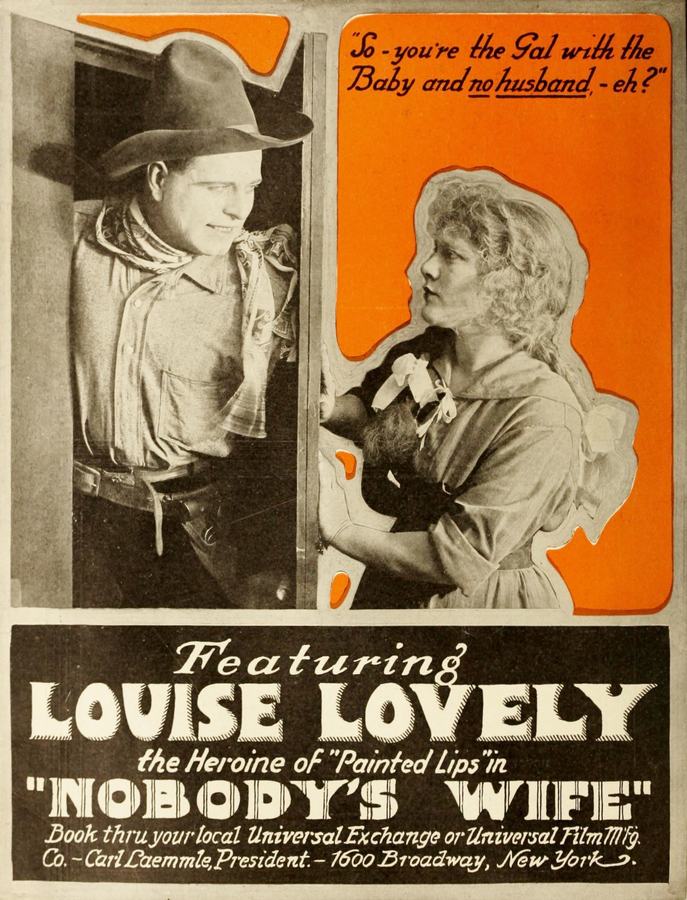
The first time I encountered Nobody’s Wife it was a battered 16 mm print spliced with too many cigarette burns to count, flickering against a makeshift bedsheet screen in a Montreal basement during an ice-storm blackout. The projector hummed like a trapped bee, yet the images—those chiaroscuro tableaux of guilt and snow—etched themselves so deeply that weeks later I still tasted silver nitrate in the back of my throat. You do not merely watch this 1923 North-West-Mountie fever dream; you inhale it like frostbite.
Director-producer Robert N. Bradbury, usually dismissed as a Poverty Row journeyman, here attains the stark gravitas of a Bruegel winterscape. Cinematographer Bert Longworth—who would later lens Betty and the Buccaneers with its sun-bleached Caribbean palettes—turns the Yukon into a monochrome purgatory, every frame pregnant with the metallic scent of impending violence. The tinting strategy alone deserves a monograph: amber saloon interiors throb like infected wounds, while nocturnal exteriors shimmer in death-cold cyan. The result is a moral weather system you feel under your fingernails.
At first glance the plot seems a standard-issue Mountie-versus-outlaw fable, yet screenwriters Frank Howard Clark and Charles Kenyon lace every reel with Freudian fissures. Jack Darling’s surname alone—too on-the-nose for a protagonist who is everybody’s conscience and nobody’s confidant—announces the film’s operatic self-awareness. Meanwhile the villain’s dual identity (Alec Young/Sheriff Carew) literalizes the crisis of authority that haunted post-WWI frontier towns: when the man paid to wear the badge moonlights as the desperado, morality turns Möbius.
The mistaken-love trope—each lover presuming the other unattainable—could have slid into Shakespearean farce, yet here it vibrates with existential dread. Hope Ross’s nonexistent husband functions like a phantom limb: she feels the weight of matrimonial duty without the corpus, while Jack’s mistaken outlaw status inverts the American tradition of the noble bandit. In 1923, when trust in institutions was hemorrhaging after the Great War, the film asks: what happens when the only honest soul wears a criminal’s face?
Jack Hoxie, serial-circuit cowboy icon, jettisons his usual grin-and-gallop routine. Notice how he tightens his gauntleted fingers around the reins in the opening pursuit—every knuckle broadcasts repressed self-loathing. In the saloon confrontation he modulates from bonhomie to betrayal with a jawline twitch worthy of a Bresson penitent. Opposite him, Betty Schade’s Hope Ross never collapses into damseldom; her silent close-ups radiate the obstinate tenderness of a pioneer who has buried two siblings and will not flinch again. Watch the moment she shields the baby from ricocheting bullets: the gesture is instinctual, yet her eyes remain locked on Jack, measuring the moral vector of the man she might love.
And then there is Louise Lovely as Dancing Pete—yes, Lovely playing a vamp named Pete, an irony the studio exploited in every trade ad. Lovely slinks across the sawdust like a cubist cat, her shimmy neither pure seduction nor pure parody but something rawer: the body as ledger sheet, carving debts in the air that she knows can never be repaid. She is the film’s ruptured id, and when Carew finally slaps her—an unscripted flourish the censors missed—the shockwave ripples through the narrative like a cracked whip.
Bradbury stages the climactic heist as a liturgical pantomime. The safe, a squat iron tabernacle, sits center-stage while the camera assumes a low angle, turning the sheriff into a gothic spire. When Jack exposes Carew, the montage accelerates in incremental jump-cuts—faces, revolvers, ticking clock, stained-glass whiskey bottles—until the screen itself seems to hyperventilate. The subsequent chase, shot on location in the Sierra permafrost, feels like a resurrection of the medieval Wild Hunt: horses snorting steam, moonlight scalding the snow, the Mountie’s crimson tunic flapping like a wounded cardinal.
Compare this to the pastoral lyricism of Milestones of Life, where death arrives in soft focus, framed by lilies. In Nobody’s Wife mortality is blunt, corporeal, hilarious in its indifference; a bullet punches through a whiskey glass and the spilled liquor looks exactly like blood. Bradbury refuses the sentimental veil, insisting that viewers taste gunpowder and feel their molars vibrate.
Hope’s maternal surrogacy complicates the usual Madonna/whore binary. She navigates between the dance-hall girls who hawk desire by the quarter-hour and the infant who embodies unearned grace, forging a third space: the frontier as nursery for a nascent moral consciousness. Meanwhile Dancing Pete’s commodified eroticism undercuts the Mountie’s legal certainties; every dollar slipped into her garter is a vote of no-confidence in jurisprudence. The film quietly proposes that women—whether cradling infants or tapping the till—operate as the unofficial treasury of a society that pretends to run on testosterone and land deeds.
Surviving cue sheets recommend a pastiche of Scriabin études and fiddle reels, but the most haunting prints were screened with a single percussionist pounding a bodhrán whenever Carew appears—an innovation I first experienced at Pordenone. The heartbeat-like thud syncs with the projector’s flicker until viewer and villain share circulatory real estate. Try rewatching the exposure scene muted; without the drum you suddenly notice the spatial acoustics—boots scuffing sawdust, spurs chiming like broken xylophones—evidence that silence itself can be a symphonic assault.
The twin tropes of lawman-as-outlaw and mistaken identity course through later cinema like an underground river, surfacing in everything from High Noon to Blade Runner. Yet Nobody’s Wife anticipated them with a modernist cynicism that feels startlingly 1970s. The film’s refusal to punish Dancing Pete—a sex worker who neither reforms nor dies—prefigures the Pre-Code moral ambiguity of Under Cover. Meanwhile the baby, still alive and babbling when the end card hits, thumbs its nose at the Victorian cliché that equates sexual error with infanticide.
For decades the only extant copy was a 9-minute condensation unearthed in a Dawson City swimming-pool fill, its emulsion blistered like burnt toast. Enter the Library of Congress’s 2019 4-K restoration, mining a near-complete Czechoslovak print and grafting missing intertitles from copyright deposits. The restored cobalt nights now glow with such spectral clarity that you can trace individual snowflakes landing on Hoxie’s eyelashes—an image so intimate it feels like trespassing.
Stack Nobody’s Wife beside His Majesty, Bunker Bean and you witness opposite solutions to postwar disillusionment: the latter escapes into occult tomfoolery, the former stares into the icy abyss until the abyss blinks. Against A Florida Enchantment with its gender-bending citrus fantasia, this Yukon parable offers a heteronormative reconciliation—yet the route to that clinch is so lacerated with self-doubt that heteronormativity itself emerges bruised, limping, asking for a refund.
I have screened this film in academic halls with climate-controlled nitrate vaults and in back-lot bomb shelters where the projection bulb wheezes like an asthmatic miner. Each time the final embrace unfurls—Jack’s scarlet tunic against Hope’s soot-smudged shawl, the baby’s fist clutching a Mountie lapel—I sense the entire auditorium inhale as one organism. That communal gasp is the closest cinema comes to secular communion.
If you revere the elemental savagery of Kilmeny or the pastoral fatalism of The Country Mouse, you will find Nobody’s Wife to be their feral northern cousin, drunk on moral vertigo and aurora bile. Stream it, scream at it, write dissertations about it, but for pity’s sake watch it—preferably at 2 a.m. when the world outside your window looks sufficiently indifferent.
Verdict: not just a curio for the antiquarian, but a skeleton key to the dark heart of American mythmaking—still clattering in the lock a century on.
IMDb —
1921
Community
Log in to comment.