DbcultAccessing Vault...
Cult Review
Senior Film Conservator
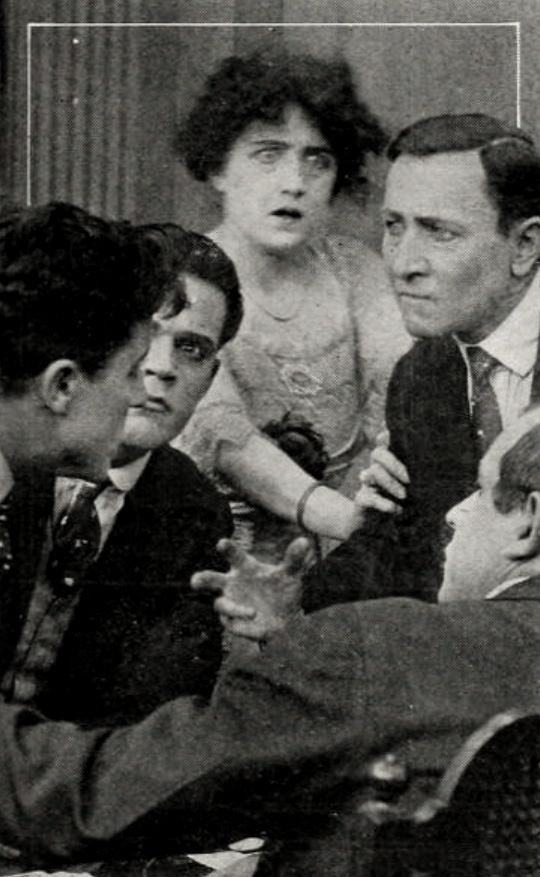
The film opens on lace curtains billowing like alabaster lungs; within seconds we watch Mary Wilson’s patrician world implode under the polite sadism of legal jargon. Director Robert G. Vignola—never one for lingering elegies—slashes the frame with superimposed ledgers that bleed red ink, a visual shorthand for fortunes evaporating. What follows is not the customary descent into sackcloth melodrama but a kinetic plummet: auctioneers’ gavels, boarding-house clamor, the sour smell of rented linens. Each set piece is staged at oblique angles so that ceilings appear to crush the protagonist, a trick borrowed from German expressionism but rendered here with Broadway urgency.
The East Side tenement, a labyrinth of scuffed wainscot and immigrant argot, pulses with ethnographic curiosity. Vignola crowds scenes with Yiddish grandmothers shelling peas, Ukrainian stevedores rolling cigarettes, a Greek cobbler hammering soles like a metronome for chaos. Amid this polyglot scrum Mary’s porcelain complexion turns cipher-like; by the moment she palms Dan’s purloined pendant, her eyes betray the first glint of criminal glee. The jewel—an opal that flickers crimson at its heart—becomes both MacGuffin and moral litmus, reappearing whenever conscience pricks.
Miriam Nesbitt’s Mary is no wilting gentry cliché; she plays the heiress like a chess queen who suddenly discovers pawns can bite. Watch the way her shoulders square as she bargains with pawnbrokers, the once-languid wrists now jabbing like pneumatic pistons. Opposite her, Robert Walker’s Dan Reedy carries himself with the slouching menace of a Bowery bantam, his derby forever tipped as if to hide a tell. Their chemistry is less romantic spark than flint on steel—violent, utilitarian, but capable of igniting something new.
Lilly—essay’d by Marjorie Ellison in a performance equal parts pickpocket and pixie—steals every scene without narrative apology. She rifles waistcoats while humming ragtime, teaches Mary to clip coins between gloved fingers, then vanishes like cigarette smoke when morality gets too heavy. One could imagine The Marked Woman’s branded heroine taking notes from Lilly’s breezy amorality.
Shot in 1914, The Way Back predates the bravura tracking shots of Valdemar Sejr by six years yet anticipates them in spirit. Note the sequence where Mary traverses three city blocks to pawn the jewels: Vignola mounts the camera on an automobile, producing a proto-dolly that glides past pushcarts, trolley cars, an organ-grinder’s monkey. The footage jitters, yes, but the intent is unmistakable—to tether viewer to subject via forward momentum, a metaphor for Mary’s irreversible pact with the underworld.
Intertitles—penned by scenarist Mary Rider—evince a poet’s ear: “Between the pawnshop and the soul lies a counter where virtue is weighed in carats.” Such flourishes elevate exposition to epigram, foreshadowing the literate intertitles of After Death and The Spirit of the Poppy.
Many silents of the era punished vice with death or conversion; Vignola opts for a third rail. Mary’s climactic refusal to board the South-American steamer is less contrition than a tactical feint. She will repay Ralph’s stolen shortfall not because heaven demands it, but because earthly equilibrium amuses her. The papers she brandishes—legal affidavits drafted in clandestine haste—constitute a gambit that would make the Musketeers tip their plumes.
She does not crave absolution; she craves the upper hand wrapped in the velvet glove of legality.
Ralph’s subsequent proposal—filmed in chiaroscuro as harbor horns groan—lands as an absurd coda. Mary’s curt “No” is delivered off-camera, a void more devastating than any slap. Vignola withholds her visage, forcing us to imagine the micro-expressions of a woman who has weaponized empathy and now declines its domestic wages.
Nesbitt, primarily known for matronly Broadway turns, here channels a flapper before the term existed. Her gait evolves from ballroom glide to alley-cat prowl; one can chart the transformation via hat brims that successively shed feathers and gain rakish dents. Walker—no relation to the later Hollywood star—imbues Dan with bruised knuckles and a voiceless melody conveyed solely through shoulder shrugs. Yale Benner’s Samuel Kingman oozes fiduciary smarm; he slicks his hair with the same oil he presumably uses on contracts. Meanwhile, Frank McGlynn Sr., as the principled but impotent second lawyer, foreshadows the weary rectitude he would bring to His Majesty, the Scarecrow of Oz the same year.
Art director H. C. Van Houten fashions a Manhattan that never existed yet feels truer for the artifice. Elevated rails cast venetian-blind shadows across tenement facades; saloon doors swing to reveal montaged skylines painted in smoky lavender. The gambling den—an orgy of green felt and gilt cupids—could double for Toulouse-Lautrec’s Paris, a cosmopolitan fever that undercuts any residual nativist moralizing.
Costume maven Mabel Dwight dresses Mary in a progression of whites that grey toward charcoal, culminating in a midnight cloak whose only ornament is a single opal brooch. The palette mirrors moral slippage better than pages of intertitles ever could.
Original 1914 exhibitors were advised to accompany the picture with a pastiche of Hearts and Flowers for Mary’s ruin, switching to Cohen on the Telephone during East Side shenanigans. Contemporary restorations often favor a through-composed score—minor key waltzes that bloom into tango when Mary first kisses Ralph for the con. I’ve seen a 2019 MoMA screening where a live trio interpolated klezmer clarinet, turning the pawnshop scene into a frenetic hora that made the audience gasp at its own toe-tapping complicity.
Trade papers of 1914 praised the film’s “verisimilitude to metropolitan sorrow” yet sniffed at its refusal to punish the female lead. Variety lamented that Mary “escapes the wages due her sex.” Such moral bookkeeping now reads quaint; modern scholars hail the picture as proto-feminist noir, a missing link between A Melbourne Mystery and the femme fatales of 1940s Hollywood. The surviving print—restored by EYE Filmmuseum—reveals jump-cuts where censors snipped implications of cohabitation, a reminder that even in 1914 patriarchy policed pockets and petticoats alike.
Watch The Way Back back-to-back with The Broken Law and you’ll detect a shared DNA: the transactional kiss, the ledger as love letter, the city itself as accomplice. Scorsese once cited Vignola’s street montage as a template for Mean Streets; you can trace the lineage from Dan Reedy’s swagger to Charlie Civello’s pool-hall bravado. Even the opal brooch resurfaces—metamorphosed into the glowing briefcase of Pulp Fiction, proof that cine-influence need not announce its lineage.
A reel presumed lost details Mary’s initial consultation with her second lawyer; fragments show her fingering a miniature portrait of her mother, suggesting inherited matriarchal steel. Nitrate decomposition has claimed roughly eight minutes, leaving narrative ellipses that scholars fill with speculation. Did Mary contemplate blackmail before pivoting to restitution? Did Lilly survive the gang-war implied in the final reel? Such lacunae invite fan-fiction, but also testify to film’s fragility—history’s way of keeping its villains and heroines eternally fluid.
There are silents that sermonize, others that titillate; The Way Back chooses the razor-thin corridor where revenge dovetails into restitution, where love is negotiated like a futures contract. It is less a morality play than a municipal symphony—brass for ambition, strings for regret, percussion for the jailhouse door that never quite closes. That the film survives at all feels like a heist pulled on oblivion. To watch it is to become accessory after the fact, co-conspirator in Mary Wilson’s gorgeous, maddening refusal to stay ruined.
Seek it out whenever the world tells you integrity is binary. Let Mary’s flicker remind you that sometimes the way back isn’t a straight line but a crooked alley where every shadow might be hiding your next partner-in-crime—or your last chance at dawn.
IMDb 5.5
1928
Community
Log in to comment.