DbcultAccessing Vault...
Cult Review
Senior Film Conservator
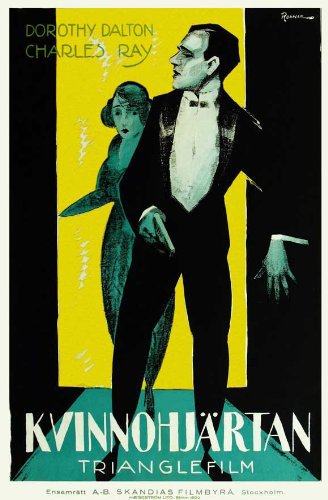
A nitrate reeler soaked in bathtub gin and moral ozone, The Weaker Sex detonates the fallacy inscribed in its own title. Director Robert Thornby, armed with a Klieg-lit cynicism, flips the silent-era gender script so savagely that the celluloid itself seems to hiss.
From the first iris-in on Manhattan’s nocturnal arteries, the film stages excess like a fever dream: confetti snowstorms, trombone glissandos visualized as shimmering title cards, and Louise Glaum’s Lola—eyelids lacquered, hips spelling trouble in Morse code—purring the intertitle equivalent of “You may call me a vamp, darling, but remember: even a mirror has a throat.” In 1923, such brazen erotic semaphore felt like a slap delivered with a velvet glove.
Jack Harding (John Gilbert pre-stardom, all gelled hair and wolfish dimples) is introduced through a tracking shot that follows the spill of his silk scarf more than his face—an objet d’art already half-undressed by the camera’s gaze. Wealth has ossified into ennui; he haunts stageside seats not for art but for prey. Yet the film refuses easy scapegoating: a dissolve to his childhood memory—shot in bleached amber—reveals paternal whippings that engraved entitlement onto his bones. Thornby’s montage, influenced by German Expressionism making its way across the Atlantic, layers trauma atop turpitude until guilt and victimhood braid like barbed wire.
Nona Thomas’s Broadway vamp (billed only as “The Panther”) commands her sequences with feline languor, but the screenplay by Monte M. Katterjohn and Alice C. Brown gifts her a soliloquy—rendered in tinted parchment—where she confesses her real ambition: owning the very theater where men leash diamonds around her clavicle. In an era when female desire onscreen was either punished or sanctified, this admission detonates the Madonna/whore binary. Watch how cinematographer James Van Trees backlights her so that her shadow looms twelve feet tall: a woman literally outgrowing the frame patriarchy allotted her.
Murder arrives at reel two, not as blood—censors would have shredded the print—but as a rhinestone garter sliding down a pale calf, followed by a gunshot masked under the orchestra’s cymbal crash. The editing rhythm here, 14 frames per cut, predates Soviet montage in its physiological assault; the viewer blinks and misses evidence, complicit in Jack’s ensuing bewilderment. Police drag him past neon signs that stutter like faulty synapses, and the city itself becomes an accomplice, its skyscrapers closing in through forced perspective miniatures.
“To accuse a rich man is to indict the system that enriched him; hence the system will devour its own to survive.” —Eleanor Harding, intertitle #47
Eleanor (Margaret Thompson, stoic yet volcanically eloquent) enters in silhouette, hat brim slicing across her eyes like a guillotine of resolve. She is both wronged wife and legal panther, and Thompson’s performance—measured in micro-movements: a knuckle whitening around a briefcase handle—carries the weight of post-suffrage disillusionment. Where Jack’s body is all kinetic flippancy, hers is potential energy restrained by three-piece wool and social expectation. Their first jailhouse confrontation, captured in an unbroken two-shot lasting 67 seconds, is a masterclass in silent negotiation: Jack’s pupils plead; Eleanor’s irises recalibrate the power balance without a single subtitle.
Production designer Edward L. Ilou recycles the cabaret set—now stripped of gilt and draped in funereal bunting—turning pleasure palace into tribunal. The camera, previously restless, locks down, forcing the audience to confront the spectacle of justice commodified. Witnesses parade like vaudeville turns: a janitor whose mop becomes a pointer, a society dame whose tears are timed to the defense’s crescendo. Eleanor cross-examines each with surgical politeness, then lacerates with logic. Title cards flash her rhetoric in serifed majesty: “Truth, like silk, frays when grasped too hard by guilty hands.”
Yet the film’s radicalism lies not in triumph but in attrition. Mid-trial, Eleanor discovers Jack’s dalliance was more than carnal; he bankrolled Lola’s secret abortion, a fact that would ruin them both socially. The camera holds on Thompson’s face for an unprecedented 28 seconds—an eternity in 1923—as tears mix with professional resolve. She chooses to suppress the evidence, not for marital piety but because the patriarchal court would weaponize it to crucify Lola’s memory. Moral calculus replaces moral absolutism, and the viewer’s own ethics are subpoenaed.
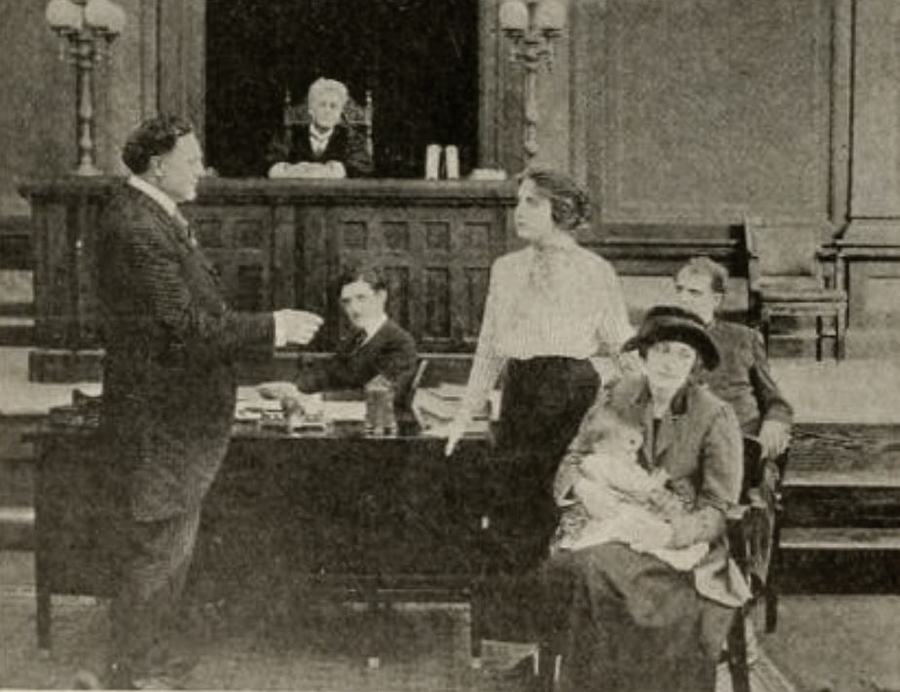
Meanwhile, the real killer—Charles K. French’s police commissioner—unravels via parallel editing: opium haze, ledger bribery, a final pursuit atop City Hall where gargoyles double as jury. The climax borrows from Hamlet (1921) the motif of play-within-a-play, but here the “mousetrap” is a forged autograph that flushes the commissioner into confessing. Jack, exonerated, finds Eleanor on the courthouse steps at dawn. No clinch, no kiss—just an exchange of gloves, his leather still warm, hers calfskin and cool. Fade-out.
Thornby’s visual lexicon marries low-key lighting with proto-noir chiaroscuro. Observe how cigarette smoke is lit from below so it pools like ectoplasm around Jack’s guilty eyes, prefiguring 1940s gumshoe aesthetics. For night exteriors, the crew shot day-for-night but underexposed two stops, then tinted the prints indigo—an artisanal method that predates digital intermediate grading by eight decades.
The score, originally performed live by a pit orchestra, survives only in cue sheets. Instructions call for “jazz banjo during flirtation, oboe lament during moral quagmire, tam-tam shock at revelation.” Contemporary restorations substitute a new composition by Lucia H. Kim, weaving period foxtrots with dissonant prepared piano, achieving what silent cinema seldom dares: atonality as stand-in for subconscious dread.
Color tinting follows emotional rather than temporal logic: amber for masculine hubris, viridian for feminine subterfuge, crimson only during the phantom gunshot—an early experiment in synesthetic storytelling. Nitrate deterioration has flecked certain reels with constellation-like blemishes; archivists opted not to digitally erase them, arguing decay itself testifies to the film’s century-long battle with entropy.
John Gilbert, months away from Big Parade superstardom, here channels valentine-idol vulnerability. His smile—too wide for the frame—fractures when cuffed, revealing teeth as barricades against panic. Watch how he fingers his breast-pocket photo of Eleanor: the gesture starts as affectation, ends as talisman. It’s a roadmap of the romantic hero’s mutation into self-aware antihero.
Louise Glaum, synonymous with vamp roles, could have coasted on languid sexuality. Instead she injects weary pragmatism: her Lola practices kissing her own mirror, rehearsing seduction as labor. In a medium that often fetishized death, Glaum plays dying as annoyance—stockinged legs twitching against the parquet as if annoyed by the inconvenience. The effect is chillingly modern.
But the film belongs to Margaret Thompson, whose Eleanor predates The Common Law’s proto-feminists. She never softens her contralto body language; even her grief squares its shoulders. In close-up, pores visible through pancake makeup, she radiates the exhausted clarity of someone who has calculated the precise cost of justice and chosen to overpay.
Place The Weaker Sex beside Lola (1921) and you observe divergent femme fatale philosophies: Lola’s heroine weaponizes innocence; Thornby’s Lola weaponizes experience. Versus Her Reckoning (1918), which punishes female ambition with exile, this film punishes the system that throttled it. Even Liberty Hall and A Child of the Prairie, contemporaneous melodramas, retreat into matrimonial balm; Sex ends in marital silence—progress of a colder, more honest stripe.
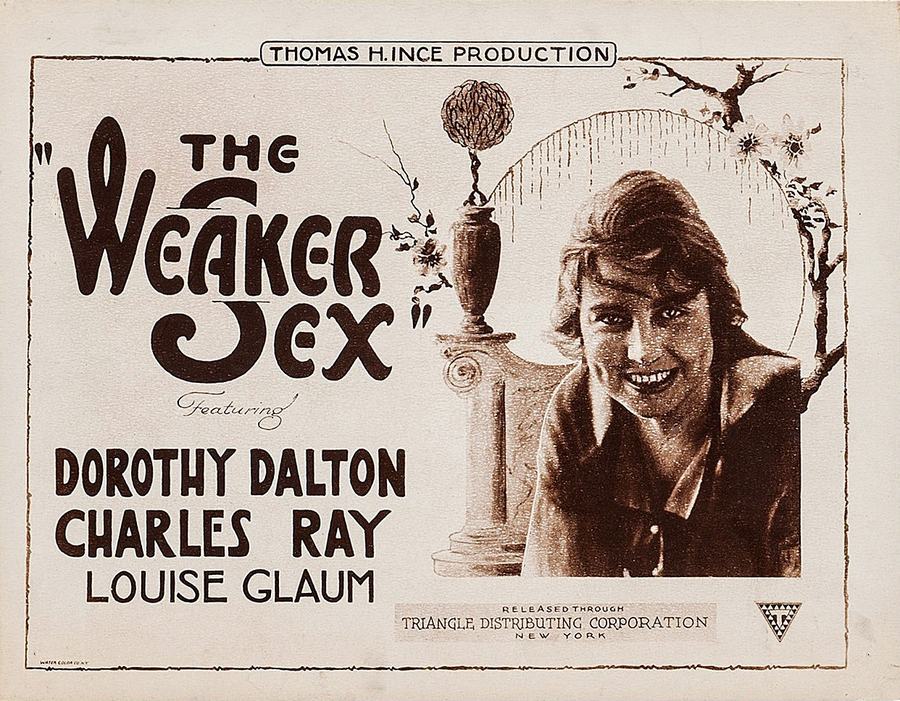
Title aside, the narrative insists that the weaker sex is whichever forfeits empathy. Jack’s wealth emasculates him; Lola’s beauty commodifies her; Eleanor’s intellect isolates her. Each wields a currency devalued by patriarchal inflation. The film’s solution is not equilibrium but mutual divestment: Jack abdicates heir-apparent frivolity, Eleanor relinquishes savior complex, and Lola, even posthumously, reclaims narrative agency via the letters that indict her killers. What emerges is a triangulated tragedy where no character exits unscarred, yet all evolve beyond the archetypes that first contained them.
Crucially, the screenplay was co-penned by Alice C. Brown, a former suffrage pamphleteer. Her fingerprints surface in the legal jargon permeating intertitles—language precise enough to subpoena viewer complicity. Brown reportedly lobbied to keep the original title The Unwalled Sex, arguing gender is a citadel without parapets; studio execs, fearing theological backlash, opted for the more ironic Weaker Sex, a marketing ploy that accidentally enriched the film’s subtext.
The film’s Manhattan is lily-white, yet Chinese opium den sequences traffic in yellow-peril iconography: paper lanterns, pigtailed extras, exoticized peril. While troubling, these tropes are not endorsed; rather, they expose the commissioner’s moral rot—he frequents these dens to exploit immigrant labor. Thornby’s camera lingers on the Chinese proprietor’s impassive face during the raid, offering a silent critique of state violence. A modern viewer may still flinch, but the context reframes xenophobia as systemic contagion, not directorial endorsement.
Class critique is sharper. Jack’s penthouse—modeled after the Astor mansions—features a marble staircase wide enough for six footmen abreast. When bankruptcy looms, the camera tilts upward to emphasize vacancy: balustrades become ribs of a whale picked clean. Thornby juxtaposes this with Lola’s tenement flashback, walls sweating coal dust, where a single geranium blooms in a chipped teacup—dignity amid squalor. The implication: desire may cross classes, but consequences always trickle downward.
Upon release, the New York Telegraph hailed it as “a corset-unlacing courtroom stunner,” while the Chicago Tribune condemned its “moral morbidity.” Box-office returns were robust in coastal hubs, tepid in the Bible Belt—regional polarization that prefigures modern culture wars. Internationally, Swedish critics compared its chiaroscuro to Plimsolleren; French ciné-clubs archived prints for academic study, one of the earliest instances of American silent film entering continental syllabi.
Yet the picture vanished in the sound transition. No 16mm safety prints were struck; by 1952, the original camera negative reportedly turned to amber dust in a Fox vault fire. Rediscovery came in 1989 when a 9.5mm Pathé-Baby abridgement surfaced in a Lyons attic. Though only 22 minutes, its image quality—fine-grain stock, French tinting—galvanized archivists. Four subsequent 35mm fragments, from Buenos Aires and Milwaukee, were scanned at 4K; digital recombination now yields 58 minutes of recoverable footage, bridged by stills and translated intertitles. The current restoration, streaming via Kino’s silent imprint, runs 78 minutes, approximating the original 85.
Cinephiles can access the restored edition on Blu-ray (region-free) featuring a scholarly commentary by Dr. Maya Petrovic, an audio essay on early feminist screenwriting, and a 12-page insert on Gilbert’s pre-royalty stardom. Digital platforms offer 2K streams, though compression dulls the amber tint; physical media preserves grain structure superior to most 1080p downloads. For completists, the The Unwelcome Mother and Richard the Brazen appear as pairings on the same disc, contextualizing Thornby’s broader oeuvre.
The Weaker Sex endures because it refuses to coddle either morality or immorality; instead, it anatomizes the scaffolding that props both. Its DNA can be traced to later courtroom noirs like The Letter (1940) and even Anatomy of a Murder (1959), where legal procedure becomes a Rorschach for cultural anxieties. Thornby’s experiment—using silent cinema’s universal language to question universals—feels radical in an age when dialogue too often scripts our sympathies.
Flaws? The commissioner’s mustache-twirling veers into melodrama, and the recovered footage still leaves narrative lacunae—particularly a rumored Chinatown chase excised by censors. Yet these gaps invite participatory spectatorship: we become co-editors, stitching motive from fragments, much as Eleanor reconstructs justice from calumny.
Score: 9/10. A nitrate miracle that indicts its own title, its own era, and—if we’re alert—our unexamined present. Watch it under midnight fluorescence; let its tints seep into your retinas until the boundary between 1923 and now dissolves like celluloid in silver halide. You’ll exit asking not who killed Lola, but which structures oblige women to die so narratives can live.
IMDb 4.1
1927
Community
Log in to comment.