DbcultAccessing Vault...
Cult Review
Senior Film Conservator
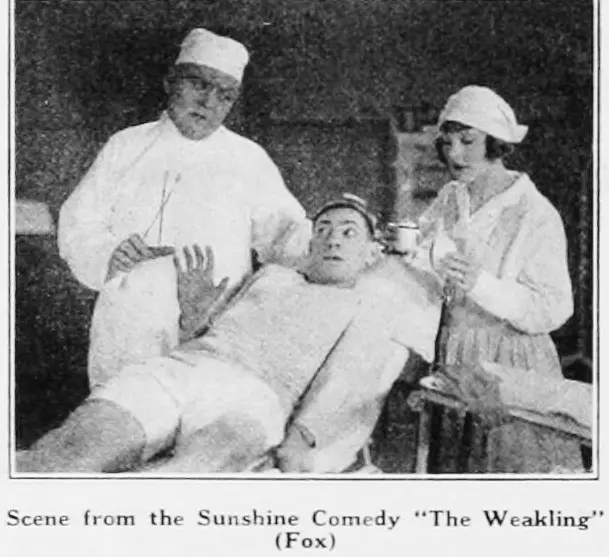
In the pantheon of silent-era physical comedy, The Weakling stands as a fascinating, albeit frequently overlooked, exploration of the subversion of masculinity. Henry Murdock, portraying the titular protagonist, navigates a world where the physical prowess of the collegiate elite is the only currency of value. Unlike the more polished underdogs found in The Pinch Hitter, Murdock’s Henry is not a hidden talent waiting for a moment of grace; he is a vessel for pure, unadulterated chaos. The film eschews the standard redemptive arc of the era, opting instead for a narrative driven by the capricious whims of fate and the visceral consequences of pharmaceutical intervention.
The initial sequences of the film establish a rigid social hierarchy within the college setting. Henry is depicted as an ocularly-challenged wallflower, a stark contrast to the hulking antagonists who dominate the track and field. When his sister—a character who functions as a catalyst for his transition from passivity to accidental action—pushes him into the fray, the cinematography shifts into a frantic, kinetic rhythm. The athletic events are not portrayed with the grace of a sports drama, but rather as a series of kinetic collisions. Henry’s victories are birthed from the debris of his failures; he wins not because he is faster or stronger, but because his very presence disrupts the mechanical precision of his competitors. This thematic thread of 'victory through disruption' is a common trope that Murdock handles with a unique, jittery energy that differentiates this work from the more stoic performances in Nineteen and Phyllis.
The lighting during these outdoor sequences utilizes the harsh, naturalistic glare of the early 20th-century sun, casting long shadows that emphasize Henry’s diminutive stature against the looming architecture of the university. There is a palpable sense of dread beneath the comedy, a realization that Henry is a foreign body within a system designed to crush the 'weak.' This tension reaches its zenith when the campus bully, driven to a state of apoplectic rage by his loss to a 'non-entity,' orchestrates a systematic dismantling of Henry’s physical person. The transition from the sunny fields of athletic competition to the dark, violent alleyways where Henry is beaten is jarring, signaling a shift into a much darker comedic register, reminiscent of the atmospheric weight found in The Sons of Satan.
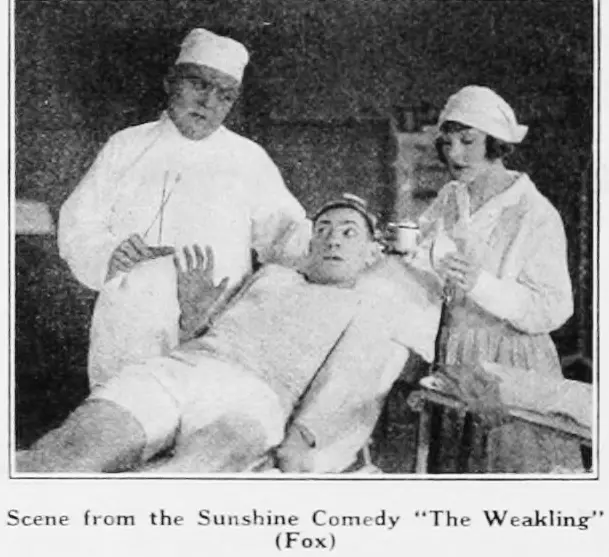
The middle act of The Weakling is perhaps its most avant-garde contribution to the silent short form. Following his brutalization, Henry is transported to a hospital—a setting that typically serves as a site of recovery but here becomes a stage for surrealist exploration. The administration of ether serves as a narrative hinge, pivoting the film away from reality and into a fever dream of slapstick. Murdock’s performance under the 'influence' is a masterclass in loose-limbed physical acting. He becomes a liquid entity, flowing through the corridors, evading nurses and doctors with an uncanny, drug-induced agility.
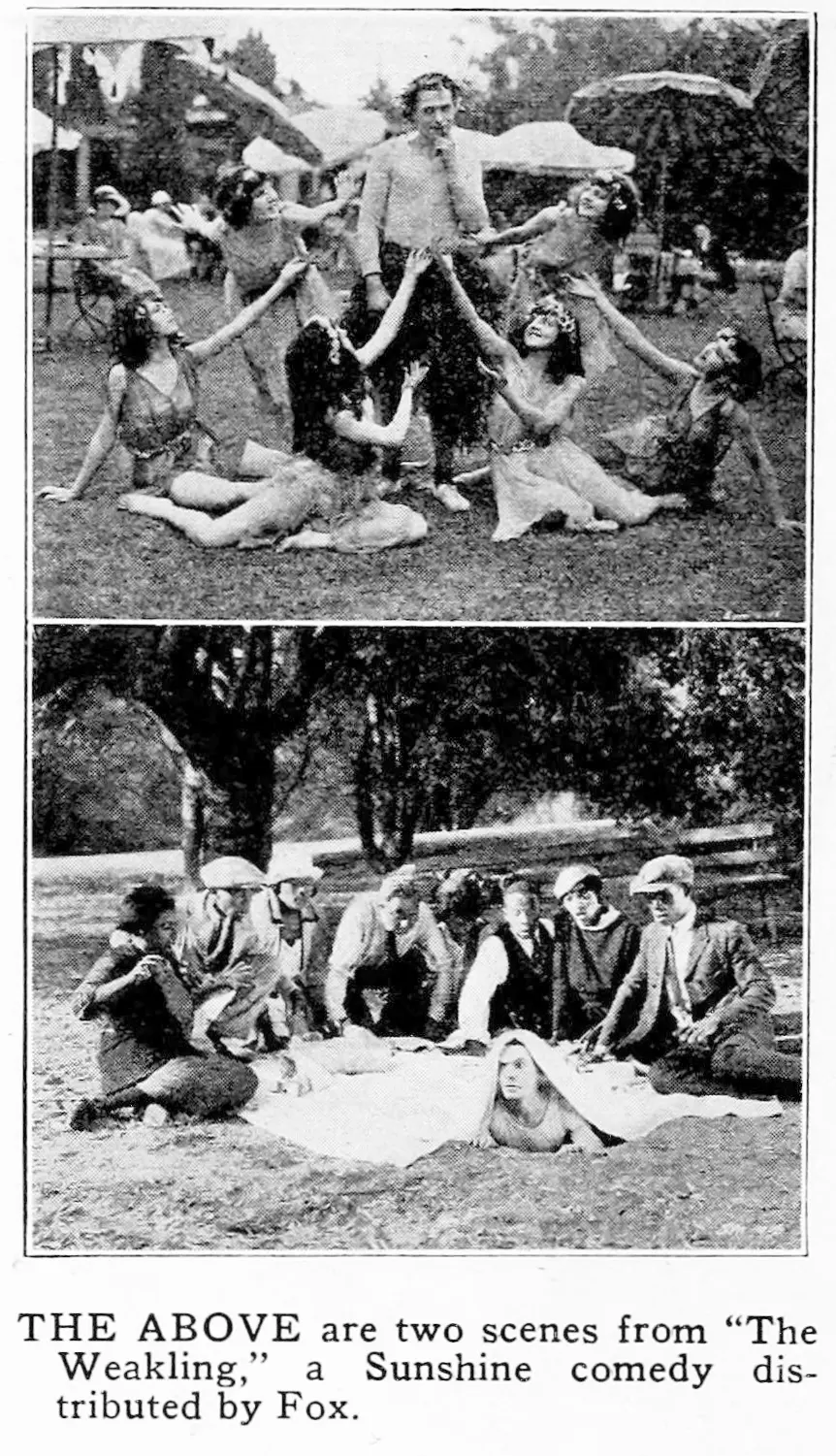
This sequence functions as a psychological liberation for the character. Stripped of his social anxieties and physical inhibitions by the anesthetic, Henry finally becomes the formidable force his sister envisioned, albeit in a destructive and nonsensical manner. The hospital itself is filmed with a sterile, almost oppressive geometry that Henry’s erratic movements constantly violate. It is a subversion of the medical drama, where the patient becomes the predator. One cannot help but draw parallels to the chaotic domestic disturbances in Squabs and Squabbles, though Murdock’s antics here possess a more hallucinatory quality. The laughter generated is not merely from the absurdity of the situation, but from the catharsis of seeing the 'weakling' finally dismantle the structures of authority that have historically marginalized him.
Furthermore, the pacing of this segment is relentless. The editing mimics the racing pulse of an ether-addled brain, with quick cuts and frantic camera pans that capture the escalating hysteria. It is a significant departure from the more measured pacing of contemporary films like The Holy City, showcasing a willingness to experiment with the medium’s ability to represent altered states of consciousness. The hospital sequence is not merely a comedic interlude; it is the core of the film’s philosophical inquiry into the nature of courage and the artificiality of social roles.
The climax of the film takes to the skies, a daring move for a production of this scale. Henry’s escape in an aeroplane—with his tormentor, the bully, trapped as an unwilling passenger—represents the ultimate reversal of the power dynamic. The 'weakling' is now literally and metaphorically above his oppressor. The aerial stunt work is remarkably visceral, capturing the precariousness of early aviation. Henry’s 'lack of knowledge concerning the motor' translates into a series of terrifying 'fancy figures' in the air—loops, dives, and stalls that are as much a product of his incompetence as they are a manifestation of his newfound, ether-fueled audacity.
The visual metaphor of the plane out of control perfectly encapsulates Henry’s entire journey. He is a man who has spent his life trying to navigate a world whose 'controls' he does not understand. In the cockpit, his ignorance becomes a weapon. The bully’s transition from a figure of absolute authority to a whimpering passenger is a satisfying, if brutal, pay-off. However, the film avoids a purely triumphant ending. When the bully finally attempts to regain control of the machine, his arrogance leads to a disastrous nose-dive. The 'strong' man’s attempt to impose order on a chaotic situation results in catastrophe, while the 'weak' man’s embrace of the chaos allowed him to soar, however briefly.
This ending is strikingly cynical for a 1920s comedy. It suggests that survival in a modern, mechanized world is more about the ability to endure chaos than the ability to master it. The disastrous results of the crash are not shied away from, leaving the audience with a lingering sense of the high stakes involved in Henry’s bumbling adventure. This level of consequence is rarely seen in lighter fare like What Happened to Jones or His Briny Romance, placing The Weakling in a more complex category of silent cinema that borders on the dark comedy or even the proto-noir.
To understand the impact of The Weakling, one must look at the landscape of 1920s cinema. The era was obsessed with the 'New Man'—an athletic, capable, and technologically savvy individual. Henry Murdock’s performance is a direct critique of this archetype. By highlighting the 'spectacled youth' who wins through accidents, the film mocks the burgeoning obsession with physical perfection and meritocratic success. The use of an aeroplane, the ultimate symbol of 1920s progress, as a vehicle for a near-fatal comedy of errors is particularly pointed.
In comparison to other films of the time, such as The Phantom Fortune, which deals with the pursuit of wealth and status, The Weakling is more concerned with the basic struggle for dignity in a world that prizes brawn over brains. Even Murdock’s interactions with the medical establishment reflect a skepticism toward the institutionalized 'fixing' of the individual. His rampage through the hospital is a rejection of the idea that he needs to be 'cured' of his timid nature. Instead, the ether reveals that his timidity is merely a mask for a more volatile, untapped energy.
The technical aspects of the film, while limited by the standards of the day, show a sophisticated understanding of spatial comedy. The way Murdock uses his spectacles as a prop—continually adjusting them even in moments of extreme peril—adds a layer of character-driven humor that elevates the film above simple slapstick. It shares a certain thematic DNA with The Catspaw, where the protagonist is caught in gears larger than himself, but Murdock’s Henry possesses a more anarchic spirit. While he may be the 'weakling' of the title, his impact on his environment is anything but weak; he is a human wrecking ball, leaving a trail of broken records, bruised bullies, and crashed planes in his wake.
Ultimately, The Weakling is a testament to the versatility of Henry Murdock as a comedic performer. He manages to balance the pathos of a bullied youth with the manic energy of a drug-induced escape artist. The film’s willingness to engage with themes of violence, drug use, and the failure of the 'strong' makes it a much more substantial work than its simple plot summary might suggest. It is a relic of a time when comedy was not afraid to be dangerous, and when the smallest man on screen could cause the most significant disasters. For those interested in the evolution of the underdog story, or for fans of silent cinema who crave something a bit more biting than the standard fare of Sawdust or The Devil-Stone, this film remains a vital, chaotic, and deeply entertaining piece of history. It serves as a reminder that sometimes, the most dangerous person in the room is the one who has absolutely no idea what they are doing.
IMDb —
1924
Community
Log in to comment.