DbcultAccessing Vault...
Cult Review
Senior Film Conservator
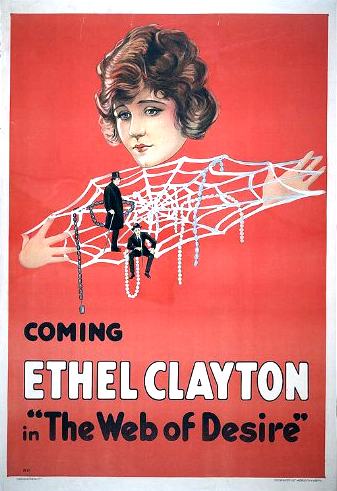
The silent era, often erroneously dismissed as merely a precursor to sound, consistently delivered narratives of profound emotional resonance and intricate moral complexity. Among these cinematic treasures, 1919's 'The Web of Desire' stands as a testament to the period's sophisticated storytelling, a potent drama that navigates the treacherous currents of sudden wealth, marital neglect, corporate espionage, and the arduous path to redemption. It’s a film that, even a century later, speaks volumes about the enduring fragility of human relationships when tested by the twin forces of ambition and societal pressure. The genius of its construction lies not just in the dramatic turns of its plot, but in its nuanced portrayal of characters caught within circumstances largely beyond their control, or perhaps, within the insidious 'web' of their own making.
At its core, 'The Web of Desire' is a cautionary tale about the disruptive power of an unexpected windfall. John Miller, portrayed with a compelling gravitas by Rockliffe Fellowes, is initially the industrious president of the Western Power and Development Company. His world shifts dramatically when his wife, Grace (Ethel Clayton, delivering a performance of quiet anguish), inherits a substantial stock portfolio from her father, instantly elevating them to millionaire status and necessitating a move to the bustling, competitive landscape of New York. This sudden ascent, far from bringing contentment, introduces a subtle yet devastating wedge into their marriage. Miller, now burdened by the immense responsibilities of his expanded enterprise, becomes emotionally distant, his mind consumed by the relentless demands of the financial world. This narrative arc, where wealth becomes a catalyst for marital decay rather than comfort, echoes themes found in other contemporary works exploring the darker side of prosperity, such as the social critiques embedded within films like 'The Spender', which often depicted the moral hazards accompanying unchecked affluence.
Grace's plight is particularly poignant. Feeling increasingly neglected and isolated in her opulent new surroundings, she seeks solace and intellectual stimulation outside the confines of her marriage. Her gravitation towards a bohemian set of acquaintances is not an act of malice, but a desperate search for connection and validation. This exploration of a woman's emotional vulnerability and her subsequent seeking of solace in unconventional circles is a recurring motif in early cinema, often serving as a dramatic device to highlight societal expectations versus individual desires. Ethel Clayton's portrayal of Grace is particularly effective in conveying this internal struggle, presenting a character who is neither purely victim nor villain, but a complex individual navigating a difficult emotional landscape.
It is within this bohemian milieu that Grace encounters Stuart Mordant, a character etched with a chilling blend of charm and duplicity. Mordant, an attorney for Thomas Hurd—Miller's formidable business rival—is a master manipulator. He quickly discerns Grace's emotional void and, with calculating precision, begins to exploit it for his own gain, and more significantly, for Hurd's corporate agenda. The film masterfully builds Mordant's character as a classic silent-era antagonist, not overtly villainous in appearance, but insidious in his methods. His bargain with Hurd, promising control of Miller's company for a half-million dollars, is a stark illustration of the ruthless corporate landscape of the era, where personal relationships could be weaponized for financial conquest. This kind of calculated betrayal, where trust is systematically eroded for material gain, finds parallels in the moral quandaries explored in dramas like 'The Reward of the Faithless', where the consequences of such actions reverberate through the lives of all involved.
Mordant's success in compromising Grace and Miller is a painful process to witness. The film, through its visual storytelling, conveys the subtle shifts in Grace’s demeanor and Miller’s growing suspicion. The revelation of Grace's perceived betrayal, meticulously orchestrated by Mordant, shatters Miller's world. Rockliffe Fellowes conveys Miller's devastation with an intensity that transcends the lack of spoken dialogue, his expressions a canvas of pain, anger, and disillusionment. The immediate insistence upon divorce, while harsh, is presented as an understandable, albeit tragic, reaction from a man whose trust has been utterly violated, or so he believes. The subsequent transfer of Grace's stock to Mordant is the cruelest twist, a final, seemingly irreparable blow to Miller's professional and personal life, orchestrated by a villain who understands the power of both emotional and financial leverage.
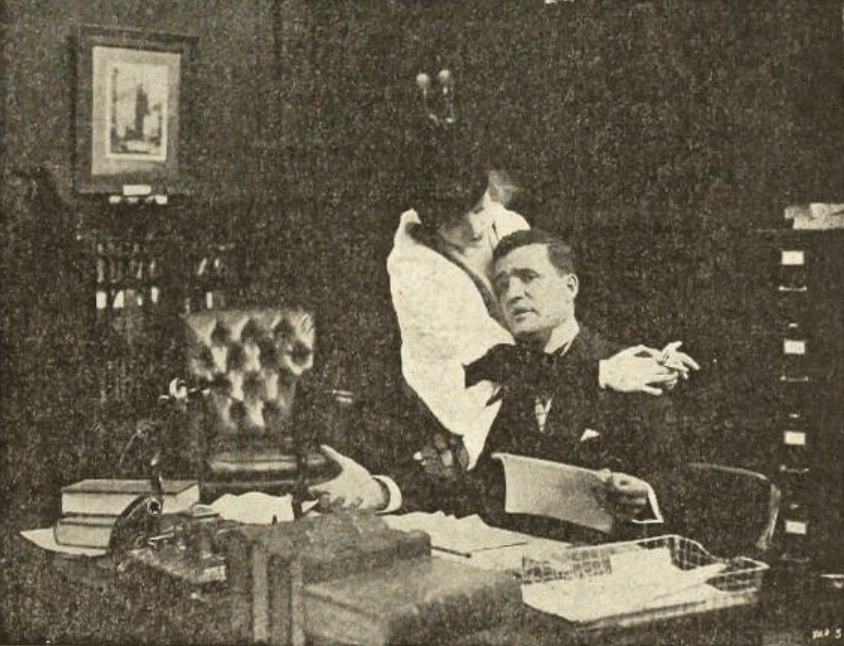
The climax of 'The Web of Desire' is a masterclass in dramatic tension and resolution, a hallmark of Frances Marion's exceptional screenwriting. As Hurd prepares to demand Miller's resignation at the pivotal stockholders' meeting, signifying the complete takeover of his company, Grace makes a dramatic entrance. This moment is exquisitely staged, a sudden ray of light piercing the gloom of impending ruin. Her exposure of Mordant's machinations, and the subsequent destruction of the fraudulent stock transfer, is a powerful act of defiance and self-redemption. It's a scene that resonates with the cathartic power of truth prevailing against deceit, a testament to the enduring human spirit's capacity for agency even in the face of overwhelming odds. Such narrative turns, where a seemingly helpless protagonist rises to confront injustice, are often a core element of silent-era melodrama, providing audiences with a satisfying, albeit often hard-won, sense of justice.
The confrontation between Miller and Mordant that follows is perhaps the film's most ethically complex moment. Miller’s offer of a pistol, suggesting suicide as Mordant’s only honorable alternative, is a stark reflection of the societal codes of honor prevalent in that era, particularly in the face of such profound betrayal. It’s a moment that asks the audience to grapple with the definition of justice and the consequences of one's actions. Mordant's subsequent flight to Europe, leaving behind a note exonerating Grace, is a final act of cowardice, yet paradoxically, it provides the crucial closure needed for Grace and Miller to begin anew. This resolution, while perhaps not entirely satisfying from a purely punitive standpoint, emphasizes the film's focus on the restoration of emotional and relational integrity over mere retribution. The notion of characters escaping consequences, yet leaving behind a crucial truth, is reminiscent of the moral ambiguities explored in works like 'My Lady Incog.', where hidden truths often drive the narrative forward.
The success of 'The Web of Desire' rests heavily on the shoulders of its principal cast, who, without the benefit of dialogue, had to convey a vast spectrum of emotions through facial expression, body language, and carefully choreographed movement. Rockliffe Fellowes, as John Miller, embodies the archetype of the driven businessman, whose ambition blinds him to the needs of his spouse, only to be utterly devastated by the consequences. His performance is a masterclass in controlled intensity, allowing the audience to feel his character's journey from detached ambition to heartbroken fury and, finally, to a tentative hope for reconciliation. Ethel Clayton, as Grace, is equally compelling. She beautifully portrays the gradual erosion of a woman's spirit under neglect, her yearning for connection, and her ultimate strength in confronting her betrayer. Her transformation from a vulnerable, seeking soul to a woman of decisive action is believable and inspiring.
Even the supporting cast, including Doris Field and William A. Williams in their respective roles, contribute to the tapestry of the narrative, providing depth and context to the central conflict. The silent film actor's craft was a unique blend of theatricality and subtle realism, demanding a mastery of non-verbal communication that often feels more profound than spoken words. The impact of their performances is a testament to the directorial vision and the clarity of the screenplay by Frances Marion and E. Lloyd Sheldon, ensuring that every gesture and every glance served a specific narrative or emotional purpose. Their ability to project complex inner lives onto the screen without uttering a single word is a powerful reminder of cinema's universal language.
The screenplay for 'The Web of Desire,' penned by the prolific and groundbreaking Frances Marion alongside E. Lloyd Sheldon, is a standout example of early cinematic writing. Marion, one of Hollywood's most celebrated and influential screenwriters, consistently crafted narratives that were ahead of their time in their psychological depth and their exploration of social issues. Here, she delves into the intricate dynamics of power, gender, and morality with remarkable precision. The plot is not merely a series of events but a carefully constructed unraveling and re-stitching of relationships, where every action has a discernible consequence. The way Grace's initial neglect leads to her vulnerability, which in turn is exploited, creating a domino effect of betrayal and corporate jeopardy, showcases a keen understanding of cause and effect in human drama. This meticulous construction of narrative, where characters are driven by understandable (if flawed) motivations and external pressures, elevates the film beyond simple melodrama into a profound character study. Marion's ability to imbue her female characters with agency, even when they appear to be victims of circumstance, is a hallmark of her work, and Grace's ultimate act of defiance is a powerful example of this.

The film's exploration of 'environment' as a shaping force, as seen in how the move to New York and the pressures of wealth transform both John and Grace, is also a notable aspect of Marion's writing. It implicitly suggests that while individuals possess agency, they are also products of their surroundings and the societal expectations placed upon them. This thematic exploration finds echoes in other films of the period, such as 'Environment', which similarly examined the profound impact of external circumstances on individual lives and moral choices. The enduring relevance of such themes speaks to the timeless quality of Marion's insights into the human condition.
Despite the absence of spoken dialogue, 'The Web of Desire' communicates its complex narrative with remarkable clarity and emotional depth. The visual language of silent cinema—its reliance on expressive acting, evocative set design, strategic use of intertitles, and dynamic cinematography—is fully utilized here. Directors of the era had to master the art of conveying intricate plot points and subtle emotional shifts through purely visual means. One can imagine the close-ups emphasizing Grace's loneliness or Miller's furrowed brow, the dramatic staging of the stockholders' meeting, and the symbolic imagery used to underscore the film's themes of entrapment and liberation. The film's title itself, 'The Web of Desire,' suggests a visual metaphor that would have been brought to life through careful composition and editing, creating a sense of characters ensnared by forces they struggle to comprehend or control. This visual sophistication is what often distinguishes the best silent films, allowing them to transcend the limitations of their medium and achieve a universal appeal.
The pacing, a critical element in silent storytelling, would have been carefully managed to build suspense and emotional impact. The slow burn of marital dissolution, the rapid escalation of corporate intrigue, and the climactic reveal would have been orchestrated to maximize audience engagement. While specific directorial credits aren't provided in the prompt, the seamless integration of performance and narrative suggests a skilled hand guiding the production. The film stands as a testament to the collaborative artistry inherent in silent filmmaking, where every department, from set design to costume, contributed to the overall narrative tapestry. It is this holistic approach that allowed films like 'The Web of Desire' to captivate audiences without a single spoken word, proving that true cinematic power lies in visual and emotional storytelling.
What makes 'The Web of Desire' resonate even today is its exploration of themes that remain universally pertinent. The dangers of neglecting a partner for career ambition, the corrosive influence of wealth when untempered by emotional intelligence, the ease with which individuals can be manipulated in moments of vulnerability, and the arduous journey towards forgiveness and reconciliation—these are not period-specific concerns. They are fundamental aspects of the human experience. The film’s depiction of Grace’s initial emotional neglect and her subsequent search for validation outside her marriage serves as a powerful reminder of the importance of emotional intimacy in any relationship. Similarly, Miller’s single-minded pursuit of business success at the expense of his personal life offers a stark warning about misplaced priorities.
The resolution, where Grace and Miller decide to “unravel their problems together,” is particularly insightful. It avoids a simplistic happy ending, instead suggesting that true reconciliation is not about forgetting past hurts, but about committing to a shared effort to rebuild trust and understanding. This nuanced conclusion elevates the film beyond mere melodrama, offering a more realistic and mature perspective on marital recovery. It suggests that the 'web of desire' is not merely one of temptation and betrayal, but also the intricate, often fragile, network of commitment and communication that binds two people together. In an era where relationship dramas still dominate popular culture, 'The Web of Desire' offers a compelling, historically significant antecedent to many of the themes we continue to explore on screen today.
Ultimately, 'The Web of Desire' is far more than a historical curiosity; it is a vital piece of cinematic heritage that showcases the profound capabilities of silent filmmaking. It delivers a gripping narrative, powered by stellar performances and a masterful screenplay, that continues to provoke thought and stir emotion. It reminds us that the complexities of human nature, the allure of ambition, and the enduring power of love and forgiveness are themes that transcend time and technological advancements in storytelling. For those willing to immerse themselves in the artistry of the silent screen, this film offers a deeply rewarding experience, a powerful testament to the timeless art of cinema. Its enduring message about the delicate balance between personal fulfillment and professional ambition, and the necessity of nurturing emotional bonds, resonates with an undiminished clarity, inviting us to reflect on the intricate webs we weave in our own lives.

IMDb 1.7
1936
Community
Log in to comment.