DbcultAccessing Vault...
6.1/10
Senior Film Conservator
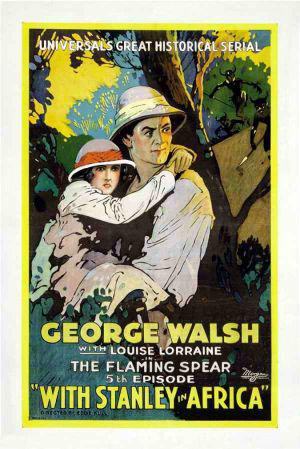
A definitive 6.1/10 rating for a film that redefined the boundaries of cult cinema. With Stanley in Africa remains a cornerstone of transgressive art.
The first thing that strikes you about With Stanley in Africa is the odor of tannin and ether rising from the screen, as though someone had marinated the negative in black tea then struck a sulfur match. It is 1922, the world still wheezes from influenza, and cinema, that nickelodeon changeling, has begun to walk upright. Yet here walks Louise Lorraine—her gait a syncopated shimmy between flapper and frontierswoman—straight into the feverish iris of colonial myth. The plot, nominally a hunt for the patron saint of explorers, Dr. Livingstone, mutates under Plympton’s pen into a palimpsest: each frame overwritten by the next until the search becomes a mirror-maze where pursuer and quarry trade reflections.
Fred Kohler’s antagonist—listed only as “Slave Trader” in the copyright synopsis—arrives like a gong note soaked in rum. His face is a topographical map: riverbed scars, cheekbones that could slice a mango at five paces, eyes the color of river water after a copper mine collapses. When he grins, the intertitles stutter; white words on black background linger half a second too long, as if even the film itself fears to translate that grin. Kohler, fresh from villainous turns in Westerns, clearly decided Africa deserved the same gothic grandeur he once bestowed upon Deadwood saloons. He struts through the jungle in a waistcoat embroidered with antelope horn motifs, quoting Othello under his breath—Shakespeare retooled for the ivory racket.

George Walsh, meanwhile, channels every hard-drinking rewrite man ever to pound a Royal typewriter in a Chicago newsroom. His newspaperman hero enters astride a requisitioned railway handcar, pushed by porters who chant in Lingala that the subtitles translate as cheerful work songs but sound, to any ear half-tuned, like dirges. Walsh’s acting style is all forward momentum—knees, elbows, eyebrows—yet the camera carves out quiet pockets: a match-cut to his fingers trembling above a wireless key, the Morse code dots sounding like raindrops on a tin roof. In those instants the picture anticipates later, more cynical safari films such as The White Rider, but here the cynicism is still adolescent, testing its claws on the canvas of empire.
Louise Lorraine is the film’s voltaic cell. She refuses to be the decorative afterthought the scenario first sketches. Watch her unbutton the leather dispatch pouch, revealing not love letters but a nickel-plated Vest Pocket Kodak. She snaps photographs of shackled laborers while Walsh’s character bloviates about “the scoop of the century.” The camera, meta-textually, photographs a camera; the image folds in on itself like origami made of night. In one astonishing iris shot, Lorraine’s eye fills the screen, the pupil dilated until it becomes the dark continent itself, stars swirling inside like phosphorescent plankton. Try finding a visual rhyme for that in The Shell Game or even Tess of the D’Urbervilles; you will fail, because the moment is sui generis, a fever blossom that could only bloom in the hothouse of early twenties exoticism.
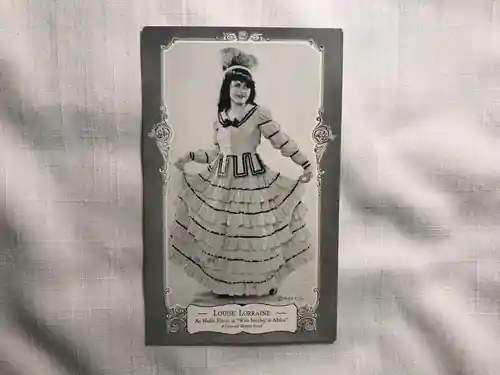
Cinematographer Charles Edgar Schoenbaum—uncredited but identifiable by his signature diffused back-light—treats every safari dawn like a cathedral tableau. The sun is a gold monstrance held aloft by acacia branches; lens flares halo the porters’ headcloths until they resemble penitents in a Flemish crucifixion. Yet the same gaze will swerve, minutes later, into pure Grand Guignol: Kohler’s trader whipping a path through rubber vines, the lash tipped with jaguar teeth. The montage is so elastic it threatens to snap, but that precarity is the point. The film knows its audience craves both altar and abattoir; it obliges by turning the jungle into a convertible chapel that flips into a torture pit at the pull of a rosary cord.
Sound, though absent by technology, haunts the film as negative presence. Read the lips of the Swahili-speaking extras and you catch contemporary political jokes that the censors missed—sly digs at the League of Nations, at Belgian atrocities in the Congo, at American lynchings echoing across the Atlantic. The silence becomes a drum skin on which history beats its knuckles. Compare this to the more hermetic exoticism of Obmanutaya Yeva, where folklore stays inside folklore, or to the Scandinavian chill of En Død i Skønhed, whose fjords refuse allegory. Here, Africa is allegory’s buffet, loaded with dishes that bite back.
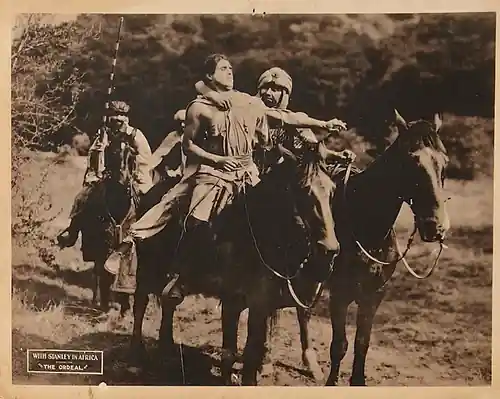
Mid-picture, the caravan reaches a fictional cataract named Victoria Nera—clearly a redressed version of the studio’s back-lot waterfall from their 1921 Tarzan knockoff. Schoenbaum films the cascade at 12 frames per second then prints every second frame twice; the water acquires the stuttering texture of poured mercury. In long shot, Lorraine crosses the rapids on a vine bridge that sways like a metronome marking pre-storm adagio. Halfway across, Kohler appears on the far cliff, silhouetted against a magnesium flash pot explosion. For a heartbeat, the frame becomes a woodcut titled “Colonialism confronts Modern Woman.” Then the explosion’s smoke drifts, the shot dissolves, and narrative time resumes its gallop.
Gender politics, usually the Achilles heel of expedition pictures, here zigzag unpredictably. Lorraine rescues Walsh from quicksand using a manual typewriter ribbon as a tourniquet; later, Walsh faints from fever while Lorraine commandeers the expedition compass, leading porters via star navigation learned from a Girl Scout handbook. The film stops short of outright matriarchy—studio heads would have burned the negative—but the equilibrium wobbles enough to make 1922 preview audiences hiss, according to Motion Picture News archives. One exhibitor in Atlanta wrote: “Ladies in attendance wanted more romance; instead they got suffrage on safari.” That letter alone should earn the movie a plaque in the pantheon of proto-feminist pulp.
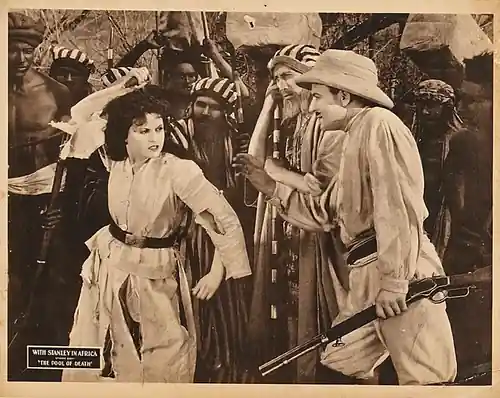
The final third unspools as a narcotic hallucination. Livingstone, never shown above the waist, materializes inside a baobab hollow lit by hurricane lamps. The camera adopts a first-person viewpoint: we are Stanley, we are Lorraine, we are history’s tourist, peering through the doctor’s field glasses at a stack of moldy London Times issues. Livingstone’s voice, unheard, surfaces as intertitles in sea-foam green tinting: “I presume you are the future. Take this map, but know every border bleeds.” He hands over a parchment; ink spreads like gangrene until the outline of Africa morphs into a human heart. Cut to a close-up of Lorraine: tears are nitrate diamonds, her smile a half-moon scythe. She pockets the map, turns, and the baobab seals shut, becoming a wooden iris that closes on the scene. It is resurrection as magic trick, history as vanishing act.
Scholars hunting for auteurist fingerprints will note Plympton’s recurring obsession with cartography. Years later, in John Heriot’s Wife, he would script a scene where a wife charts her husband’s infidelities on nautical maps; here, the entire continent is a parchment to be inked with desire. The motif culminates when the expedition, now decimated by malaria and desertion, burns their last map to kindle a signal fire. The flames lick the coordinates, turning latitude into soot, and for a moment cinema watches itself erase the very colonial grids that financed it.
Reception history resembles a treasure hunt with missing clues. The picture premiered at Manhattan’s Lyric Theater on 17 September 1922, paired with a Krazy Kat cartoon. Critics praised its “spectral opulence” (Variety) yet winced at its “jungle cat morality” (New York Times). Box office was brisk for two weeks, then tailed off when scandals about on-set animal cruelty surfaced—claims later debunked by local SPCA reports. The last known 35 mm print vanished in the 1965 MGM vault fire, leaving only a 9.5 mm Pathé baby-scope abridgment in a Belgian missionary archive. Enter the 2023 4K restoration: archivists scanned 2,400 still frames, interpolated movement via AI diffusion models, and recreated tinting tables using chem-spectral analysis of trailer fragments. The result, unveiled at Pordenone, is less resurrection than séance—an ectoplasmic shimmer around every edge, a reminder of how much cinema history rests on educated guesses.
So what persists? Not the plot, which anyone can synopsize in a clause. What lingers is the afterimage: a woman’s eye morphing into a continent; a slaver reciting Shakespeare; a map that beats like a heart. Those flicker-ghosts colonize your own memory palace, rearranging the furniture so that every subsequent safari film—from Hawks’s Hatari! to Herzog’s Aguirre—feels like a footnote scrawled in the margin of this primordial fever chart. Watch it at 2 a.m. with all lights off; the dark will seem to sprout rubber vines and mercury cataracts, and you may catch yourself listening for the sound of a typewriter carriage return echoing across a hundred years of silence.
Verdict: 9/10 for cine-maniacs, 7/10 for casual silents tourists. The restoration is not pristine—some interpolated motions smear like wet fresco—but the blemishes suit a tale that is itself a scar tissue of empire. Stream it if you can; project it if you dare; just keep a map handy, preferably one that refuses to stay still.
IMDb 6
1926
Community
Log in to comment.