DbcultAccessing Vault...
Cult Review
Senior Film Conservator
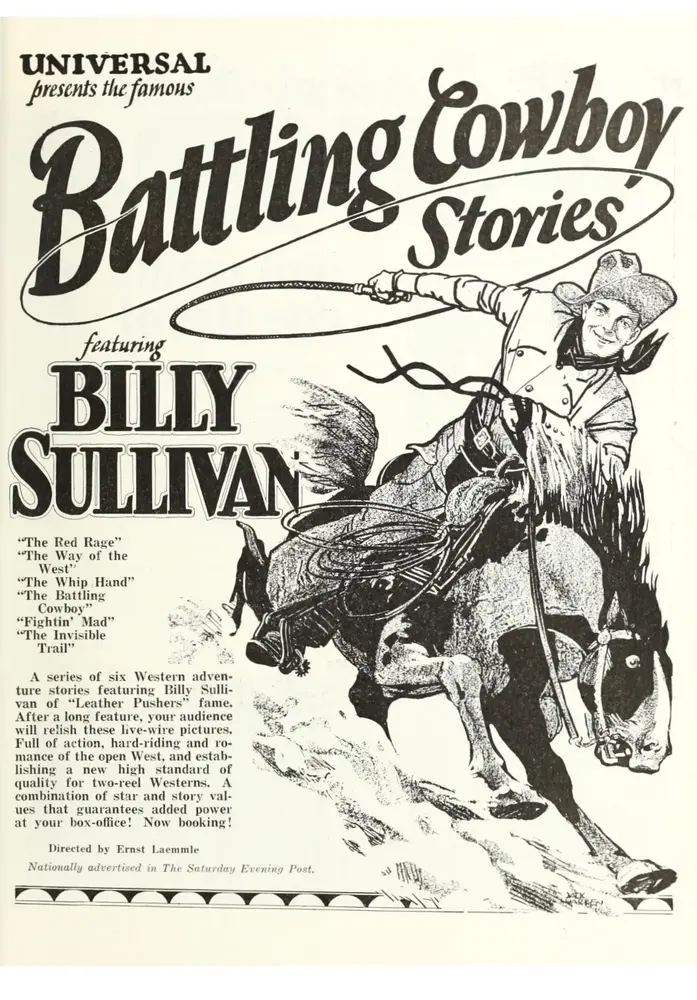
Short answer: Yes, but only if you appreciate the raw, unpolished kinetic energy of silent-era stunt work. This film is for the cinematic historian who values physical performance over complex plotting, but it is definitely not for those who demand modern pacing or high-definition clarity.
In the landscape of 1920s cinema, few actors possessed the specific, wiry athleticism of Billy Sullivan. While his contemporaries were often content to play the stoic lawman, Sullivan carved out a niche as the 'hot-head'—a man whose fists, or in this case, his whip, moved faster than his logic. The Whip Hand is a fascinating specimen of the early sequel-culture, attempting to build a 'Billy Universe' long before the concept of franchises became the industry standard.
1) This film works because Sullivan’s athleticism turns a standard ranch story into a masterclass in prop-based action choreography.
2) This film fails because its narrative structure relies too heavily on a 'temper' gimmick that feels repetitive by the second act.
3) You should watch it if you want to see how early cinema attempted to differentiate its heroes through unique skill sets rather than just moral superiority.
Isadore Bernstein’s script treats Billy’s temper not as a character flaw, but as a physical entity—a beast that must be managed. It is an interesting, albeit primitive, look at masculinity. Most westerns of this period, like The Ancient Highway, focused on the external conquest of nature. Here, the conquest is internal. Billy isn't fighting the ranch; he is fighting the urge to kill the man standing across from him.
The film’s connection to 'The Red Rage' is more than just a marketing ploy. It provides a shorthand for the audience. We know Billy is dangerous. We have seen what happens when he loses control. This creates a genuine sense of dread during the middle chapters of the film. When the villain begins his taunting, the audience isn't just waiting for a fight; they are waiting for a breakdown. It works. But it’s flawed.
The most striking element of the film is, predictably, the whip. In an era where the six-shooter was the ultimate symbol of power, Bernstein introduces the Australian whip as a tool of precision and restraint. There is a specific scene—the highlight of the film—where the villain literally tries to hand Billy a gun. It is a moment of pure temptation. The villain wants Billy to become a murderer, to descend to his level.
Sullivan’s performance here is surprisingly nuanced for the silent era. He doesn't just shake his head; he looks at the gun with a mixture of loathing and desire. When he finally pulls the whip from his belt, it feels like a religious conversion. He chooses the weapon of his home, the weapon of a laborer, over the weapon of an outlaw. The subsequent thrashing of the villain is choreographed with a frantic, rhythmic energy that puts the static gunfights of films like Speed Wild to shame.
Billy Sullivan was never going to be Douglas Fairbanks, but he had a grit that felt more modern. Compared to the slapstick energy found in Yankee Doodle in Berlin, Sullivan’s work in The Whip Hand is grounded in a heavy, almost oppressive reality. He looks like a man who has spent time in the sun. He looks like a man who has actually worked on a ranch.
This realism extends to the romance. While many silent films, such as Ladies Must Live, treated romance as a series of flowery intertitles and soft-focus gazes, Sullivan’s interaction with the lead girl is marked by a clumsy, endearing awkwardness. He knows he is too 'fiery' for her. His eventual apology and departure isn't just a plot point; it is a tragic admission of his own nature. It’s a brave ending. It doesn't give the audience the wedding they expect.
Question: Does The Whip Hand offer enough unique action to justify its place in a modern watchlist?
Answer: Yes. For fans of action choreography, the whip work is a revelation. While the plot is a standard 'ranch hand' trope, the specific use of non-lethal (yet brutal) weaponry provides a refreshing change of pace from the typical gun-heavy westerns of the 1920s. It is a lean, mean character study disguised as a B-movie western.
The pacing of the film is its greatest hurdle. Like many films of its time, such as The Fighting American, it suffers from a sagging middle act where the ranch chores take up far too much screen time. We get it—he’s a good worker. We don't need ten minutes of him hauling lumber. However, when the action hits, it hits with a ferocity that few directors of the period could match.
The cinematography relies on natural light, which gives the ranch scenes a dusty, tactile feel. You can almost smell the horse sweat and the dry grass. This aesthetic choice heightens the impact of the final fight. The dust kicked up by the whip creates a visual haze that mimics Billy’s internal rage. It is a sophisticated bit of visual storytelling for a film often dismissed as a simple sequel.
Pros:
- Exceptional whip choreography that remains impressive today.
- A complex, non-traditional ending for a silent western.
- Billy Sullivan’s intense, physical screen presence.
- Gritty, realistic production design.
Cons:
- Pacing issues in the second act.
- Simplistic portrayal of the female lead.
- Reliance on knowledge of the previous film, 'The Red Rage'.
The Whip Hand is a film that deserves more than its current status as a footnote in Billy Sullivan’s career. While it lacks the scale of The Ancient Highway, it makes up for it with a raw, focused intensity. It is a film about the burden of being a 'violent man' and the difficult choice to be better. The whip is not just a weapon; it is a leash. And watching Sullivan struggle with that leash is some of the most compelling cinema of the 1920s. It’s not a masterpiece. It’s a punch to the gut. And sometimes, that’s exactly what a movie should be.
IMDb —
1933
Community
Log in to comment.