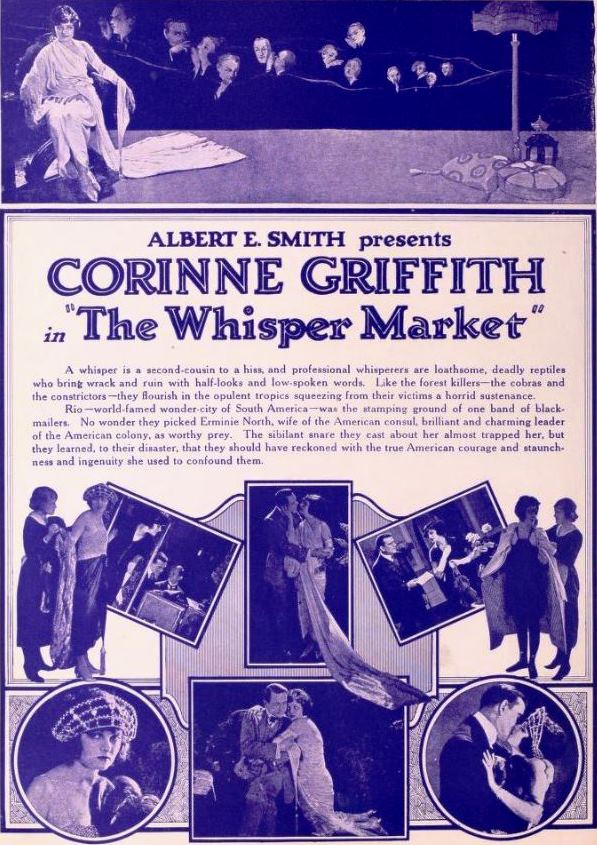
Photographed in chiaroscuro so tactile you can smell the dock-side guava, The Whisper Market is less a narrative than a fever contract—inked in morphine, stamped by consular seals, and blotted by a single magnesium flash.
Corinne Griffith’s Juliet glides through every frame like a panther who has memorised every Bible verse; the contradiction is delicious. One moment she is the Madonna of forged passports, the next a marketing genius hawking “whispers”—those cyanotype negatives that can unmake diplomats. Griffith lets the camera come to her; she rarely chases it. Watch the way her eyelids half-mast when she scents Erminie’s terror—predatory empathy, a cocktail impossible to label.
Opposite her, James O’Neill (yes, Eugene’s exiled brother) sculpts Burke into a brute-angel hybrid: cheekbones that could slice tobacco leaves, shoulders that confess the weight of every sin before he even speaks. In the hotel scene his silhouette looms over Erminie like a cathedral whose bells refuse to ring. The moment he chooses gallantry—hiding her, trading his freedom—it feels pre-ordained yet gasp-worthy.
Brazilian Shadows, American Morals
Director C. Graham Baker, aided by W.E. Scutt’s serrated intertitles, shoots Rio as though it were Purgatory’s anteroom: cobblestones slick with cane-syrup rain, tobacco warehouses exhaling nutmeg and guilt, American vice-consuls who believe jurisprudence is a polo match. The film arrived in 1923, the same year U.S. narcotics agents started poking around South American shipping lanes; audiences recognised the topical sting without needing footnotes.
George MacQuarrie’s Consul North is the embodiment of Wilsonian righteousness—starched, blinkered, yet oddly courteous even to felons. His blind spot is marital vanity, a flaw the movie weaponises with surgical glee. Watch how Baker frames him: always slightly higher than other characters, as though ethics were an altitude. The irony, of course, is that his moral summit depends on a woman’s secrecy.
The Silent Scream of Photography
What makes The Whisper Market crawl under the skin is its prescience about image culture. Ninety-nine years before deepfakes, the film intuits that a photograph is not evidence but currency, endlessly renegotiable. Burke’s camera is both weapon and confession booth; the negatives function like NFTs of shame—unique, non-fungible, desired by every side for contradictory reasons.
Compare this to Auction of Souls where photography is martyrdom, or to The Spider where it’s voyeuristic sport. Whisper Market lands closer to our current predicament: everyone trades in images, everyone is a blackmailer now, only the platform has changed.
Erminie’s Dilemma: Virtue as Liability
Eulalie Jensen’s Erminie is the film’s moral tuning fork. Note the costume arc: she enters wearing bridal ivory, exits in dove grey—innocence interrogated but not forfeited. When she kneels on Burke’s carpet, begging for the negatives, the camera hovers at her eye-level, forcing viewers to occupy her mortification. It’s a proto-feminist tableau: patriarchy has put her in jeopardy, but sisterhood—Juliet’s machinations notwithstanding—offers the escape hatch.
Some critics of the era dismissed Erminie as “another trembling wife”; modern eyes will see a woman leveraging empathy as geopolitical leverage. Her intervention at the deportation hearing is essentially back-channel diplomacy conducted with fans, gloves, and the unassailable leverage of a secret.
Visual Lexicon: Shadows, Fans, and Opium Smoke
Cinematographer Jules Cronjager (imported from German expressionist sets) renders Rio as a fever chart of trembling shadows. In the smugglers’ warehouse, opium smoke coils around lanterns like translucent pythons; the Saltmarshes’ faces emerge as though carved from candle wax. When Burke burns the negatives on a porcelain plate, the flame’s reflection paints his throat with orange vertebrae—a man cremating his own leverage.
Notice the recurring visual motif: half-closed venetian blinds. They stripe characters like jail bars, predicting Burke’s fate while reminding viewers that everyone here—diplomat, wife, smuggler—is imprisoned by somebody else’s gaze.
Sound of Silence: Music Cues Then and Now
Original exhibition notes suggest a live trio performing a tango that mutates into a minor-key habanera during Erminie’s hotel scene. Modern restorations often substitute a discordant waltz, but the true jolt comes from the intertitles—laconic, cynical, haiku-brief:
“Negatives are memories that pay rent.”
Scene from The Whisper Market
Cinematic perspective: Exploring the visual vocabulary of The Whisper Market (1920) through its definitive frames.
Try hearing that in your head while watching Erminie’s silent sob; it lands like a slap.
Comparative Echoes Across Silent Noir
If Gretchen the Greenhorn domesticates peril inside a child’s innocence, and The Gentleman from Indiana moralises crime into civic duty, Whisper Market refuses either comfort. It sits closer to Had og Kærlighed’s urban cynicism, though Rio’s tropical rot replaces Copenhagen drizzle.
Meanwhile Az ördög explores demonic temptation in moralising allegory; Baker’s film locates the demonic in passport ink and photographic emulsion—modernity’s own sulphur.
Reception Ripples: Then, Forgotten, Reborn
Trade papers in January 1923 praised the film’s “tropical sultriness” but yawned at its “moral somersaults.” It disappeared from American screens by summer, victim to a flood of college-football comedies. Brazil banned it outright for “defaming consular dignity,” inadvertently ensuring bootleg prints circulated like samizdat among Rio’s cine-clubs.
Seventy-eight years later a nitrate reel surfaced in a São Paulo basement, Portuguese subtitles baked into the emulsion. The 2021 4K restoration by Riviera Film Lab reintroduced the movie to festival audiences who gasped at its MeToo-era resonance: blackmail, image ownership, bureaucratic misogyny.
Why It Matters in 2024
Streamed today, the plot feels ripped from encrypted Telegram channels where politicians pay crypto to suppress leaked selfies. The film whispers a question we still can’t answer: Is a secret shameful, or is the leverage it provides to others the true corruption? Burke’s sacrificial nobility complicates any binary; Juliet’s entrepreneurial venom feels weirdly feminist in a twisted, Ayn-Rand-meets-Carmen-Miranda fashion.
Critics hunting “strong female leads” will find two here, each weaponising patriarchal rules for divergent ends. One ends up in cuffs, the other in a gilded cage of her own design—freedom and punishment doled out with random elegance.
Technical Bravura and Quirks
The original release ran 7,200 ft.; the restored print is 6,840, hinting at lost scenes, probably trimmings demanded by censors. Tinting alternates between amber interiors and viridian exteriors, a heat-cold polarity that underscores claustrophobia. One continuity gaffe—Juliet’s beauty mark migrates from chin to cheek—somehow heightens the film’s fever-dream texture rather than detracts.
Intertitles switch between English and Portuguese on alternate cuts, a nod to co-production logistics that accidentally turns the viewer into a code-switching smuggler themselves.
Performance Notes Under a Microscope
Griffith’s micro-gesture when she pockets Burke’s hotel key—fingertips brush her pearls, a subconscious tell of arousal and calculation—lasts maybe eight frames, yet it seeds the third-act betrayal. O’Neill, stage-trained, modulates between grandiloquent shrugs and minimalist stillness; the contrast sells Burke’s existential whiplash.
Howard Truesdale’s George Saltmarsh is the weak link, all moustache-twirling boilerplate. Luckily the film sidelines him, recognising that the real electricity arcs between Juliet, Burke, and Erminie.
Final Projection
Does the ending satisfy? Only if you accept that justice in capitalist modernity is a coin toss with two heads. Burke walks, but into stateless limbo; the Saltmarshes fall, yet their network undoubtedly sprouts new hydra-heads; Erminie keeps her marriage, but her bed now holds a ghost. Closure is escorted out of the country alongside Burke—passport stamped, future unwritten.
The Whisper Market is not a bedtime story; it is a last cigarette before the long customs line, a reminder that every photograph, every whisper, every secret souvenir we tuck into our luggage can turn into someone else’s currency. Watch it once for historical curiosity, twice for cautionary prophecy, three times to marvel at how silently a century can pass while human nature stays stubbornly, seductively, catastrophically unchanged.
Availability: Restored 4K Blu-ray from Kino Lorber (region-free); streaming on Criterion Channel and Filmin.pt; DCP bookings via Riviera Film Lab for repertory cinemas.