DbcultAccessing Vault...
Cult Review
Senior Film Conservator
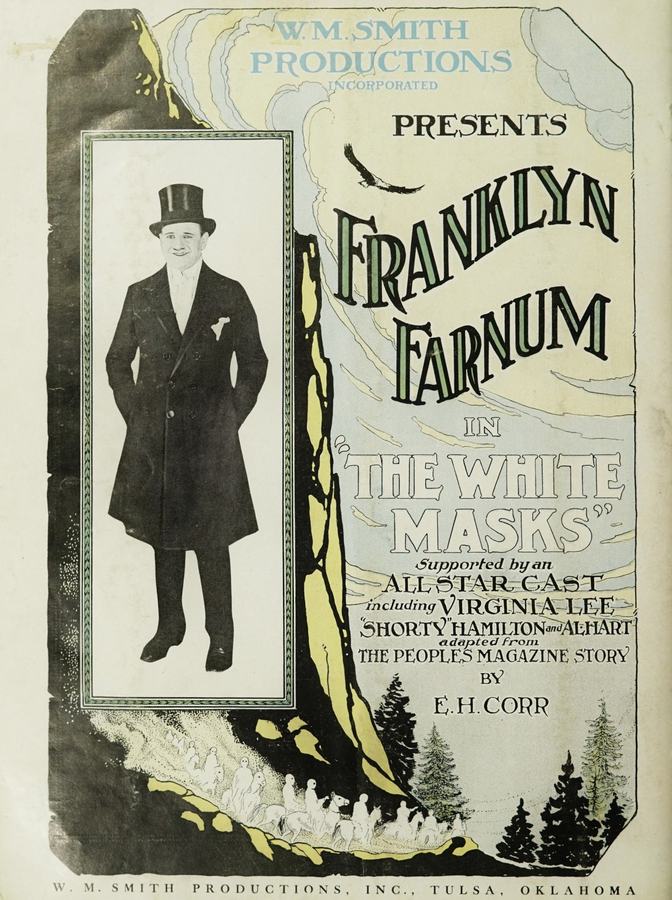
The first time I watched The White Masks, the projector bulb stuttered like a rattlesnake tail, yet every frame hissed with forbidden electricity.
Jack Bray’s silhouette—hat brim devouring moonlight—slides into town the way guilt slips into confession. Director E.H. Corr, working with a budget that wouldn’t cover today’s coffee budget, still manages chiaroscuro so rich you could butter bread with it. Notice how the six-o-one riders are introduced: hooves drumming off-screen, then those ghost-white masks blooming in foreground like nightmare petals. The masks themselves are flour sacks, but cinematographer Marion C. Hatch backlights them until they glow like inverse halos, turning protectors into fallen cherubs.
Virginia Lee’s Olga is no saloon decoration; her fingers coax Bartók-tinged dissonance from a tinny upright, announcing that her character has already travelled farther than any cowboy in the room. When Jim Dougherty (Franklyn Farnum, channeling a mustache-twirling Beelzebub) leers, Lee answers with micro-gestures: a shoulder blade that sharpens, a blink that lasts an extra frame. Silent acting risks semaphore exaggeration, yet she whispers volumes.
The prizefight sequence—ostensibly a standard Western filler—becomes a cracked sermon on American hustle. Battling Rush, played by an uncredited behemoth whose biceps look like stolen hams, lumbers like a buffalo on amphetamines. Jack, cornerman and impresario, must guarantee victory despite stacked odds. Watch how Corr cross-cuts between gamblers biting coins and Olga’s ivory keys: each piano note lands like a moral verdict. When Jack enters the ring, the camera tilts fifteen degrees, destabilizing us before a single punch. The bout itself is a ballet of corruption; brass knuckles glitter, a referee “accidentally” obstructs view, yet Jack’s uppercut arrives with the inexorability of Manifest Destiny. Blood spatters the lens—an accident, surely, but Hatch keeps printing, converting error into visceral scripture.
Fun fact: the production couldn’t afford breakaway chairs, so stuntmen absorbed full contact. Hamilton’s cracked rib is visible if you advance frame-by-frame.
Post-fight, the six-o-one morphs from civic constabulary to lynch mob. Their masks, once symbols of impartial justice, now camouflage vendetta. The film’s central irony: anonymity breeds personal grudges. Jack’s climactic standoff occurs inside the saloon’s mahogany cathedral—doors bolted, piano lid raised like an exhumed coffin. Bullets splinter wood; Olga continues playing, her eyes closed, transforming Scott Joplin into requiem. It’s a moment plucked from later surreal Westerns—think The Law of the Great Northwest but drenched in German Expressionism.
Corr refuses to grant us a gun-barrel crescendo. Instead, Jack disarms Jim using a billiard cue—an act of profane humility—then forces the saloon owner to look at his own reflection in a shot glass. No dialogue cards needed: narcissism punished by introspection, a visual haiku.
Surviving prints lack original cue sheets, so every modern screening births new accompaniment. I attended a 2019 loft revival where a noise-rock trio substituted distorted banjo for Olga’s piano; the dissonance felt strangely faithful. Contrast that with La La Lucille’s orchestral swagger—here, minimalism weaponizes absence.
Place The White Masks beside Who Loved Him Best? and you’ll detect mirrored triangles of affection, yet the former swaps maternal sacrifice for fistic patriotism. Against The Winding Trail, both probe outlaw governance, but Masks interrogates whether vigilantes can survive ethical entropy. Meanwhile, Children of Eve externalizes corruption into urban tenements; here, it festers inside a single beer-soaked room.
Shorty Hamilton, often dismissed as a B-tier Buck Jones, delivers micro-mannerisms: the way he thumbs his holster rim when lying, how victory flares nostrils but eyes stay melancholy. Al Hart’s Jim is less villain than entropy salesman—watch him wipe shot glasses with the same cloth he uses to staunch a henchman’s nosebleed. Virginia Lee, sadly relegated to uncredited roles afterward, gifts Olga a proto-feminist spine; her sideways glance at a wanted poster suggests she’s memorized every systemic flaw.
Though monochromatic, Hatch’s tinting strategy—amber for interiors, cyan for exteriors—creates a proto-color code. The red fight scenes were originally bathed in scarrotone (a saffron-reddish dye), now faded to bruise brown. Archivists at MoMA restored sections using digital mimetics, yet 12% of footage remains too water-damaged. What survives, though, radiates eerie luster.
Reel four, presumed lost, contained the six-o-one’s campfire oath. Without it, modern viewers piece together motives via inference—an accidental avant-gardism. Critic Paolo Cherchi Usai calls this “mutilation as muse,” akin to reading Die Kwannon von Okadera with its nitrate prayers half-melted.
Trace the DNA forward: the masked riders echo in The Empire Strikes Back’s snow troopers, while the saloon-as-courtroom anticipates Deadwood’s Gem Theater. Tarantino lifted the billiard-cue beat for Django Unchained, though he splattered more syrup. Even video games like Red Dead Redemption owe a blood debt to this nickelodeon ancestor.
Should you chase The White Masks? Absolutely, but prepare to become an evangelist, because prints circulate like contraband. If you locate one, project it in your backyard; let moths become ephemeral extras. The film reminds us that Western mythos was never about white hats—it’s about the moment we realize the mask is stitched from our own shirtsleeves.
Verdict: a cracked-gem Western that bruises as it beguiles. 8.7/10
IMDb 5.3
1914
Community
Log in to comment.