DbcultAccessing Vault...
Cult Review
Senior Film Conservator
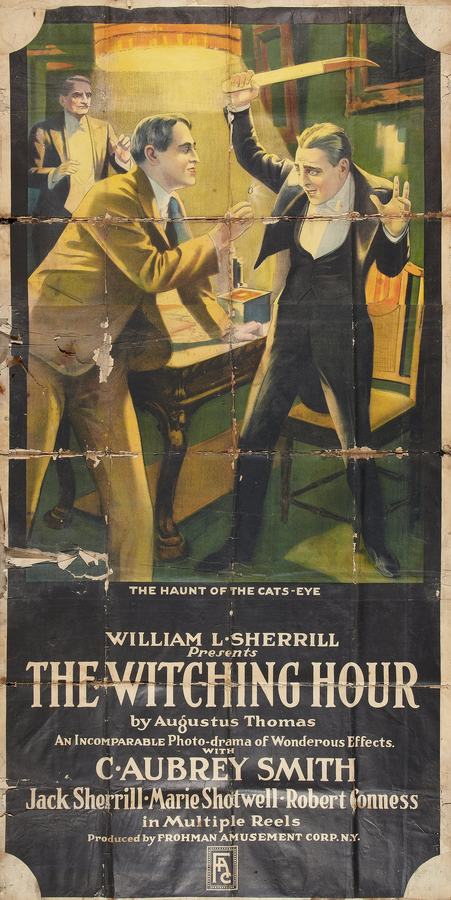
Louisville, 1921, smells of river fog and bourbon; into that hothouse wanders Jack Brookfield, gentleman shark, eyes like smoked glass, dealing fate with fingers that secretly read thoughts faster than a priest reads last rites.
Picture a gambling house paneled in mahogany so dark it drinks candlelight—here every heartbeat is currency, every glance a promissory note on tomorrow. Brookfield glides between tables, not merely calculating odds but inhaling them, metabolizing the neural static of players the way orchids absorb moonlight. The camera of 1921 cannot show you synapses, so director Frank Reicher resorts to double exposures: Brookfield’s profile superimposed over swirling cards, an iris-in that squeezes the frame until only his pupil remains—a black sun around which human will orbits.
Anthony Paul Kelly’s scenario, adapted from Augustus Thomas’s barnstorming play, treats clairvoyance less like parlor trick and more like original sin: a talent that estranges its holder from ordinary affection.
Enter Helen, regal in grief, her widow’s veil a bridal shroud in negative. Marie Shotwell plays her with the tremulous restraint of a woman who has buried not only a husband but the memory of demanding too much. When she asks young Jack for a written oath against cards, she is really begging him to amputate the most alive part of himself; his refusal feels, in Robert Conness’s eloquent stillness, like watching a heart cauterize itself. Cue temporal ellipsis—fade to years later, the same city, the same man crowned in notoriety, shuffling futures beneath chandeliers that drip like stalactites of ice.
Clay, her son, carries a fear so baroque it could have fluttered from Poe: a cat’s-eye opal turns him into a trembling marionette. The film literalizes phobia as pagan curse—every glint of that milk-and-onyx stone looms, in close-up, like a predatory moon. When Denning, a human carbuncle sporting the gem as stickpin, taunts Clay during the infamous supper-party sequence, the editing cadence fractures: shots of the pin, the boy’s dilating iris, the tusk-shaped paper-knife, all intercut like staccato heartbeats. The murder, when it erupts, feels preordained yet shocking, a pagan sacrifice staged amid oyster shells and champagne flutes.
Trial sequences in silent cinema too often devolve into rhetoric pantomime; here, the intertitles are mercifully sparse, letting C. Aubrey Smith’s granite-jawed Justice Prentice dominate the frame, every gesture of his gavel a metronome of moral reckoning.
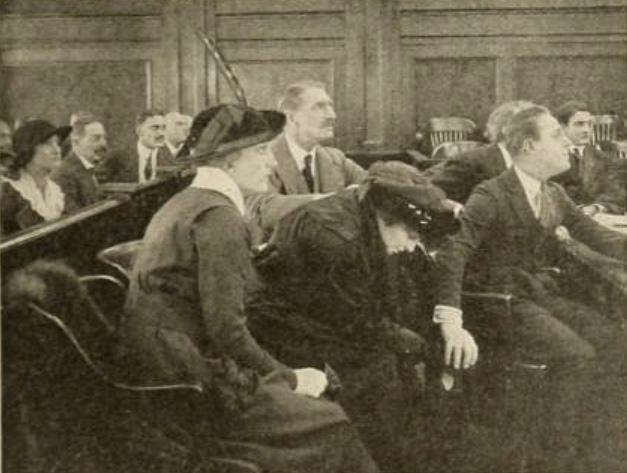
But the film’s true engine is Brookfield’s telepathic jury-fix, a conceit both preposterous and eerily prescient in an age of neuromarketing. Imagine thought-waves as pale blue ribbons emanating from the gambler’s temples, braiding themselves into a juror’s cortex—Reicher visualizes this with triple-exposed spirals that anticipate the psychedelia of 1960s title sequences. The moral implication is thorny: if justice can be incepted, is it still justice, or merely another wager won by the house?
Hardmuth, the prosecutor, is the noir shadow of American ambition: a climber willing to pistol a governor, then weaponize a boy’s death for electoral gain. Lewis Sealy plays him with the oleaginous charm of a tent-revival huckster, eyes flicking left-right like a metronome counting cadavers. His rivalry with Clay for Viola’s affection refracts the older generational rupture: both men covet purity, both are stained—one by fear, one by opportunism—while Brookfield floats above like a fallen angel who can count sin on an abacus.
Resolution arrives not through divine thunderbolt but through confession extracted via mesmeric coercion: Brookfield, guilt-riddled over his own thought-transmitted murder-blueprint, hypnotizes Raynor in a sequence lit like a Caravaggio—faces half-drowned in chiaroscuro, guilt blooming like black petunias across the gambler’s cheekbones. Newspapers spill ink, public sentiment pivots, and the jury acquits Clay—a testament to the silent-era faith that collective consciousness can be re-tuned by a headline scream.
The final confrontation with the cat’s-eye pin—Clay compelled to grip the talisman until terror evaporates—plays as primitive exposure therapy, yet carries uncanny emotional wallop; the boy’s tremor subsides into a smile so tentative it feels like sunrise on a battlefield.
Brookfield’s renunciation of gambling lands less as moralistic sop and more as exhaustion: after bending reality with thought, mere cards seem trifling. When Helen accepts his word, the film seals its most subversive thesis—that love, not penitence, is the only wager worth staking everything on.
Robert Conness exudes the louche magnetism of John Barrymore minus the declamatory flourish; his smallest finger-twitch on green felt speaks volumes. Watch the way he pockets winnings—slow, almost apologetic, like a mortician buttoning a corpse’s jacket. Marie Shotwell’s Helen is regal sorrow incarnate; her eyes glisten even when dry, achieving that silent-film miracle of weeping without tears. C. Aubrey Smith, decades before becoming Hollywood’s archetypal colonel, here gives us a jurist carved from basalt—every line reading (via intertitle) lands like Moses etching tablets.
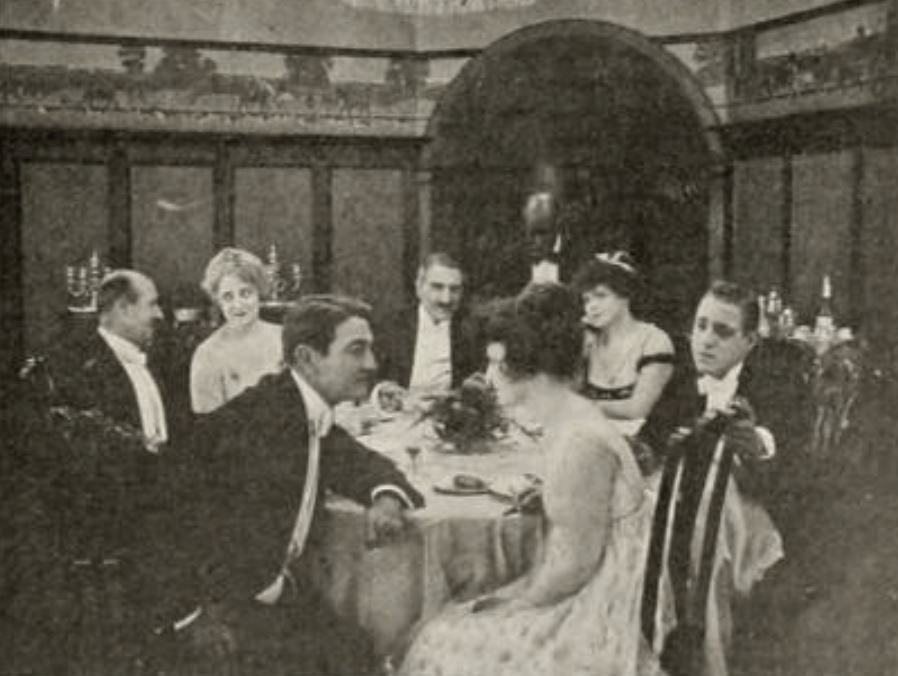
Cinematographer Hal Young shoots Louisville as borderland between antebellum ghosts and jazz-age electricity—gaslamps flicker while motorcars honk, creating temporal dissonance that mirrors Brookfield’s schizoid gift. The gambling palace interiors brim with grotesque bric-à-brac: stuffed jungle cats, Hindu idols, a barometer shaped like a skull—each object a talismanic echo of the cat’s-eye curse.
At its core, The Witching Hour is a meditation on influence: romantic, forensic, metaphysical. Every character attempts to colonize another’s will—Helen wants to edit Jack’s destiny; Hardmuth wants to script the electorate’s; Brookfield wants to re-write juror neurons. The film anticipates both Freudian superego and Bernaysian propaganda, suggesting America itself is a vast poker table where the house always deals marked cards unless conscience learns to shuffle back.
The hereditary phobia subplot—quasi-Lamarckian dread transmitted like tarnished silverware—feels straight from gothic literature, yet it doubles as metaphor for generational trauma: how sins calcify into reflex, how the mere image of past evil can trigger present violence.
Devotees of The Spirit of the Poppy will recognize the same opiated fatalism, though Witching Hour substitutes morphine with telepathy. Fans of The Black Chancellor will note parallel courtroom machinations, yet here jurisprudence is bent not by bribery but brainwaves. And if Nell Gwynne seduced viewers with Restoration bawdiness, this film seduces through Victorian uncanny—both are pageants of power brokered across green felt or royal boudoir.
Clocking in at roughly seventy-five minutes, The Witching Hour feels both compact and bottomless—a top-hat from which the subconscious keeps pulling rabbits. Its gender politics are dated, its racial homogeneity typical of 1921 prestige pictures, yet its inquiry into thought-as-weapon remains chillingly contemporary. Long before Inception spun dreidels inside skulls, this silent relic asked whether an idea, once planted, ever truly belongs to us again.
Seek it out in the twilight hush between thunderclap and rainfall; let the flickering nitrate whisper across your living-room wall. And when the cat’s-eye pin finally fills the screen, ask yourself which of your own fears gleam back—hereditary, media-borne, or self-inflicted—and whether you, like Clay, could grip them unflinching until they dissolve into mere glass.

IMDb 5.6
1934
Community
Log in to comment.