DbcultAccessing Vault...
6/10
Senior Film Conservator
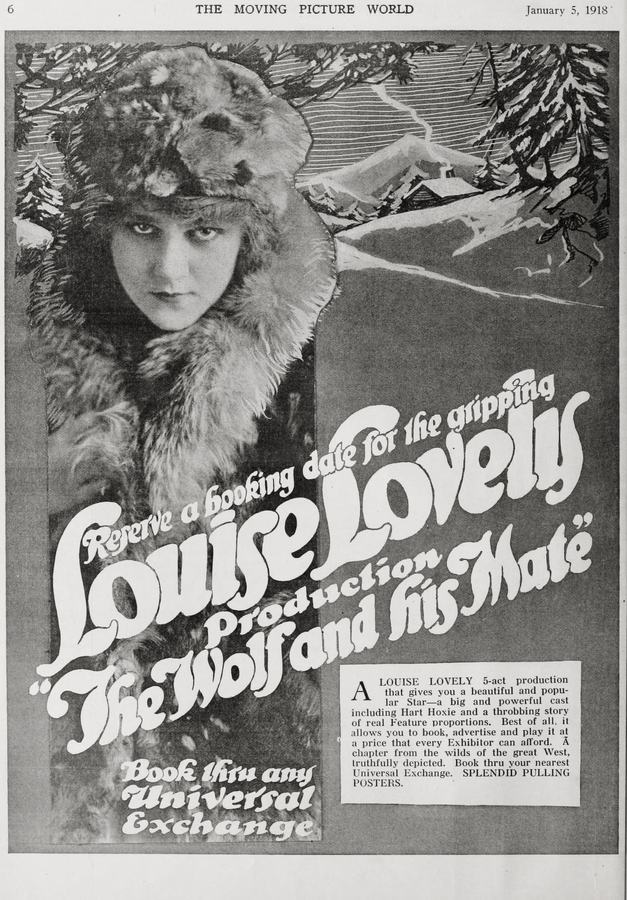
A definitive 6/10 rating for a film that redefined the boundaries of cult cinema. The Wolf and His Mate remains a cornerstone of transgressive art.
The Wolf and His Mate is a film that thrives in the shadows of its own contradictions. It is a story of violence that becomes a hymn to redemption, of isolation that births an unexpected kinship, and of a man whose ferocity is both his curse and his salvation. Set against the brooding majesty of the northern wilderness, the film’s narrative is as much about the land it portrays as it is about the souls who battle within its borders. Donald Bayne, the titular Wolf, is a figure carved from the same granite as the mountains he treads—a man whose pride and fury are as formidable as the natural world he inhabits. Yet, within this hardened exterior flickers a vulnerability that the film teases with rare subtlety, particularly in the silent moments between him and Bess Nolan, whose quiet strength becomes his reluctant anchor.
The film’s opening sequence is a masterstroke of visual storytelling. Bayne, stripped of his cabin after a botched legal dispute, erupts in a fit of rage that would make even the most stoic viewer flinch. His physicality is raw, almost feral, as he confronts Steve Nolan, the man who now owns his home. Yet, this is not a man driven by mere spite; it is a primal assertion of ownership, a refusal to let the world erase his legacy. When Nolan’s tragic death leaves his niece Bess to inherit the cabin, Bayne’s initial reaction is to camp outside her door like a sentry from a forgotten age. This act, though ostensibly one of dominance, is layered with irony—he becomes both guardian and intruder, a status that the town’s judgmental whispers only deepen.
The central dynamic between Bayne and Bess is handled with the delicacy of a scalpel. Their marriage, forced by social convention rather than desire, is a taut thread stretched across the film’s second act. Betty Schade’s portrayal of Bess is a revelation—her eyes, often downcast, carry the weight of a woman who has learned to navigate a world that sees her as fragile yet expects her to be unyielding. Meanwhile, Hector Dion’s Bayne is a study in contradictions: his towering frame and thunderous presence belie a character who is, at his core, a man in search of absolution. Their interactions are stilted at first, underscored by the tension of unspoken grievances, but gradually evolve into a shared understanding born of necessity. The cabin, once a symbol of Bayne’s loss, becomes a crucible where their mutual respect is forged.
What elevates The Wolf and His Mate beyond a mere melodrama is its unflinching exploration of the consequences of honor. When Bess’s sister and “Snaky” Burns abduct Rose, the narrative pivots into a high-stakes rescue mission that strips Bayne of any pretense of detachment. The sequence in which he infiltrates the criminals’ hideout is a tour de force of kinetic cinematography. Shadows play across his face as he moves with a predator’s precision, yet the film never lets us forget that he is also a man haunted by his own past. The rescue itself is not a triumphant march but a desperate, almost fumbling act of love—a stark contrast to the mythic “hero” Bayne has been cast as in the town’s eyes.
The film’s denouement is as unconventional as it is poignant. Unlike the tidy resolutions of many silent-era films, The Wolf and His Mate leaves its characters in a state of quiet transformation. Bess’s acceptance of Bayne is not a romantic epiphany but a pragmatic acknowledgment of the man he has become. Their final exchange, conveyed through a series of glances and a single, trembling hand clasping another, speaks volumes about the unspoken bond they have forged. It is a conclusion that feels earned, neither saccharine nor cynical, but deeply human.
Cinematographically, the film is a feast for the eyes. The use of natural light in the forest scenes is nothing short of breathtaking, with dappled sunlight filtering through the trees to create a chiaroscuro effect that mirrors the moral ambiguity of the characters. The score, though minimal, swells at key moments with a mournful, almost operatic quality that echoes the grandeur of the setting. One particular scene—a close-up of Bayne’s weathered face as he watches Rose play in the snow—is a testament to the power of silent film to convey emotion without a single line of dialogue.
Comparisons to other silent-era works are inevitable. The film’s themes of honor and redemption echo those of Madame Butterfly, though The Wolf and His Mate diverges by grounding its narrative in the rugged North rather than the exotic East. Likewise, the courtroom drama that opens the film bears the DNA of The Finger of Justice, yet it avoids the latter’s didacticism by focusing on the personal rather than the political. What sets The Wolf and His Mate apart is its refusal to romanticize its protagonist. Bayne is no noble savage; he is a man flawed and fallible, and it is precisely this humanity that makes his journey resonate.
In the pantheon of silent films, The Wolf and His Mate holds a unique place. It is a work that challenges the notion that the absence of sound weakens storytelling—here, every glance, every gesture, and every sweeping landscape is a note in a symphony of emotion. The performances, particularly Dion and Schade’s, are so nuanced that they transcend the era’s limitations, offering a window into the souls of characters who might otherwise be reduced to archetypes. The film’s enduring power lies in its ability to balance the grandeur of its setting with the intimate struggles of its characters, creating a narrative that is both epic and deeply personal.
For modern audiences, The Wolf and His Mate is a reminder of the silent film’s capacity to convey complex emotions through visual storytelling. It is a film that rewards attention to detail—subtle shifts in expression, the way the wind tugs at a character’s coat, the fleeting glances that hint at unspoken histories. While some may find its pacing deliberate to the point of austerity, this measured approach only enhances the tension, allowing the audience to breathe in the same cold, crisp air as the characters. It is a film that demands to be felt, not just watched.
In conclusion, The Wolf and His Mate is a masterclass in silent cinema, a work that marries the rugged beauty of its setting with the raw humanity of its characters. It is a film that lingers, not for its plot twists but for the quiet moments that speak volumes about the resilience of the human spirit. For those who dare to look beyond the surface, it offers a profound meditation on the cost of pride and the redemptive power of compassion. A true gem of the silent era, it deserves a place in any cinephile’s collection.
IMDb —
1925
Community
Log in to comment.