DbcultAccessing Vault...
Cult Review
Senior Film Conservator
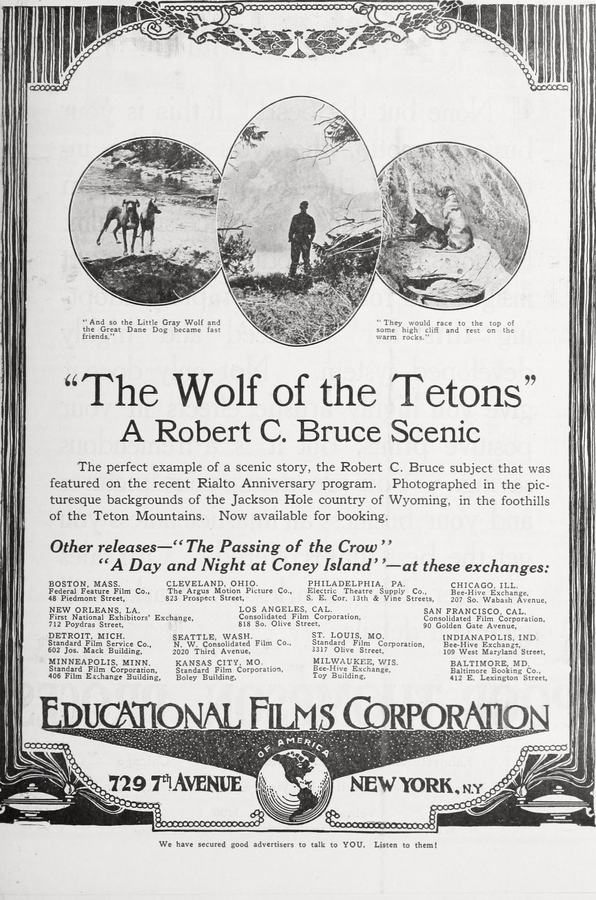
There are films that merely tell a story, and then there are those that etch themselves onto the very fabric of one’s cinematic consciousness, becoming not just a narrative but an experience. Robert C. Bruce’s 'The Wolf of the Tetons' undeniably belongs to the latter category. From its opening frames, capturing the formidable grandeur of the titular mountain range, it establishes an atmosphere of rugged authenticity that few productions, then or now, have managed to replicate with such conviction. Bruce, a true auteur in the burgeoning landscape of early cinema, not only penned the tale but also embodied its central, enigmatic figure, Elias Thorne, delivering a performance that is as much a force of nature as the landscapes he traverses.
The film plunges us headfirst into the isolated existence of Thorne, a man whose profound symbiotic relationship with the wilderness has earned him the sobriquet, 'The Wolf.' He moves through the Tetons with a primal grace, a silent sentinel of a world untouched by the clamor of encroaching civilization. This initial tranquility, however, is merely the calm before a storm of industrial avarice. The arrival of Silas Blackwood, a ruthless mining magnate, shatters the pristine serenity, introducing a conflict that is as old as humanity itself: man versus nature, progress versus preservation, greed versus integrity. Blackwood’s ambition, fueled by an insatiable desire for the Tetons' hidden riches, sets in motion a chain of events that threatens to obliterate not just Elias’s solitary peace, but the very essence of the wilderness he holds sacred. The film masterfully builds this tension, allowing the audience to feel the slow creep of dread as Blackwood’s machinery grinds closer, a metallic beast threatening to devour the organic heart of the mountains. This thematic resonance, the struggle against overwhelming odds, echoes the spirit found in films like The Debt, though here, the debt is owed not to man, but to the land itself.
What truly elevates 'The Wolf of the Tetons' beyond a simple adventure story is Bruce’s nuanced portrayal of Elias Thorne. He is not merely a hero in the conventional sense, but a complex, almost feral figure, whose connection to the wild is both his strength and his vulnerability. His silence speaks volumes, his eyes conveying a depth of understanding and a quiet defiance that words could never capture. When Blackwood’s men, desperate to remove any obstacles to their plunder, frame Elias for a series of destructive acts, the transformation of 'The Wolf' from a reclusive guardian to a hunted avenger is both compelling and inevitable. Bruce’s performance here is a marvel of physical acting, every movement deliberate, every expression laden with unspoken emotion. He embodies the spirit of resistance, an embodiment of the mountains themselves fighting back against desecration. The film’s exploration of justice, or the lack thereof, in the face of unchecked power, might draw comparisons to the moral quandaries presented in The Weakness of Man, but Bruce’s narrative feels more viscerally connected to the very earth beneath its characters' feet.
The cinematography, even by today's standards, remains breathtaking. Bruce, clearly a visionary, understood the power of the landscape as a character in itself. The Tetons are not merely a backdrop; they are an active participant in the drama. Wide shots of snow-capped peaks, deep canyons, and winding rivers imbue the film with an epic scope, emphasizing the insignificance of human conflict against the backdrop of nature’s eternal majesty. The chase sequences, particularly, are a masterclass in spatial awareness and tension building. Elias, moving with the fluidity of a true mountain man, uses the treacherous terrain to his advantage, blurring the lines between predator and prey. These scenes are shot with a raw energy that is palpable, placing the viewer right alongside Elias as he navigates precipitous cliffs and icy rivers. The visual storytelling here is so potent that it transcends the limitations of its era, speaking a universal language of struggle and survival. One might recall the raw, untamed spirit of films like It's a Bear, but 'The Wolf of the Tetons' elevates the natural world to an almost spiritual plane.
Bruce's dual role as writer and lead actor provides a unique cohesion to the film. His writing is lean, muscular, and devoid of unnecessary exposition, allowing the visuals and the actions of the characters to carry the narrative weight. This economy of storytelling is a testament to his understanding of the cinematic medium. He crafts a world where every gesture, every silent glance, holds significance. The antagonist, Silas Blackwood, though perhaps a less developed character than Elias, serves as an effective foil, embodying the destructive force of unchecked capitalism. His urbanity, his detachment from the land, stands in stark contrast to Elias’s primal connection, highlighting the central thematic conflict with unflinching clarity. The narrative arc, while seemingly straightforward on the surface, delves into deeper philosophical questions about man’s place in the natural order and the price of progress. It’s a thematic depth that resonates with the contemplative nature seen in a film such as Mutter Erde, though with a distinctly American frontier spirit.
The film’s climax is a visceral, emotionally charged confrontation that brings the central conflict to a head. Elias, cornered but unbowed, makes his final stand, not just for himself, but for the very soul of the Tetons. It’s a sequence that avoids easy answers, instead opting for a resolution that feels earned and impactful, leaving a lingering sense of both triumph and melancholy. The legacy of 'The Wolf of the Tetons' is undeniable. It cemented Robert C. Bruce’s status as a formidable talent, an artist capable of weaving grand narratives with intimate human drama. His vision of the American West is one of both breathtaking beauty and brutal realism, a far cry from the sanitized portrayals often found in contemporary films of its time. It’s a film that speaks to the enduring power of the individual against overwhelming odds, a theme that continues to captivate audiences and finds echoes in later works like Lone Star.
Beyond its narrative and performances, 'The Wolf of the Tetons' is a masterclass in using setting to drive emotion and plot. The isolation of Elias, mirrored by the vastness of the mountains, creates a profound sense of solitude that makes his eventual fight for justice all the more poignant. The sounds of the wilderness – the howling wind, the rushing rivers, the distant cries of animals – are woven into the fabric of the film, enhancing its immersive quality. Even without the full technological arsenal of modern filmmaking, Bruce manages to create a soundscape that is both evocative and essential to the storytelling. This attention to detail, this understanding of how every element contributes to the whole, is what truly sets Bruce apart as a filmmaker. His command over the visual and thematic elements is reminiscent of the disciplined storytelling seen in films like The Race, but with a grandeur unique to the frontier.
The film also subtly critiques the very notion of 'progress' when it comes at the expense of natural harmony. Blackwood’s operations are portrayed not as innovation, but as a destructive force, a scar on the pristine face of the earth. Elias Thorne, 'The Wolf,' becomes a symbol of resistance, a champion for the voiceless wilderness. His struggle is a metaphor for the larger battle between humanity’s destructive impulses and its capacity for stewardship. This environmental consciousness, perhaps ahead of its time, gives the film an unexpected contemporary relevance. It’s a powerful reminder that some things are worth fighting for, even against seemingly insurmountable odds. The raw, untamed spirit of the protagonist, often misunderstood and feared, mirrors the plight of the wilderness itself, making the title resonate on multiple levels. This nuanced portrayal of a character on the fringes of society, fighting for a cause greater than himself, brings to mind the complex heroes in The Outlaw and His Wife, though Elias is driven by protection rather than escape.
In an era when many films relied on theatricality and exaggerated performances, Bruce’s approach in 'The Wolf of the Tetons' is remarkably restrained and naturalistic. His portrayal of Elias is understated, allowing the audience to project their own understanding onto his taciturn demeanor. This subtlety is a significant factor in the film’s enduring appeal, allowing it to transcend the period in which it was made. It doesn't rely on cheap thrills or melodramatic flourishes; instead, it draws its power from the inherent drama of its setting and the authenticity of its central character. The film’s pacing, deliberate and unhurried at times, then surging with adrenaline during the pursuit sequences, reflects the rhythms of the wilderness itself. It breathes with the landscape, making the audience feel every chill wind and every arduous climb. This organic flow is a hallmark of truly great filmmaking, distinguishing it from more formulaic productions like Flips and Flops.
Ultimately, 'The Wolf of the Tetons' is more than just a Western or an adventure film; it is a profound meditation on identity, belonging, and the indomitable spirit of both man and nature. Robert C. Bruce, as both writer and performer, crafts a singular vision, a cinematic poem to the wild heart of America. It leaves an indelible mark, reminding us of the delicate balance that exists between progress and preservation, and the courage it takes to stand as a guardian of the natural world. It is a film that demands to be seen, not just appreciated for its historical significance, but revered for its timeless artistry and its potent message. Its depiction of a character fighting for his home and his way of life resonates with the fierce independence seen in Jim Grimsby's Boy, yet here, the 'home' is an entire mountain range, and the 'life' is a philosophy of coexistence.
The enduring power of 'The Wolf of the Tetons' lies in its refusal to simplify complex issues. It presents a world where morality is often gray, and survival is a constant, brutal struggle. Elias Thorne, the 'Wolf,' is not an idealized hero but a man shaped by his environment, driven by instinct and a deep-seated sense of justice. His story is a testament to resilience, a powerful narrative about finding one's strength in adversity and standing firm against the tides of change. This film is an essential piece of cinematic history, a work that continues to inspire and provoke thought, solidifying its place as a classic that transcends its genre. It’s a compelling argument for the preservation of wild spaces and the wild spirit within us all, a narrative as enduring as the mountains themselves. Its stark portrayal of conflict and survival could even be seen as a precursor to the intense character studies found in films like Chains of the Past, but with a uniquely rugged, frontier sensibility that makes it stand alone in its powerful evocation of the American wilderness.

IMDb —
1920
Community
Log in to comment.