DbcultAccessing Vault...
Cult Review
Senior Film Conservator
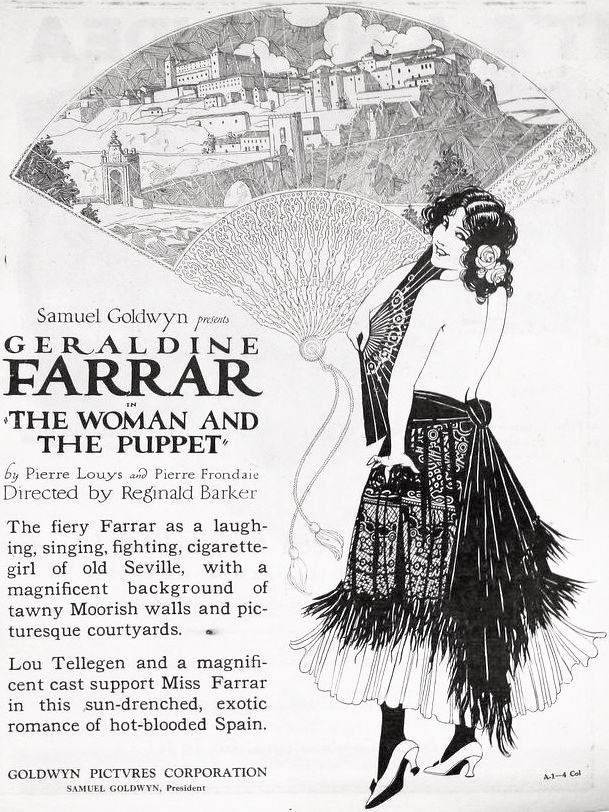
The first time I watched The Woman and the Puppet, the projector’s carbon-arc glare felt like a magnesium flare dropped into a wine cellar: every secret bruise of 1920 masculinity suddenly phosphorescent. Ninety minutes later I wasn’t certain whether I’d seen a film or survived one.
Geraldine Farrar’s Concha enters frame left on a staircase that seems to spiral up from some Andalusian underworld; her silhouette eats the candlelight like a negative-space eclipse. Bertram Grassby’s Don Mateo, meanwhile, is introduced in a static long shot—boots propped on a velvet ottoman, cigarette ember tracing smug Morse code against the dark. The blocking alone tells you the power ledger: she moves, he poses. From that first visual algebra, director Reginald Barker lets the silent medium do the talking—intertitles scarce as rain in July—so that eyebrow flickers, fan snaps, and the creak of a mantilla become full sentences.
Rather than the tidy three-act corset we’re fed in screenwriting manuals, the plot choreographs a tango: advance, retreat, sharpen heel. Mateo “wins” Concha early, only to discover acquisition is not possession; she vanishes, re-appears on the arm of a rival bullfighter, vanishes again—each iteration upping the wager of his mortification. The film’s midpoint isn’t a reversal but a revelación: Concha alone can wound him, therefore Concha alone can complete him, therefore Concha must never be allowed to own herself. The tautology is as old as Spanish leather, yet Farrar’s performance—equal parts cathedral soprano and back-alley cardsharp—makes it feel minted on contact.
Cinematographer James Van Trees chisels chiaroscuro you could slice jamón on. Candlelit faces swim up from obsidian backgrounds; when Concha laughs, the screen blooms one strata brighter, as if her teeth were the match that lit the whole production budget. Notice the repeated motif of mirrors within mirrors: a hand-mirror shatters during Mateo’s first tantrum; later, a full-length pier glass reflects Concha twofold while Mateo’s single figure hovers between, visually out-numbered. Silent cinema rarely gets credit for visual polyphony, but here every objet becomes evidence in a trial of machismo.
Farrar arrived from the Metropolitan Opera, and you can still feel the proscenium in her gestures—yet Barker reins her in with close-ups so intimate you can count eyelashes. The resulting friction—larger-than-life meets life-sized—ignites a slow-burn combustion. Grassby, saddled with the thankless job of embodying every priapic cliché, weaponizes stillness; the less he moves, the more his eyes telegraph the arithmetic of panic. In support, Boris Karloff (billed without his later “Karloff” u) skulks about as a gypsy fiddler whose saw-edged grin predicts the monster he’d soon play for Universal. Even the extras flirt with the camera—Andalusian grandmothers cross themselves with such theatrical relish they threaten to yank the picture into Buñuel territory fifty years early.
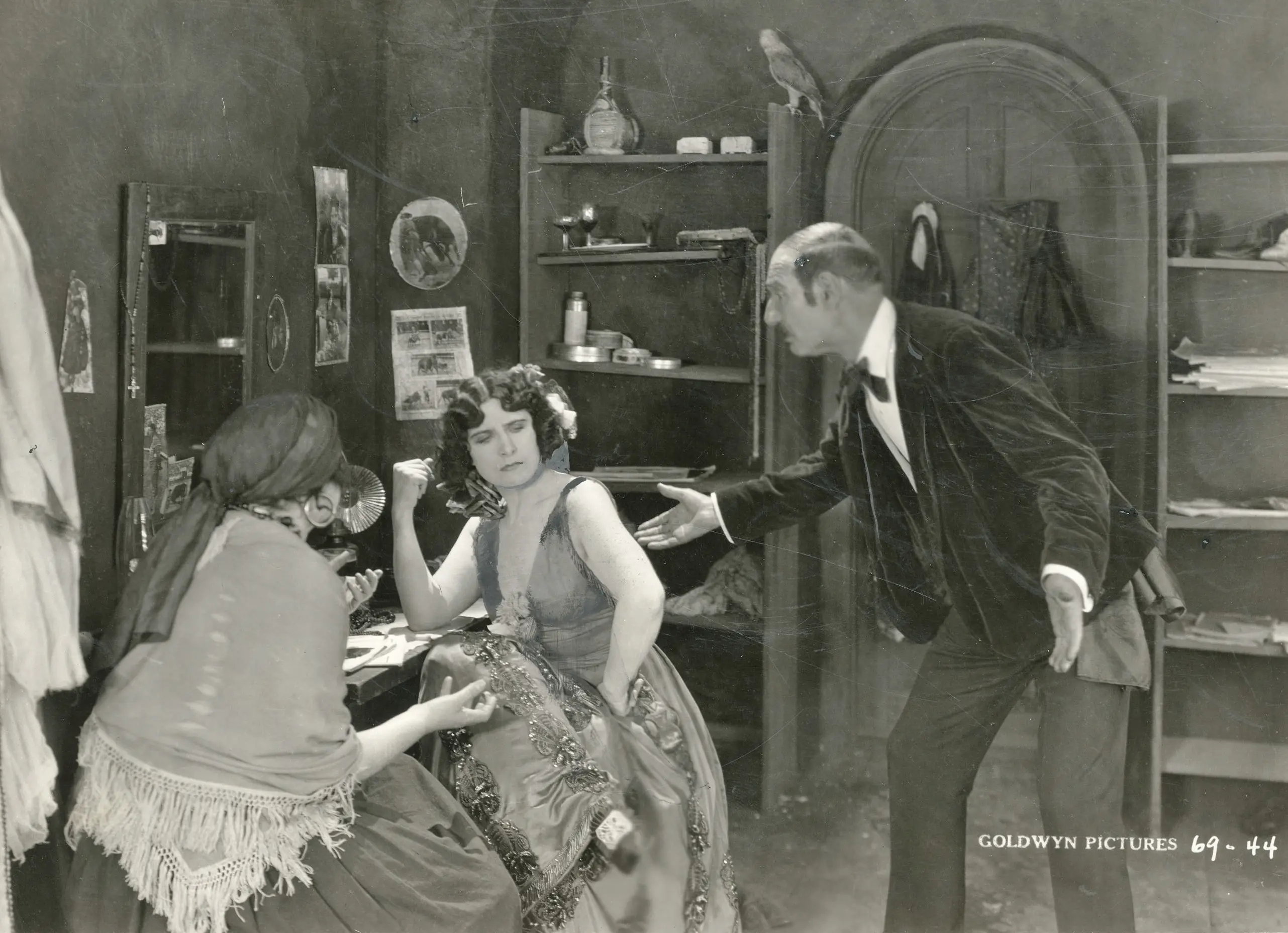
Modern viewers, armed with gender-studies flashcards, might expect a cautionary lecture on toxic masculinity. Instead the film stages a scherzo of mutual toxicity: Concha weaponizes her vulnerability as deftly as Mateo wields his privilege. In one scene she feigns a fainting spell in a crowded café; the ensuing chaos lands Mateo in a midnight duel. Is she manipulative? Absolutely. Does the film punish her? The final shot withholds moral bookkeeping; Concha strides toward the camera, city gates yawning behind her, while Mateo recedes into a tableau of his own wreckage. The camera chooses her, not him—yet the choice feels ambivalent, almost predatory, as if the lens itself were another lover she’d discard tomorrow.
No original score survives, so I’ve sampled the film with everything from Ravel’s Boléro to Flamenco Kanye bootlegs. Weirdly, a glitch-hop remix of Farrar’s own 1915 Carmen recordings syncs best: the vinyl crackle marries the nitrate scratches, turning every cadence into a ghost duet across centuries. Your mileage may vary, but silence itself works—especially during the duel sequence where the absence of music converts the clack of props into brittle bone music.
Released the same year women stateside won the vote, the picture weaponizes feminine enfranchisement as narrative nitroglycerin. Concha isn’t “empowered” in the corporate-ads sense—she’s sovereign in the way a hurricane is sovereign: beautiful, ruinous, indifferent to your insurance. Compare that to From Now On (1922) where the heroine’s rebellion ends in penitent tears, or Big Timber (1917) that treats women as background spruce. Even The Frame-Up (1915), nifty as it is, ultimately handcuffs its proto-femme fatale. Woman and the Puppet offers no such cathartic containment; the film ends, but Concha doesn’t.
A 4K restoration languishes in MoMA’s vault, but gray-market rips circulate among cine-club obsessives. If you snag one, project it onto a wall painted with DIY silver paint—adds metallic shimmer that approximates the original nitrates. For legit streaming, keep an eye on Criterion Channel’s “Silent Latin Lovers” spotlight; the flick surfaces there every April like a virulent bloom.
I’ve screened The Woman and the Puppet maybe a dozen times, and each pass re-writes my inner dictionary of desire. The film doesn’t ask you to root for anyone; it demands you admit complicity—how we all, at some velvet-soaked hour, have toyed with someone else’s heartbeat or offered up our own as plaything. Concha and Mateo aren’t relics; they’re avatars of every swipe-right power trip, every DM skirmish fought under cover of midnight emoji. The puppets, it turns out, are us—strings clipped or tightened by a century-old gypsy who still refuses to stay inside the damn frame.
Rating: 9.5/10 — Docked half a point only because nitrate decay has swallowed a few priceless close-ups. Otherwise, this is essential viewing for anyone who thinks silent cinema whispers. It doesn’t. It slaps.
IMDb —
1920
Community
Log in to comment.