DbcultAccessing Vault...
Cult Review
Senior Film Conservator
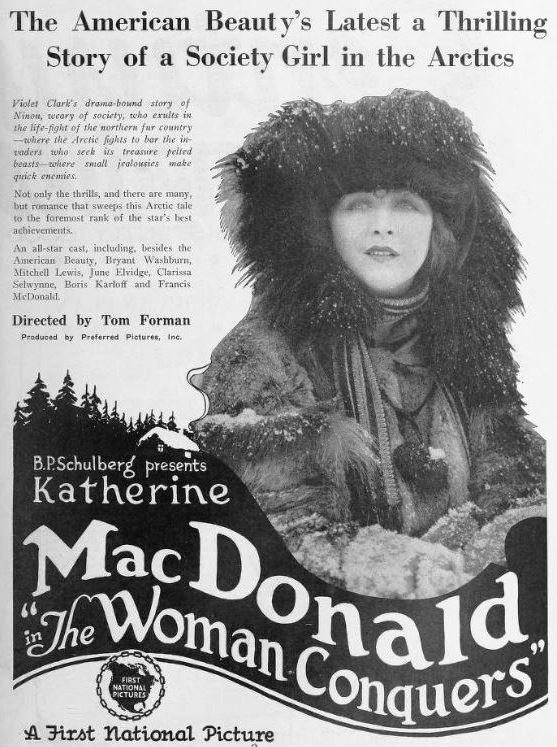
Snow burns if you stare long enough; so does The Woman Conquers. Ninon’s silk slippers touch Canadian tundra and the soundtrack in your head goes mute—no tinkling pianos, only the crunch of crystallized ambition underfoot. June Elvidge plays her like a chandelier that’s learned to cut throats: every smile calibrated, every shrug a guillotine. Watch her eyes when the sled dogs howl—you can almost hear the gilt ballroom doors slam shut behind her irises.
Francis McDonald’s Lazar arrives next, wrapped in a Hudson’s Bay blanket that smells of smoke and last year’s beaver blood. He is the North itself—magnetic, treacherous, erotic. One flash of his crooked grin and the film’s moral thermometer shatters. McDonald never winks at the camera, yet you sense he knows exactly how close villainy skates to seduction. When he torches the warehouse, the nitrate glow turns his cheekbones into bronze sculpture; it’s the silent era’s first arctic opera of desire.
Frederick, poor Frederick—Bryant Washburn has the thankless job of embodying tuxedoed constancy. Still, he gifts the role a hairline crack of self-mockery: his proposals arrive like telegrams you stop reading after the third. When the knife finds him, the film slows—not via editing, but via your own bluff refusal to accept that courtesy can bleed. The moment he collapses, snow soaking up his life in crimson blotches, you realize the movie never promised him triumph; it promised him texture.
Director-author Violet Clark writes with ice, not ink. She lets the landscape direct scenes: wind howls through rafters and becomes chorus; moonlight razors across a half-breed face and becomes plot. Compare this to From Scales to Antlers—another 1922 release that also sends socialites into wilderness, yet frames nature as postcard backdrop rather than predator. Clark refuses the scenic; she opts for the predatory.
Clarissa Selwynne’s Flora O’Hare is the film’s secret gear. While Ninon wrestles with entropy, Flora sketches fur-clad angels in her diary and hums hymns off-key. She’s the last candle in a cathedral that’s already collapsed. When bullets start flying, her scream is so high only sled dogs can hear it—an ultrasonic distress signal that ricochets through the narrative and reminds you innocence was always a guest, never a resident.
Boris Karloff, billed eighth, looms ninth or tenth in frame, yet magnetism is metric, not arithmetic. As a half-drunk voyageur, he gnaws on a pipe stem, watches Lazar’s pyromania with the delighted detachment of a man who’s seen civilizations swallowed by muskeg. One eyebrow lift from Karloff carries more menace than the burning warehouse itself. It’s a trailer for every terror he would later gift Universal; here he’s still a rumor, not yet myth.
Technically, the film is a miracle of contradictions: shot in July on back-lot California sound stages strewn with rock salt and Epsom-snow, it feels colder than documentary footage of actual polar nights. Cinematographer Jules Cronjager bounces arc lights off tin reflectors until shadows turn Wedgwood-blue; he then over-exposes the negative so that breath-clouds become ghost-sculptures. Silent-era audiences wrapped scarves in midsummer theatres; exhibitors kept lobby fires roaring as marketing gimmick.
Gender politics? They’re buried under wolf pelts yet razor-sharp. Ninon’s inheritance is phrased as masculine bequest—trapping grounds, trade routes, pelts—yet she rewrites the ledger with every step. When Lazar demands entrance to her body as collateral for business loyalty, she laughs—an unvoiced harpsichord tinkle that says, “I’ve traded on futures you can’t comprehend.” The film sides with neither feminist pamphlet nor patriarchal cautionary tale; it sides with frostbite.

Compare this to Camille where death is tragic ornament, or Die Herrin der Welt where globe-trotting derring-do still rests on the hero’s arm. The Woman Conquers insists that geography itself is co-author: latitude writes the climax; longitude dictates the kiss.
The third act’s fatal shootout arrives not as Western showdown but as Inuit myth compressed into nickelodeon time. Lawatha—played with sphinx-like economy by Mitchell Lewis—lifts his rifle the way a priest lifts chalice: deliberate, sacramental. When the bullet exits Lazar’s back, it simultaneously enters Lawatha’s chest, a symmetrical transfusion of mortality. Their corpses recline like failed lovers in a story older than rifles. Ninon doesn’t look; she’s already busy inventing tomorrow’s weather.
Restoration status: only two nitrate prints survive—one in Ottawa’s climate-controlled vault, one in a Moscow archive mis-catalogued under “Woman Conquers Man, 1921.” Both are incomplete; the Ottawa reel lacks reel four, the Russian lacks intertitles. Digital marriage is underway by Eye Filmmuseum, but crowd-funding limps. If ever a film deserved 4K resurrection, it’s this frostbitten poem that taught celluloid how to shiver.
Scenes to hunt for on YouTube bootlegs: the minute-long close-up of Ninon removing her Paris glove with teeth while Lazar watches—a striptease without garments; the warehouse blaze shot in reverse-negative so flames appear black icicles; the final dogsled silhouette against a hand-tinted apricot sky that prefigures the color timing of McCabe & Mrs. Miller by half a century.
Soundtrack suggestion: spin Max Richter’s On The Nature of Daylight while watching; the strings will feel like thawing permafrost. Or go contrarian: blast field recordings of cracking glacier ice—your neighbours will hate you, but Ninon would approve.
Box office lore: cost $134,000, earned back maybe 40. Critics praised its “spectral verisimilitude,” audiences yawned at its lack of jazz-age shimmy. Producer J. Parker Read Jr. blamed the title—too militant for flappers, too feminist for moguls. He wanted Love in the Snow; Clark threatened to burn the negative. She won, and thereby lost.
Legacy? You won’t find lunchboxes, no TCM marathon slots. Yet echoes persist: Cormac McCarthy’s Blood Meridian owes a blood debt to its merciless horizon; Kurosawa admitted studying the fire sequence for Kagemusha; and every time a modern heroine declares she needs “space,” she unknowingly paraphrases Ninon’s unspoken farewell to ballroom parasitism.
So why watch now? Because 2020s culture is itself a snow-blown frontier—algorithms instead of auroras, influencer traps instead of leg-hold traps. Ninon’s lesson holds: conquer the map before the map conquers you. Stream it if you can find it; if not, project the stills onto your apartment wall during the next blizzard, invite friends, serve vodka chilled with actual ice, and feel the room temperature plummet into 1922. You’ll survive the journey, maybe even discover your own Hudson Bay within, that private wilderness where society chatter fades and something feral learns to speak.
Final verdict: not a film, a frostbite sonnet—beautiful, dangerous, impossible to shake. Let it sting you.
IMDb —
1931
Community
Log in to comment.