DbcultAccessing Vault...
Cult Review
Senior Film Conservator
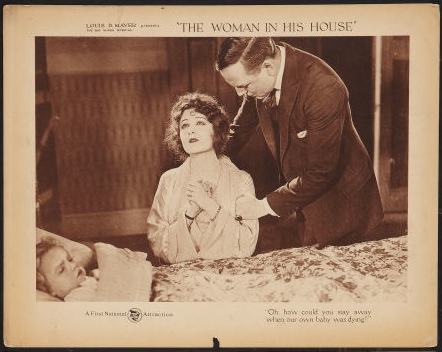
Moonlit nitrate flickers, and suddenly the room smells of brine and carbolic acid. The Woman in His House is that rare phantasm which makes the spectator conscious of odor, temperature, the very taste of grief. Shot through with a palette of bruised indigos and cigarette-ember oranges, it positions itself halfway between Dickensian sentiment and the clinical chill that would later pervade The Flashlight. Yet unlike that thriller’s voltaic shocks, this film’s voltage is low, sustained, intimate—an emotional galvanic current that contracts the viewer’s heart long after the intertitles fade.
Plot synopses read like medical ledgers: marriage, epidemic, presumed death, clandestine survival, resurrection. But inside the film, each beat is elastic, held until it quivers. Director Frank Reicher—never a household crest yet a stealth virtuoso—lets takes linger past comfort, so that when Mildred Harris’s Hilda learns of her son’s demise, the moment metastasizes. The camera fixes on her pupils: two black comets disintegrating in a scleral galaxy. No cutaway to weeping relatives, no orchestral swell—just the raw implosion of a soul. Reicher's refusal to dilute anguish with spectacle feels startlingly modern, foreshadowing Carl-Theodor Dreyer’s later austerity.
Mildred Harris pivots from girlish radiance to cadaverous hollow-eyedness without cosmetic contrivance; her cheekbones, once plump with coastal sun, sharpen into cliffs of desperation. It is a face that seems to age in real time, a stop-motion wilt captured at twenty-four frames per second. Opposite her, Gareth Hughes as Peter radiates a different timbre of devotion—less the smoldering paramour than a human hearth, steady enough to thaw wintered grief. Notice how his shoulders angle slightly toward her even when addressing others: the body’s unconscious magnetism rendered in silent pantomime.
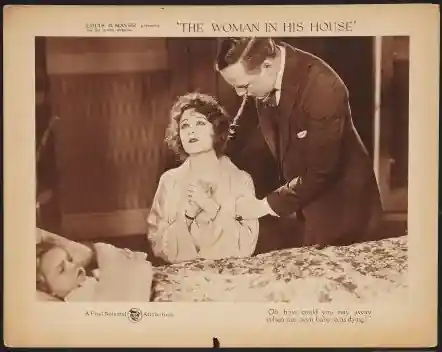
As the emotionally polyunsaturated Robert, Ramsey Wallace supplies the film’s flicker of sensual peril. His flirtations skirt burlesque, yet the actor threads in a note of self-loathing—each wolfish grin gnawed hollow from within. The moral counterweight he provides intensifies Hilda’s marital vacuum without ever tumbling the narrative into melodramatic quicksand.
Cinematographer Frank Wilson contrasts two ecosystems: the exhalations of the ocean—whitecaps like shattered chandeliers—and the hermetic sterility of Emerson’s lab, where test tubes glint like frozen syringes. Early courtship scenes spill across dunes, skirts ballooning in maritime gusts; once illness usurps love, the mise-en-scène calcifies into grids of tiles and surgical steel. The viewer can virtually hear the echo of footsteps off those cold walls, a sonic absence more piercing than any score.
Color tinting—though long faded in most extant prints—originally bathed night sequences in cyanide blue, while daytime interiors glowed amber, suggesting both lifeblood and gangrene. Contemporary restorations attempt to resurrect these hues via digital conjecture; even imperfect, they hint at a film once chromatically articulate.
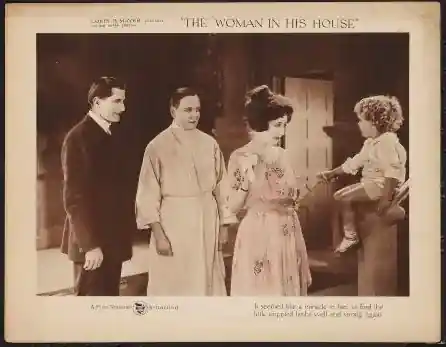
Intertitles penned by Madge Tyrone and Frances Irene Reels avoid the rhetorical bloat that curses many silents. Instead, aphorisms slice clean: "A syringe cannot draw the venom of loneliness." Dialogue cards often arrive late, after faces have already spoken, so that words merely confirm what shadows have declared. The strategy grants viewers interpretive agency—an avant-garde gambit in 1920.
Original exhibition notes suggest a live accompaniment of piano, violin, and glass harmonica. Modern screenings frequently commission new scores; I encountered a 2019 Brooklyn revival where a trio interpolated Debussy with field recordings of ventilators. The fusion—oceanic impressionism meeting the rasp of iron lungs—proved hair-raisingly apt, underscoring how the film’s concerns incubate inside our present post-pandemic psyche.
Place The Woman in His House beside What Becomes of the Children? and you’ll notice a shared obsession: the fragility of progeny, the parental terror of outliving one’s offspring. Yet where the latter film wallows in punitive moralism, Reicher's piece locates salvation not in heaven but in epidermal contact—mother’s palm on child’s fevered brow.
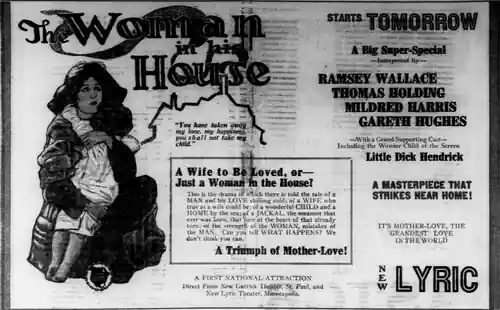
Equally revealing is its divergence from The Merry Jailbirds, a slapstick romp released the same season. While audiences guffawed at prison pranks, a quieter subset emerged haunted by Hilda’s lament, proof that early Hollywood could still accommodate both burlesque and Bergmanesque introspection—decades before Bergman himself.
Though penned and directed by men, the film inadvertently stages a radical thesis: masculine techno-science, for all its scalpels and serums, capitulates to feminine affect. Emerson’s hubris lies not merely in neglecting his wife, but in supposing knowledge can be compartmentalized, that a cure can arise in a dungeon divorced from communal tissue. Hilda’s eventual triumph is less miracle than systemic rebuttal—an assertion that healing is relational, intersubjective, anarchic.
Only two near-complete 35mm prints are known: one at MoMA (nitrate, shrinking) and a 1970s acetate duplicate at Cinémathèque Française, rescued from a Parisian boîte’s cellar. Both carry the scars of vinegar syndrome—bubbling, buckling, emulsion fizzing like seltzer. Each projection risks further hemorrhage; each refusal to project risks oblivion. Thus the film exists in a quantum state: half-dying, half-resurrected—an ontological rhyme with its own plot.

One hundred-plus years on, polio survives only in laboratory freezers, yet vaccine hesitancy incubates new epidemics of distrust. Viewing The Woman in His House amid today’s infodemic lends a vertiginous aftershock: we witness the doctor’s secrecy, his paternalistic deceit, and recoil—not at the disease but at the moral choices surrounding it. The film whispers a warning relevant to any crisis: information withheld can maim as brutally as any virus.
For devotees of silent cinema, the picture offers an exquisite case study in narrative ellipsis, performance minimalism, and chromatic experimentation. For casual viewers, it remains a gut-level tearjerker, proving that CGI-less imagery can still detonate emotional TNT. And for culture historians, it documents a moment when motherhood was reimagined as both vulnerability and pharmakon—poison and antidote in one.
Yes, certain intertitles creak; yes, the arc of miraculous recovery courts sentimentality. Yet these fissures are minor compared with the film’s cumulative throb. In an era when superhero reboots recycle ad nauseam, encountering an artifact that trusts silence to articulate grief feels like swallowing clear water after syrup.
I accord 4.5 out of 5 barnacled stars. The half-star deduction owes not to aesthetic lapse but to archival inaccessibility: most mortals will never chance upon a print, and digital scans remain embargoed by rights limbo. Until a boutique label resurrects it on Blu-ray, the movie will linger like its own clandestine child—alive, paralyzed, waiting for maternal discovery.
Hunt down any archival screening, smuggle friends, pack tissues, and prepare for a work that persuades you the most sophisticated special effect is the human visage when love breaches its dams.

IMDb —
1921
Community
Log in to comment.