DbcultAccessing Vault...
Cult Review
Senior Film Conservator
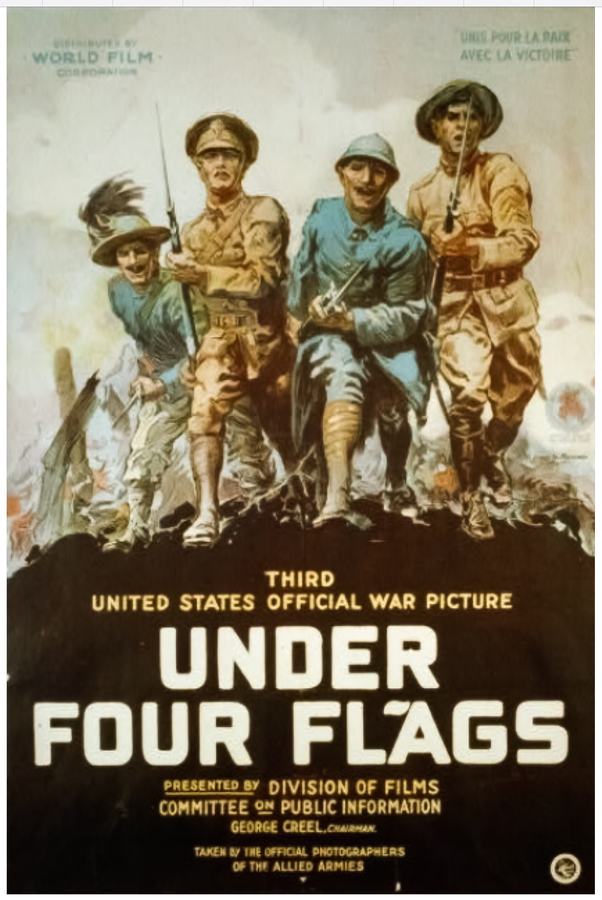
Under Four Flags is less a documentary than a time-capsule heartbeat: you feel the thud before you understand the history.
Imagine newsreels not as cold ledger but as arterial spray—every frame pulses with the knowledge that its creators might never see peacetime. Released six days after the Armistice, this 1918 collaboration between Rothafel and Beaton is the cinematic equivalent of a field dressing slapped on a hemorrhaging continent. The footage was shot while the guns still roared; the ink on the intertitles was barely dry when the bells tolled. That immediacy seeps into each splice, giving what could have been mere propaganda the jagged edge of survivor testimony.
Rothafel, later hailed as the Barnum of movie palaces, cut his teeth here on battlefield vérité. His camera operators—some borrowed from the Signal Corps, others poached from Pathé’s Paris ateliers—employ a canted, almost Expressionist framing when cataloguing shell-blasted cathedrals, then pivot to pastoral tableaux worthy of Pissarro once the scene shifts to supply-line meadows where nurses hitch up skirts to wade through poppy-choked irrigation ditches. The oscillation between carnage and fecundity creates a dialectic that textbooks rarely achieve: war as rupture, but also as grotesque fertilizer.
Viewers weaned on Peter Jackson’s They Shall Not Grow Old will recognise the colourist impulse, yet Rothafel’s monochrome retains a ghost-channel quality—faces glow under magnesium flares as though already half-remembered.
Officially silent, the film was nevertheless distributed with a prescribed orchestral score that included bugle calls captured in the Argonne and shipped stateside on wax cylinders. Modern restorations re-sync these fragments, producing a haunting disconnect: brass sections hold a triumphant chord while the screen displays a close-up of a trench foot amputation. The contrapuntal shock rivals anything in Chûshingura’s ritualized bloodletting, but here the gore is documentary, unscripted.
Kenneth C. Beaton, later a White House speechwriter, pens legends that read like dispatches filed by a sleep-deprived Homer. Observe:
"Somme mud drinks men as soil swallows seed—yet from this compost rises not grain but resolve."
Such lines risk purple excess, yet the cumulative effect is incantatory, half prayer, half audit. In contrast, the home-grown boosterism of The College Widow feels anodyne—no mud, no metaphysics, only hijinks.
There are no credited “actors,” yet faces recur until they attain the mythic stature of dramatis personae: a French sapper with a basilisk gaze who reappears in a victory parade minus an arm; an American nurse whose smile collapses into a rictus when she misrecognises a stretcher-bound fiancé. Their anonymity paradoxically heightens empathy; we supply backstories the way battlefield comrades trade tobacco for letters.
This democratic portraiture diverges sharply from the star-centric melodrama of The Lady of Lyons; or, Love and Pride where identity is fate, not circumstance.
Editors splice armistice fireworks into footage shot mere weeks earlier, producing a temporal whiplash that anticipates postmodern collage. When a New York ticker-tape avalanche overlays the dreadnought USS Arizona still under construction, the film performs ideological alchemy: grief transmutes into industrial optimism before the viewer can catch breath. Compare this chronological elasticity with the linear fatalism of The Life Story of John Lee, or The Man They Could Not Hang where each scaffold rehearsal tightens an inexorable noose.
Though monochromatic, the film insists on chromatic memory. Belgian refugees are identified by yellow armbands; in close-up the emulsion flares until the fabric becomes a solarized halo, prefiguring the high-visibility vests of protest cultures a century later. One is reminded that colour need not be physical; it can be political, a semaphore of displacement.
Sequences inside British shell factories prefigure Vertov’s man-machine hymns. Women in headscarves feed brass into stamping presses whose rhythm syncs, via clever intercutting, with frontline artillery. The result is an industrial cantata: home front and battlefront share a tempo, sister and lover fused by assembly line and trench line alike. Such montage sophistication outpaces the rather static tableaux of Who's Who in Society, where class markers stay immobile as statues.
Indian lancers appear briefly, sabres drawn, hooves churning Alpine slush. Their two-minute screen time is scandalously brief, yet Beaton’s intertitle attempts recompense: "From the Ganges to the Marne, empire answers empire." The line is paternalistic, but the imagery complicates it: turbans frosted breath-white, eyes scanning a landscape alien in both climate and cause. Modern viewers will detect the seeds of post-colonial critique, faint but unmistakable, like the first crack in a glacier.
A trench assault sequence, shot with a camera strapped to a rolling stretcher, immerses the viewer in no-man’s-land chaos. Grenade bursts strobe the frame; a lens splatter of mud reads like blood. Critics then and now condemn such scenes as proto-war-porn. Yet the immediacy eschews heroic slow-motion; instead we witness the moment when a German teenager’s helmet ribbon snags on barbed wire, his face a map of pimples and terror. The refusal to dehumanise even the enemy nudges the film toward pacifist testimony, albeit one wrapped in the Stars and Stripes.
On release, the picture grossed the modern equivalent of $120 million, becoming 1918’s top draw. But by the Depression era, audiences craved escapism, not attrition; prints languished in Exchange vaults until the Smithsonian undertook a patchy restoration in the 1970s. Today 4K scans reveal hairline scratches that resemble mustard-gas scars, a reminder that film itself is skin, aging under the projector lamp.
Where Her Double Life trades in identity subterfuge, Flags insists on the unbearable clarity of frontline existence. Both hinge on duality—public mask vs. private self—but the stakes in Flags are mortally tipped. Likewise, the florid obsession of The Mad Lover seems petulant when juxtaposed with the shell-shocked stare of a Signal Corps private who, in Flags, writes his fiancée’s name on a chalkboard then erases it with a blood-stained sleeve.
Recent machine-learning upscales interpolate missing frames, smoothing mud-splash into hyper-real sludge. Purists balk, yet the result uncannily mirrors soldiers’ memoirs: battle as temporal hallucination where seconds elongate into viscous minutes. The algorithm, trained on peace-time footage, cannot decide whether a blurred figure is running or falling—an ontological limbo that rivals Ein seltsames Gemälde’s surreal brushstrokes.
Instructors of media studies deploy Flags to illustrate what Paul Virilio termed "dromology": the logic of speed as a weapon. Watch how a French 75 artillery piece cycles in sync with the cutting rate—24 frames per second mirrored by 24 rounds per minute. Cinema and cannon share a cadence; perception itself becomes ballistics.
The closing shot—four children hoisting each nation’s flag atop a shattered cathedral—was re-shot after an accidental solarisation rendered the original negative a blizzard of white. Paradoxically, this flaw distils the film’s essence: history overexposes, memory burns. Under Four Flags survives not as triumphalist ledger but as scorched retina, a warning that every victory bell casts a shadow longer than the peace it proclaims.
Verdict: Essential, not as antique artifact but as living wound—watch it, then flinch at fireworks for the rest of your days.
IMDb 6.3
1932
Community
Log in to comment.