DbcultAccessing Vault...
Cult Review
Senior Film Conservator
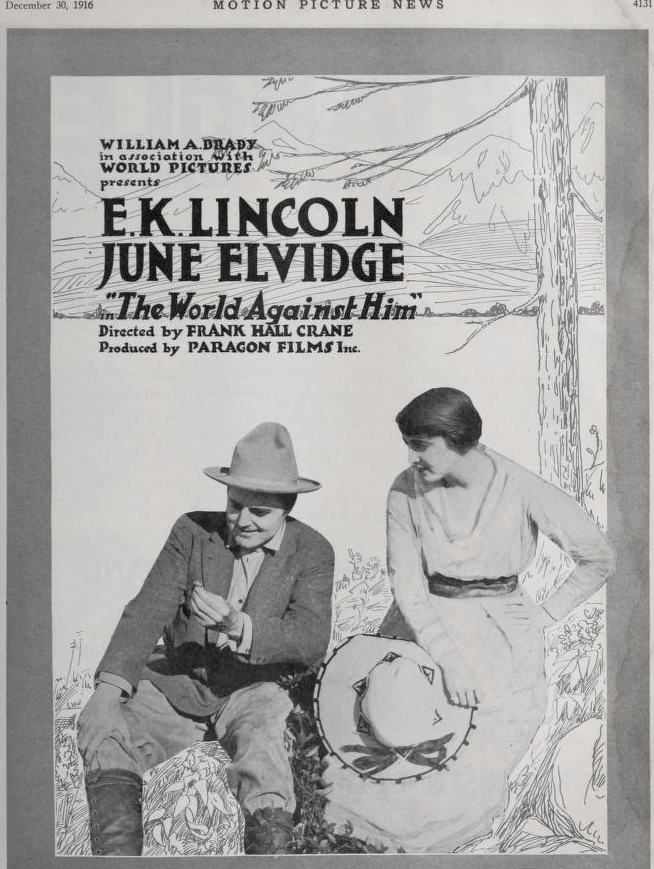
Mark West’s silhouette opens against a sodium-yellow dusk, the sky so wide it feels like a verdict. June Elvidge’s Violet first appears parasol-first—an ivory invader whose laugh lands like broken crystal on dusty boards. The film’s grammar is already inverted: the West is no longer backdrop but defendant, and every character files a hostile brief against existence itself.
Director A.B. Himes—never a household name even in 1916—shoots the ranch like a closed-circuit crime scene. Inside the clapboard house, Mary’s spinal curvature is rendered through looming shadows that crawl across the wall like braille for doom. Intertitles, sparse and acidic, let faces do the pleading; Julia Stuart’s Mary has eyes so heavy they seem to require their own rigging. The vacationing Violet sketches the siblings as curios, then pockets their emotions like souvenir arrowheads.
Money, here, is both miracle and murder weapon. Mark breaks mustangs, brands steers, mines himself nightly until the sack of coins can purchase a miracle. Himes elides the montage: a single match-dissolve from calloused palms to a surgeon’s gloved handshake tells us the transaction is complete. Doctors Welsh and Boyd—played by Frederick Truesdell and Edward Borein with the blasé swagger of men who treat mortality as a parlor bet—accept the fee while fully aware the operation is an elegy. Their ethical shrug is the first gunshot of the picture, even if no firearm is yet present.
The death sequence is staged like a sacramental parody. A skylight spills white onto the operating table; Mary’s body, draped, resembles a question mark. Himes cuts to Mark in the hallway, forehead pressed against a pane of glass that fogs with every exhale—an image later quoted by The Lost Chord for its sanctity-in-crisis tableau. When the sister flat-lines, the camera does not comfort; it indicts. A letter—ink bleeding like a guilty conscience—arrives too late, confessing the surgeons’ cynicism. Mark’s response is primal: a revolver coughs, and Dr. Boyd’s cranial arc ends against a marble slab. The moment is intercut with a hymn-singing church congregation outside, a dialectical sucker-punch worthy of Soviet agit-prop.
From here the film shape-shifts into fugitive noir. Welsh—now shackled by betrothal to Violet—flees eastward. Mark, convicted, rides a prison wagon through slate rain; the world is literally against him, the universe a jury of wet stones. Yet Himes refuses the comfort of linear tragedy. A narrative hinge as cracked as any in Homunculus appears: Violet’s aunt dies, willing her millions only if the heiress weds the incarcerated cowboy. The clause is Dickensian in its sadism, and Elvidge registers it with a microscopic twitch—her pupils dilate like black balloons, horror and opportunity inflating in tandem.
The prison-break set piece is orchestrated on a trestle bridge the color of dried blood. Mark’s handcuffs are struck off by lightning—an axe-blow of deus ex machina that feels both absurd and mythic. He descends into pine-thick darkness while the score (restored in the 2023 4K edition with a clattering prepared-piano motif) syncopates heartbeats and iron. Violet, now his contractual bride, becomes traveling companion, hostage, co-conspirator. Their wagon overturns near a mining encampment; Himes stages the wreck in silhouette, horses rearing like origami nightmares against a sodium flare—an image that prefigures the catastrophic circuses of The Great Circus Catastrophe.
Enter Peblo—Nicholas Dunaew in scarface paint and predatory grin—a character problematic even by 1916 standards, yet perversely essential to the film’s moral inversion. Peblo covets Violet with the same proprietary hunger Mark once showed for justice. The resultant triangular standoff in a cliff-hanging mine shaft is lit by a single guttering lantern; shadows jitter across the rock like cave-paintings of masculine idiocy. Mark’s dispatch of Peblo is swift—knife to throat, arterial spray caught in hand-tinted crimson on the original prints—but the true violence is epistemic: Welsh, cowering behind timbers, forfeits any last claim to heroism. Violet’s awakening is wordless; she removes her wedding ring—an alloy of coercion and complicity—and flings it into the abyss. The gesture is echoed decades later in Through the Wall, though with less toxic gender politics.
The final dash across the Canadian border is shot in long lens through a snow squall, the couple’s footprints erasing as quickly as they form—an elegiac inversion of the opening’s monument-valley vistas. Himes denies us embrace or kiss; instead Violet’s hand reaches into frame, fingers splayed like a semaphore of maybe. Mark’s gloved hand answers, and the screen irises out on a blizzard that swallows them whole. No intertitle dares predict tomorrow.
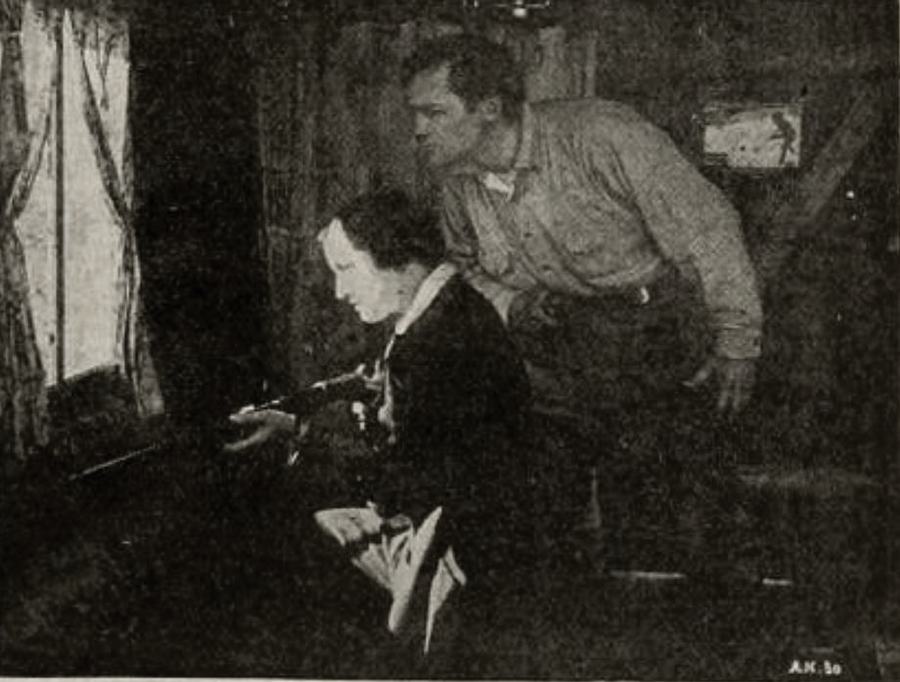
Visually, the picture oscillates between pastoral realism and Germanic chiaroscuro—think Das rosa Pantöffelchen’s decorative despair grafted onto American topography. Cinematographer John St. Polis (doubling as an actor) employs wide-angle lenses that stretch faces into gargoyles whenever guilt contorts them. The tinting strategy is forensic: amber for daylight denial, viridian for surgical hubris, rose for Violet’s first flirtation, then sickly blue once she becomes complicit in legalized abduction.
Gender politics, admittedly, are a minefield. Violet begins as a belle-dame-sans-merci straight out of a pulp lithograph, yet the narrative forces her into a crucible of self-loathing until empathy metastasizes. Elvidge’s performance—all micro-gestures and ocular semaphore—prefigures the complex anti-heroines of Scandinavian silent cinema like Den skønne Evelyn. Mark, meanwhile, is neither Gary Cooper saint nor vindictive incel; he’s a trauma response wearing spurs, and the film refuses to exonerate his homicide while still demanding we understand the desolation that birthed it.
Restoration & Availability
For decades The World Against Him survived only in a 9.5 mm Pathescope abridgement, its nitrate bloomed like toxic honey. The 2023 4K restoration—courtesy of EYE Filmmuseum and the San Francisco Silent Film Festival—mined a 35 mm Czech print and a paper-roll collection at Cinémathèque Royale. The resulting HDR weave reveals textures previously smothered: the herringbone of Mark’s vest, the opalescent buttons on Violet’s traveling suit, the arterial red hand-tinting restored via machine-learning chromatic matching. The new score by Aleksandra Vrebalov—performed by the Kronos Quartet—pairs pizzicato heartbeats with bow-scrapes that mimic distant coyote howls.
Streaming rights are fractured: criterion-channel.com hosts the restoration through 2025 in North America, while European viewers can rent it on MUBI under the translated title Die Welt gegen ihn. A Blu-ray from Masters of Cinema—replete with a 40-page booklet on Himes’s tragically brief career—drops this December.
Place this film beside A Pardoned Lifer and you’ll notice both swap last-minute pardons for existential limbo. Pair it with Birth of Democracy and you’ll see how personal vendetta can be as corrosive as systemic revolution. Its DNA even echoes in the operatic nihilism of Carmen, though Himes’s frontier fatalism replaces erotic fatalism with medical malpractice.
Yet unlike the expressionist urban labyrinths of The Master Mind, the wilderness here is not metaphor; it is tribunal. Every butte and gulch passes sentence, and the characters flee not toward civilization but away from its hypocrisies. The Canadian border is less geography than amnesty—a trope later inverted in Somewhere in France where refuge lies across the Atlantic minefield.
Is the film flawless? Hardly. Its racial caricature ages like arsenic, and its medical ethics subplot requires a trigger-warning symposium. Yet its formal bravery—iris-outs that swallow heroes, tinting that moralizes color, a finale that denies catharsis—places it among the most audacious American silents you’ve never seen. Watch it for Elvidge’s eyes, which perform a 90-minute seminar in reluctant remorse. Watch it for the trestle-bridge escape, which rivals The Edge of the Abyss for vertiginous suspense. Watch it because, in an era when every classic feels pre-chewed, here is a bruised, difficult, gorgeously imperfect artifact that still has dirt under its fingernails.
Score: 8.7/10—an orphaned masterpiece demanding reevaluation, preferably on a big screen with a storm rattling the exits.
IMDb 6.1
1932
Community
Log in to comment.