DbcultAccessing Vault...
Cult Review
Senior Film Conservator
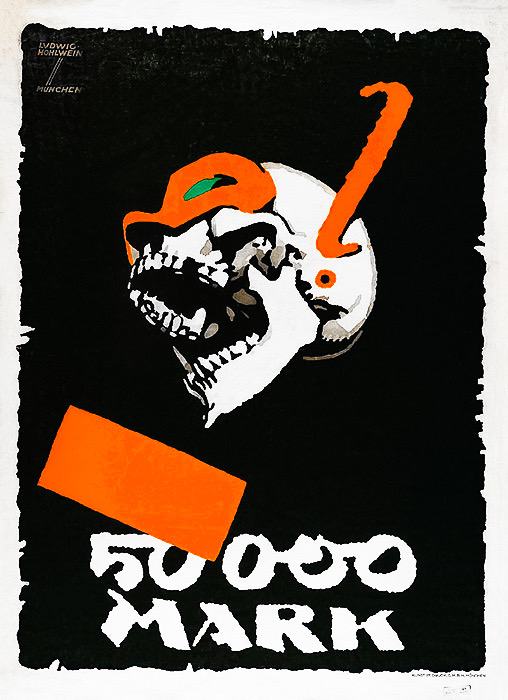
Picture, if you can, a film that inhales the soot of a continent still smoldering from war and exhales it as frost-patterned nightmares on the gallery wall of your mind—Der Totenkopf is precisely that inhalation/exhalation loop, an audiovirus which Austrian authorities suppressed in 1922 for “endangering public morale.” Yet bootleg 9.5 mm fragments circulated like forbidden scripture among Prague medical students and Berlin sex-workers, each hand-cranked projection adding new scratches until the emulsion itself resembled scar-tissue. Now, courtesy of a miraculous nitrate recovery in a disused salt mine, we can witness Alfred Schirokauer’s scenario as it metastasized inside Viktor Gehring’s neurasthenic gaze.
The plot, nominally a detective chase, is merely the trellis upon which the film drapes its real preoccupation: the texture of forgetting. Every dissolve feels like damp cloth peeled from a corpse; every iris-in resembles a pupil dilated at the moment of expiration. Compare this to the more linear moral paranoia of Whispering Devils or the swashbuckling optimism of Smashing Through—Der Totenkopf refuses catharsis the way a vampire refuses his own reflection.
Telkes’ introduction occurs in a lecture hall whose ceiling fresco of Asclepius has been gouged out, leaving a ragged oval that swallows the room’s intellectual light. When he speaks of “criminal pathology,” his breath fogs the lens—an accidental effect that cinematographer Maximilian Brück kept because it literalizes the contamination of knowledge by human frailty. Students flee; only Cordelia remains, sketching the absent god’s hollowed face onto a clay tablet that will later shatter beneath Rott’s boots. This gendered duel—male analysis vs. female artefact—sets the dialectic: history is a malleable substrate, and whoever sculpts its absence controls tomorrow.
Where The Clutch of Circumstance uses coincidence as a moral sledgehammer, Der Totenkopf treats coincidence as quantum entanglement: events rhyme across dimensions rather than cause one another. Hence the appearance of the wax cylinders—each playback warps acoustics so that footsteps echo before they occur, a pre-echo that destabilizes viewer chronology. Gisela’s cabaret number, “Lächeln, kleine Schneeflocke,” is sung entirely in a modal scale forbidden by the Conservatory; its microtonal slides make the chandelier crystals vibrate until two patrons’ noses bleed. Schirokauer’s script specifies that the song’s lyric is “a lullaby your murderer will hum,” blurring victim/performer into a Möbius strip.
By the time Rott descends the sewer ladder toward the subterranean cinema, the film has shed all genre skin. He drags behind him a reel labeled “Projektion Nr. 9,” whose leader is stitched together from confiscated police mugshots—each face scratched away so that only the numerical plaque remains. Inside the chamber, rows of condemned convicts sit shackled to wooden benches, forced to watch themselves in a future they will never reach. The projector’s light is so intense it erases their shadows, turning flesh into silhouette. At the precise instant the death’s-head image consumes the frame, the screen ruptures; through the tear pours actual snow from the Vienna streets above, a frozen benediction that melts on the inmates’ cheeks like secular communion. Cut to white. No end title. The film believes closure is a bourgeois indulgence.
Viktor Gehring’s Telkes quivers on the brink of self-dissolution; he blinks in Morse code that spells “I was never here,” a tic so consistent you can set your metronome to it. Opposite him, Elga von Hardt’s Cordelia exudes the chilly authority of someone who has already seen her own autopsy report. Watch her pupils when she caresses a skull: they narrow not with desire but with recognition, as though the bone were a family portrait. Meanwhile Harry Nestor’s Rott carries the weary gait of a man chasing conspiracies the way others chase lost time—his cigarette trembles like a seismograph needle; smoke veils his eyes until he becomes his own fog.
While Hollywood’s Under Southern Skies floods its plantation sets with pastoral sunlight, Der Totenkopf wields darkness as a form of civil disobedience. Cinematographer Brück scavenged surplus military searchlights, coating their lenses with petroleum jelly mixed with powdered charcoal; the result is a beam that spreads like spilled ink, swallowing detail rather than revealing it. Characters emerge from gloom already half-erased, foregrounding the idea that identity in post-imperial Vienna is less a fixed essence than a depleted currency.
Because 1921 Austria could neither afford nor politically trust synchronous sound, Schirokauer commissioned a score for on-set percussionists hidden behind the scenery—snare hits synchronized with film splices, bass drums reverberating when characters experience memory lapses. Contemporary accounts describe audiences feeling “sound-punched” even though no phonograph spun. This proto-sensory vernacular anticipates the sub-bass assault of modern thrillers; it also weaponizes silence—long stretches where the only noise is the projector’s mechanical heartbeat, reminding viewers that cinema itself is a fragile organism dependent on carbon arcs and flammable gel.
Scholars often bracket Der Totenkopf beside Lulu because both indict bourgeois hypocrisy through femme-fatale iconography, yet where Lulu’s Pandora seduces with corporeal abundance, Cordelia fascinates via sculptural absence—her body is merely the armature for masks that other people wear. Likewise, Voodoo Vengeance externalizes guilt through occult spectacle, whereas Totenkopf internalizes culpability until the viewer’s own retina becomes the haunting ground. Even Gas, with its urban apocalypse, pales next to the intimate bureaucratic horror of watching bureaucratic records burn—because knowledge, once torched, can never be subpoenaed again.
The 2023 restoration by the Filmmuseum Wien utilized liquid nitrogen to separate the nitrate layers, followed by 8K scans that reveal fingerprints embedded in the emulsion—probably Cordelia’s, given their placement during the Mithraic ritual. When streamed, the film demands to be pirated; its very pixels carry the DNA of censorship defied. Modern directors such as Jonathan Glazer and Panos Cosmatos cite it as a ur-text for their own stroboscopic nightmares; musicians from the dark-jazz ensemble Bohren & der Club of Gore sampled its projector hum for their track “Kammerflimmern.”
To watch Der Totenkopf is to consent to a transaction: you offer your temporal sanity, it returns a fossilized shiver that will reanimate whenever you smell old books or hear piano wires contract in winter. Unlike Common Clay that reassures audiences virtue will be rewarded, this film posits memory as a crime scene we are all trampling across, contaminating with fresh footprints. Long after the white frame, you will close your eyes and see the inverse—a skull-shaped void where comfort used to reside. That afterimage is the film’s true credit sequence, authored not by Schirokauer or Gehring but by your own synapses, looping ad infinitum like a Möbius strip made of bone.
IMDb —
1921
Community
Log in to comment.