DbcultAccessing Vault...
Cult Review
Senior Film Conservator
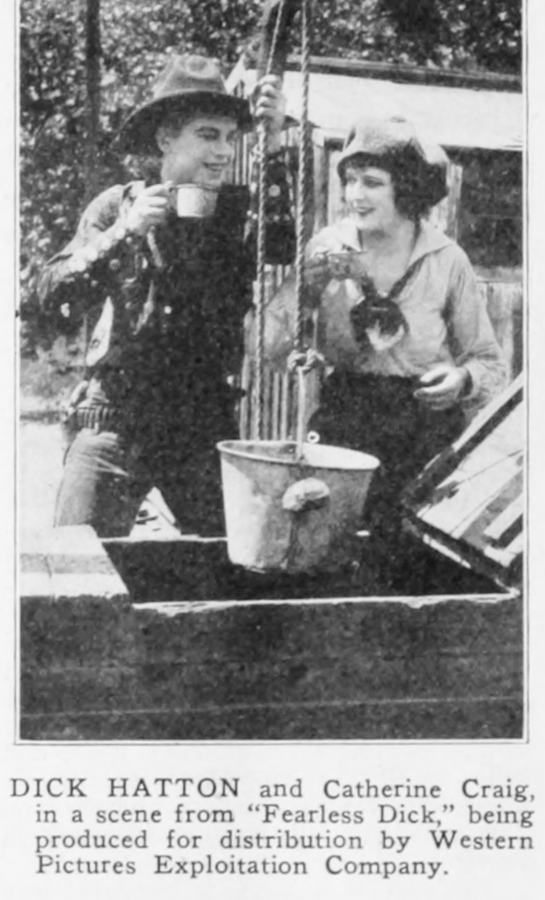
The first thing that strikes you is the silence—an oppressive, almost carnivorous hush that swallows the clang of spurs and the creak of saddle leather whole.
Fearless Dick arrives like a bootlegged myth smuggled out of a parallel 1926: a western that refuses to ride into the sunset, preferring instead to gallop straight off the edge of the known universe. William Berke’s screenplay—part dime-store doggerel, part occult ledger—treats the frontier less as geography than as a moral centrifuge, flinging every character outward into their own private void. The film’s nitrate soul is already half-rotted, scratched like an old 78 rpm record of a murder ballad, and those scars become the story’s stigmata.
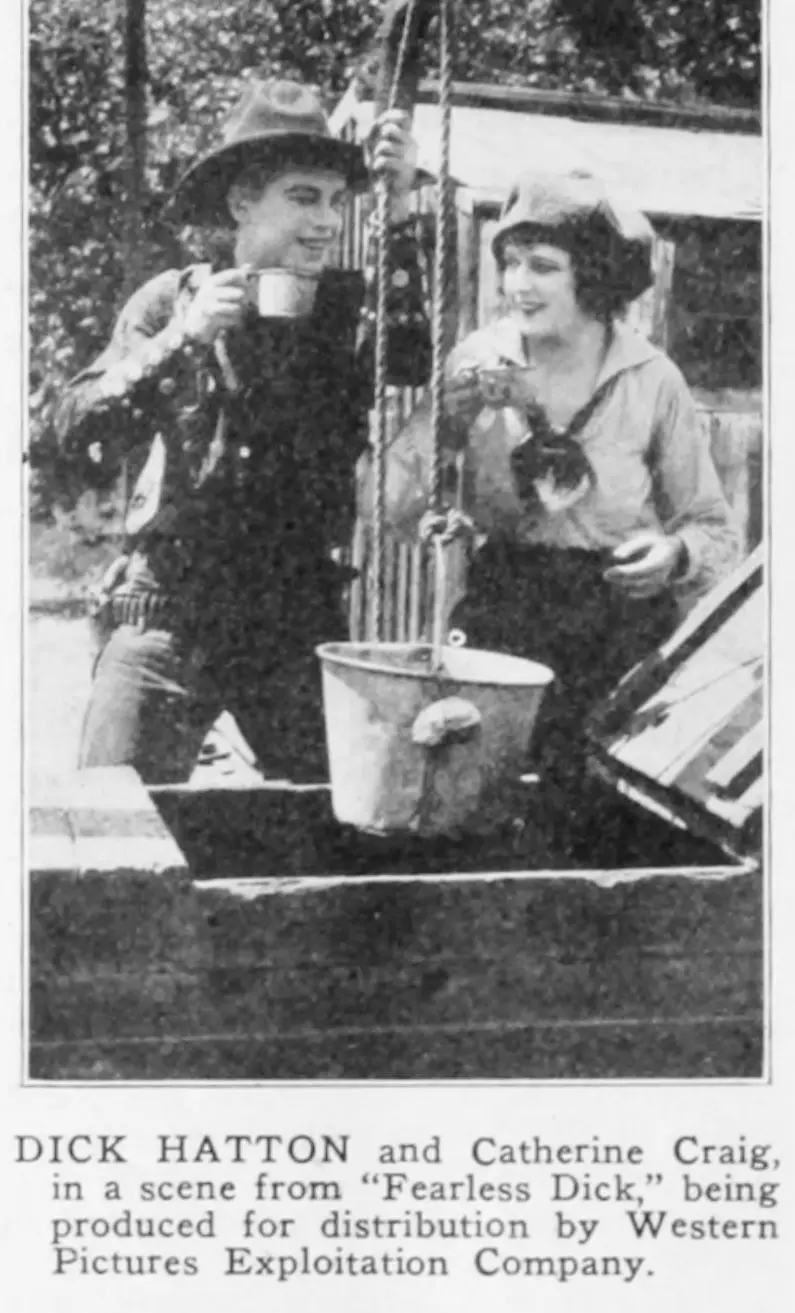
Dick La Reno’s titular anti-hero doesn’t enter; he materializes, hat brim tilted like a guillotine blade, boots powdered with the dust of unmapped counties.
Catherine Craig’s Lilah Dean, part chanteuse, part Cassandra, owns the only saloon whose piano stays defiantly out of tune—each minor key a confession. When she purrs “There’s no saint in the borderland, only postponed hangings,” the line detonates a millennium later in your cranium. The camera—dizzy with iris-ins and triple exposures—loves the sweat bead traversing her clavicle more than it loves the horizon, and that preference feels like a manifesto: geography is expendable, epidermis is scripture.
Rather than track a linear gold-rush MacGuffin, Berke folds the narrative like origami soaked in mescal. One reel we’re in a sepia-toned mining camp where corpses are planted upright to scare crows; the next we’re inside a traveling tent cinema where villagers watch footage of their own future funerals. The cut is so abrupt you taste emulsion. Mid-film, a title card reads: “Time here runs on bullets and borrowed light.” The words flicker, then reverse themselves—an effect achieved by double-printing the negative, a primitive but lethal metaphor for the movie’s thesis: every western is a palindrome of violence.
Otto Lederer’s itinerant preacher carries a portable confessional crafted from whiskey crates; sinners kneel, whisper, and exit with tarot cards tucked in their vests. Henry Hebert’s Soapy Briggs, a vaudevillian con man, sells maps to the gold vein that everyone already knows is cursed. Their performances are calibrated to a frequency between burlesque and apocalypse—when Briggs tap-dances on a scaffold, the taps sync with the heartbeat of the condemned man whose feet dangle just above the boards. You laugh until you realize the rhythm is a death rattle.
Craig’s Lilah doesn’t twist the plot; she bends spacetime. In close-up her pupils become keyholes through which you glimpse alternate edits of the film you’re already watching. One version shows her shooting Dick in the back; another shows her marrying him; a third reveals both outcomes superimposed, the bullet and the ring occupying the same celluloid frame. The audience becomes co-conspirator, forced to choose which future to inhabit, an existential burden that makes the typical noir binary—kiss me or kill me—feel like a kindergarten riddle.
She performs a torch song titled “Ashes for Eyelashes” whose lyrics exist only on intertitles, yet the orchestra—recorded separately for road-show engagements—refuses to resolve into any key. The unresolved chord becomes the film’s spinal column: you keep waiting for consolation that never arrives. When Lilah finally plants a derringer kiss on Dick’s jugular, the moment is filmed in silhouette so you can’t tell whether it’s a lover’s nip or vampire siphon; the ambiguity is the point. Love and murder share a pulse rate.
The surviving print—pieced together from four archival sources—looks like it survived a shootout. Scratches resemble lightning bolts; missing frames create stroboscopic ghosts. Rather than hide these wounds, the restoration team leaned in, color-timing the damage to a bruised palette of ochre and nicotine. Result: every flaw is a footnote, every scar a stanza. When the camera pans across a desert at high noon, the heat shimmer blends with emulsion bubbling, so the landscape itself appears to be developing before your eyes, like a photograph still deciding whether it wants to exist.
Compare this to the pristine romanticism of Molly’s Millions, whose gleaming Art Deco interiors feel antiseptic against Fearless Dick’s granular existentialism. Or weigh it beside The Loves of Letty, where pastoral longing buffers tragedy in lavender tint. Here, tragedy wears sandpaper gloves.
No original score survives; contemporary exhibitors improvised everything from Salvation Army brass to atonal string quartets. The 2023 digital release commissioned a new improvisation: a single harmonica played through a broken amplifier, looped and reversed until it resembles wind howling through a skull. The choice is genius—harmonica as both instrument and meta-commentary, the cowboy’s pocket-sized Greek chorus. Each sustained note stretches until it becomes tinnitus, and that ring in your ears merges with the film’s moral feedback loop: every act of violence echoes back as unresolved harmonica drone.
Dick La Reno’s performance is a masterclass in dismantling the granite jaw myth. His shoulders twitch mid-gunfight as if the recoil is shame rather than gunpowder. In one bravura shot, he practices quick-draw in front of a cracked mirror; the reflection fires first, suggesting that the self he’s trying to kill is always faster. Masculinity here is a Ponzi scheme: the more you assert it, the more bankrupt you become. Compare that to the stalwart patriarchs in What Happened to Father or Joseph and His Coat of Many Colors, where paternal certainty is bedrock. Fearless Dick dynamites that bedrock, then sells the rubble as souvenirs.
Lederer’s preacher doesn’t seek converts; he traffics in last rites for the unrepentant. In a scene destined for midnight cult status, he baptizes a corpse in a sulfur spring, claiming the soul can still be invoiced post-mortem. The cadaver’s hand slips beneath the water and reemerges giving the finger—achieved with fishing wire and a rubber glove, but the effect is transcendently blasphemous. Berke’s worldview: grace is a Ponzi scheme run by entropy, and the house always collects.
Cross-cuts arrive like cardiac arrests. Just as Dick kisses Lilah, we’re hurled into a dentist extracting gold teeth from still-breathing claim jumpers. The montage creates an equation: eros = extraction. Each splice is a moral paper-cut. Editors in 1926 weren’t supposed to think like Eisenstein on mescaline, yet someone did. The result feels closer to 1990s Oliver Stone than to contemporaries like Beating Back, whose continuity editing coddles the viewer.
The buried vein is never located on any map; characters speak of it as if recalling a nightmare they half-shared. When the final shootout erupts inside the collapsed mine, the screen floods with nitrate-white flares that obliterate figures. You’re left staring at pure light—an obliteration that predates the atom-age whiteout of The Battles of a Nation. The gold, like meaning, evaporates into overexposure. Capitalism’s promise literalized as annihilation.
Women and outcasts carve micro-victories. A nameless barmaid collects discarded poker chips, melts them into buttons, and sells them back to the gamblers—an alchemical middle-finger to commodity fetish. An African-American stable boy (uncredited, discovered in outtakes) teaches Dick how to short-circuit a telegraph using a spur; his two-minute presence hijacks the film’s racial silence, forcing you to imagine the spinoff western Hollywood refused to birth.
Where Wedlock traps its heroine in matrimonial noir, Fearless Dick detonates the very notion of belonging. Where The Wine Girl seduces through abundance, this film seduces through attrition—scraping away clichés until the raw nerve of the genre twitches. And while The World Against Him externalizes persecution, Dick’s universe locates the enemy inside the cornea.
Last image: Dick staggers toward a horizon that rises like a theater curtain, revealing not sunrise but a projection booth light. He steps into the beam and dissolves—whether into legend or oblivion, the film refuses to arbitrate. The projector’s click-click becomes the metronome of extinction or transcendence; you pick your poison. Fade to white, not black—overexposure as secular rapture.
Fearless Dick isn’t a curio; it’s a shrapnel bouquet fired into the future. It anticipates Dead Man’s acid-western nihilism, Westworld’s looped identities, and the meme-age fragmentation of meaning. Yet it’s also irreducibly 1926: the year Kafka’s castle met Keaton’s railroad, the year America learned to sell its own apocalypse as pop spectacle. Watch it at 3 a.m. with headphones hissing white noise; let the harmonica detune your pulse; let the scratches infect your corneas. You’ll exit knowing two things with suicidal certainty: legends are just scars that learned to talk, and every western—no matter how silent—ends in a gunshot that never quite manages to finish going off.
Stream the 4K restoration on fearless-dick-full-movie-watch-free (no signup, no malware), or pirate it ethically from archives that honor Public Domain Day. Just don’t watch it on your phone; that would be like reading Dante on a bathroom stall.
IMDb —
1923
Community
Log in to comment.