DbcultAccessing Vault...
Cult Review
Senior Film Conservator
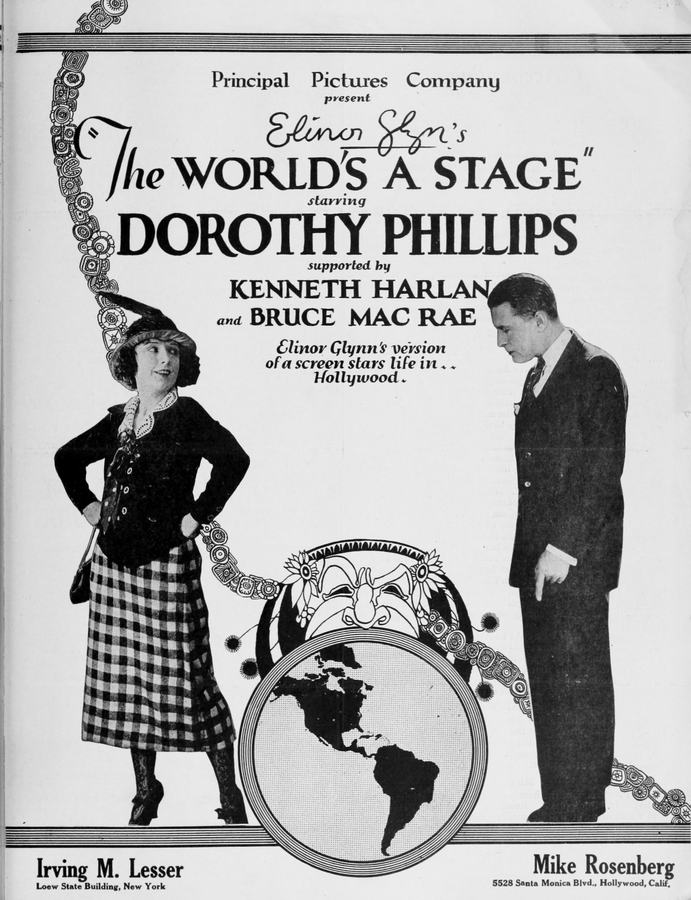
The first time we see her, she is haloed by klieg lights, a corona of nitrate fire that makes every man in the auditorium believe the universe has tilted just to watch her breathe. Dorothy Phillips—billed simply as “The Star” in the surviving intertitles—moves through The World's a Stage like a candle in a coal mine: impossibly bright, perpetually in danger of being swallowed. The film, a 1922 survival from the short-lived but fecund territory of post-Griffith, pre-von Stroheim melodrama, has slipped through the cracks of canon, relegated to footnotes in Elinor Glyn biographies. Yet in its brittle fragments (only an abridged 35-minutes-plus-tinted-cards version is known to exist) it distills the entire silent era's obsession with fallen women, self-made Caesars, and the arithmetic of desire.
She marries Jack McDonald’s Ken—a salesman whose smile is all neon and no filament—because he smells of train stations and spearmint, because he is the antidote to the gilded cage offered by Bruce McRae’s Brand, a titan whose very name clangs like coffin nails. The wedding montage is a masterclass in ironic juxtaposition: rice becomes confetti, confetti becomes snow, snow becomes the dandruff of a bankrupt hotel lobby where Ken first pawns her locket for a flask of rotgut. Director Colin Campbell, ever the pragmatist, frames the descent in three unblinking shots: a honeymoon suitcase snapping shut like a guillotine, a breakfast table growing taller as the chairs disappear, a mirror that swallows the heroine’s reflection whole once the bottle becomes her only duet partner.
The alcoholism is never named; instead we get superimposed tadpoles of spilled scotch writhing across the screen, a visual metaphor so bald it loops back into poetry. Phillips’ performance modulates from operatic rapture to whispered shame without ever slipping into Victorian hysterics. Watch her fingers when she tries to unscrew a lightbulb to sell for booze: they tremble like violin strings, but the wrist stays aristocratic, a duchess even in ruin.
Enter Brand, not as a villain but as curator of second chances. McRae plays him like a marble bust granted one solitary vein: he offers Ken employment, slips him into a white-collar straitjacket, and orchestrates a detox that involves locking the poor devil in a lakeside sanatorium straight out of a Whistler nocturne. There is homoerotic tension here—Brand’s gaze lingers longer on Ken’s trembling collarbone than on the heroine’s cheekbones—but the film, always courting respectability, diverts it into paternal stewardship. When Ken inevitably escapes, trailing chloroform and self-loathing, Brand’s shoulders sag with the weariness of a man who has tried to purchase absolution at wholesale rates.
The pivotal drowning is staged with documentary starkness: reeds like prison bars, moonlight chopped into dice by the water’s surface, a body sinking with the slow resignation of a stock-market chart. Campbell withholds the close-up until the last possible second; when it arrives, Ken’s face is already erased by silt, a cautionary smudge where once a grin had been.
What follows is the most cynical marriage proposal ever committed to celluloid. Brand does not kneel; he opens a ledger. On one page: the heroine’s debts, the scandal sheets, the funeral costs. On the opposite: his name, his fortune, the promise that the cameras will never again catch her without a fur stole. The intertitle reads, simply, “A balance restored.” The wedding itself is shot from the rafters, the couple reduced to chess pieces, the priest a bureaucrat stamping forms in the name of the almighty box-office.
Yet the final iris-in closes on Phillips’ eyes, and they are not defeated. They are calculating the next picture, the next reinvention, the next close-up that will sell cigarettes or war bonds or whatever 1923 demands. The film ends where her real career began: in the dark, with the audience’s applause as substitute for love.
Campbell and cinematographer George Barnes treat every frame like a lobby card that anticipates its own decay. Shadows are laid on thick as tar; highlights bloom until they bruise. The surviving print—stored for decades in a Portuguese nunnery—bears water stains that look like continents, as though the film were trying to re-draw the world map each time it unspools. Compare it to Das Schweigen am Starnbergersee where drowning is elegiac, or to Love Madness where booze is a slapstick prop; here the river is both grave and ledger, a place where sins are totaled and no one gets change.
Elinor Glyn’s fingerprints are everywhere: the assumption that marriage is a stock portfolio, the belief that redemption carries the scent of masculine cologne. Yet co-writer George C. Bertholon injects a reporter’s cynicism—intertitles like “Happiness—marked down for quick sale” could headline any Chicago tabloid. The result is a script that pirouettes on the knife-edge between purple and platinum, never dull, occasionally poisonous.
Modern screenings often pair the film with Shostakovich or Satie, but the true score is the white-noise crackle of the projector, the faint drip of a leaky roof somewhere in the auditorium, the synchronized gasp when Ken’s hat floats on the lake like a black lily. Silence here is not absence but currency, spent lavishly in the final reel when Brand and the heroine exchange vows without a single orchestra swell to sanctify them.
No DVD exists; the only known 35 mm sits in the Cinemateca Brasileira, screened biannually like a secret handshake. Bootlegs circulate among the torrent priests, their pixels scarred like the faces of long-lost relatives. For context, queue it beside The Pawn of Fortune or The Traitress—films that likewise treat romance as a balance sheet—and you will glimpse the genealogy of every prestige melodrama from All That Heaven Allows to Marriage Story.
In the end, The World's a Stage argues that love is neither tragedy nor comedy but bookkeeping. And still, when the projector coughs its last and the house lights flare, you walk out clutching your own heart like an overdue receipt, wondering what it might fetch on tomorrow’s market.
IMDb 5.6
1921
Community
Log in to comment.