DbcultAccessing Vault...
4/10
Senior Film Conservator
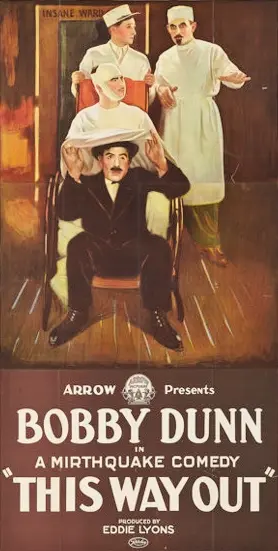
A definitive 4/10 rating for a film that redefined the boundaries of cult cinema. This Way Out remains a cornerstone of transgressive art.
Stepping back into the cinematic landscape of 1924, one encounters a fascinating array of narrative styles and burgeoning techniques. Amidst the grand epics and melodramatic serials, the short-form comedy reigned supreme, often serving as a vibrant proving ground for physical humor and character-driven escapades. 'This Way Out', a delightful confection penned by Edward Ludwig, stands as a testament to the era’s capacity for ingenious simplicity and the universal appeal of a lovelorn fool’s desperate machinations. It’s a film that, despite its brevity, encapsulates much of what made silent comedies so utterly captivating: exaggerated performances, a clear-cut objective for its protagonist, and a series of escalating, often absurd, obstacles.
The premise of 'This Way Out' is deceptively straightforward, yet it unfolds with a charmingly intricate slapstick logic. Our hero, Bobbie, portrayed with a commendable blend of earnestness and wide-eyed confusion by Bobby Dunn, is a sign painter by trade. His daily grind, however, is perpetually overshadowed by the towering hospital across the street, a bastion of healing and, more importantly, the workplace of his beloved nurse, played with a sweet yet firm demeanor by Katherine Surtess. Bobbie’s dilemma is one that transcends time: how to bridge the chasm separating him from his sweetheart, particularly when her profession places her behind institutional walls. His solution? A masterclass in ill-advised romantic strategy: feigning illness to gain admission. This initial gambit, a rather transparent display of exaggerated pain and dramatic collapse, is, predictably, met with the swift and unceremonious ejection from the hospital’s premises. The humor here lies not just in the failed attempt, but in the sheer audacity of the idea itself, a testament to the lengths to which cinematic lovers have historically gone.
What follows is a series of increasingly elaborate and hilariously futile attempts. Bobbie, undeterred by prior failures, embodies the relentless spirit of the silent film protagonist, a figure often defined by their unwavering pursuit of a singular goal, no matter how preposterous the means. Each subsequent attempt to infiltrate the hospital is met with the same result: discovery and expulsion. This repetitive structure, rather than becoming monotonous, builds a comedic rhythm, allowing the audience to anticipate and delight in Bobbie’s inevitable downfall. It's a classic comedic trope, one that finds echoes in the sustained, often frustrating efforts of characters in films like The Essanay-Chaplin Revue of 1916, where Chaplin’s tramp frequently finds himself in cyclical predicaments, only to emerge, if not victorious, then at least ready for the next round. The physical comedy here, while perhaps less refined than Chaplin's balletic grace, possesses a raw, unpolished energy that is entirely its own.
The narrative of 'This Way Out' truly elevates its comedic game in its final act. Having exhausted all conventional (and unconventional) methods of entry, Bobbie seizes upon a truly desperate measure: he takes the place of a patient about to undergo surgery. This is where the film transitions from mere slapstick to a more sophisticated, albeit still overtly comedic, form of dramatic irony. The audience is privy to the full scope of Bobbie’s misguided ambition, while he remains blissfully ignorant of the true peril he faces. The surgeon, played by Glen Cavender, is not merely a medical professional; he is also Bobbie’s romantic rival, a detail that adds a delicious layer of tension and comedic misfortune to the proceedings. The doctor, equally smitten with the nurse, sees Bobbie not as a patient to be healed, but as an obstacle to be, well, removed – at least temporarily. The climax, with Bobbie being chloroformed by his unwitting rival, is a brilliant stroke of comedic irony, a perfect culmination of his increasingly outlandish attempts. It's a moment that could easily veer into darkness but is handled with the light touch characteristic of 1920s silent comedies, ensuring the audience's laughter rather than their alarm.
The performances in 'This Way Out' are, as expected for the era, broad and expressive, relying heavily on pantomime and facial exaggeration to convey emotion and intent. Bobby Dunn, as Bobbie, carries the film with his energetic portrayal of the lovestruck sign painter. His physical comedy, from his exaggerated feigned illnesses to his desperate attempts to evade hospital staff, is key to the film's success. He embodies the 'everyman' who, in pursuit of love, becomes an 'every-fool', a relatable archetype that audiences have always embraced. Katherine Surtess, as the nurse, provides a grounding presence, her exasperation and eventual amusement at Bobbie’s antics serving as a perfect foil. Glen Cavender, as the rival doctor, exudes a subtle menace beneath his professional demeanor, making his final act of chloroforming Bobbie all the more satisfyingly villainous in a comedic sense. Eddie Lyons, in a supporting role, contributes to the ensemble's overall comedic timing, demonstrating the collaborative nature of silent film acting.
The pacing of 'This Way Out' is brisk, a common trait of short comedies designed to capture and hold attention without the benefit of spoken dialogue. Edward Ludwig, as writer, crafted a narrative that moves efficiently from one comedic set-piece to the next, never lingering too long and always propelling Bobbie towards his next, more audacious scheme. This efficiency is crucial for silent films, where every gesture, every intertitle, and every scene transition must serve a clear purpose. The film doesn't waste time on unnecessary exposition but plunges directly into the humorous predicament, a technique that ensures maximum comedic impact within its limited runtime. This directness can be seen in other short comedies of the period, such as Smarty, where character motivations are instantly clear, allowing the plot to focus on the ensuing chaos.
Viewing 'This Way Out' nearly a century after its release offers a window into the foundational elements of screen comedy. It reminds us that humor often springs from universal human experiences: love, jealousy, and the lengths to which we go for our desires. The film, like many of its contemporaries, relies on physical gags, mistaken identity, and situational irony – tropes that remain staples of comedy to this day. There's a certain purity to its humor, unburdened by complex dialogue or intricate plots, allowing the visual storytelling to shine. This simplicity is often what makes these early films so accessible and enjoyable even for modern audiences, provided they approach them with an open mind to the stylistic conventions of the era.
Compared to more ambitious narratives of the time, such as the dramatic intensity of The Witching Hour or the sweeping scope of Ruth of the Rockies, 'This Way Out' operates on a much smaller, more intimate scale. Yet, its impact, in terms of pure entertainment, is no less significant. It demonstrates that a well-executed comedic premise, coupled with committed performances, can create a memorable cinematic experience regardless of runtime or budget. The film’s focus on a single, compelling comedic conflict, much like the focused romantic entanglements in Distilled Love, showcases the power of a concentrated narrative. It’s a testament to the fact that sometimes, the most complex emotions and situations can be distilled into the most hilariously simple scenarios.
Edward Ludwig, credited as the writer, played a crucial role in shaping the comedic sensibilities of 'This Way Out'. In the silent era, writers often had to think visually, crafting scenarios that could be easily understood through action and expression rather than dialogue. Ludwig's script, though without spoken words, clearly outlines the progression of Bobbie's schemes, the reactions of the hospital staff, and the ultimate ironic twist. This required a keen understanding of comedic timing and escalation. His ability to build humor through repetition and then subvert expectations with the final chloroform scene is indicative of a thoughtful approach to silent comedy writing. While the director's name isn't provided in the prompt, it's clear that the execution of Ludwig's vision would have required a precise understanding of blocking, camera placement, and performance coaching to bring the written gags to life effectively. The interplay between writer and director in these short films was often symbiotic, each contributing to the overall comedic impact. This collaborative spirit is a hallmark of early filmmaking, where quick turnarounds and efficient storytelling were paramount.
The film also subtly reflects societal norms and anxieties of its time. The hospital, a place of authority and strict rules, becomes the perfect backdrop for Bobbie's rebellious, albeit romantically motivated, transgressions. It plays on the universal human desire to bend rules for personal gain, particularly in matters of the heart. The doctor as a rival, rather than a benevolent healer, adds a layer of human pettiness that grounds the fantastical elements of the plot. This human element, the competition for affection, is a theme found across countless genres and eras, from the dramatic rivalries in A Soul Enslaved to the more lighthearted romantic triangles in other comedies. 'This Way Out' manages to explore this without losing its comedic footing, a delicate balance that speaks to the craft involved.
In conclusion, 'This Way Out' is more than just a historical curiosity; it’s a vibrant, entertaining piece of silent cinema that continues to amuse. It showcases the talents of its cast, particularly Bobby Dunn, and the clever writing of Edward Ludwig, proving that even a simple premise can yield rich comedic rewards. For those interested in the evolution of comedy, the history of film, or simply in need of a good laugh, this short film offers a delightful diversion. It serves as a reminder of the ingenuity of early filmmakers who, without the benefit of sound or advanced technology, crafted narratives that resonated deeply with audiences and laid the groundwork for the cinematic language we understand today. Its charm lies in its unpretentious commitment to making its audience smile, a mission it accomplishes with admirable success. It's a small but significant piece of the vast puzzle that is silent film, reflecting the era's innocent yet sharp wit, and its enduring ability to connect with viewers across generations. It may not have the grand scale of some contemporary features, but its focused comedic brilliance makes it a memorable experience, a true testament to the power of a well-told visual joke. The film's unassuming nature belies its effectiveness, delivering a punchline that resonates long after the final frame.
IMDb 4.5
1916
Community
Log in to comment.