DbcultAccessing Vault...
7/10
Senior Film Conservator
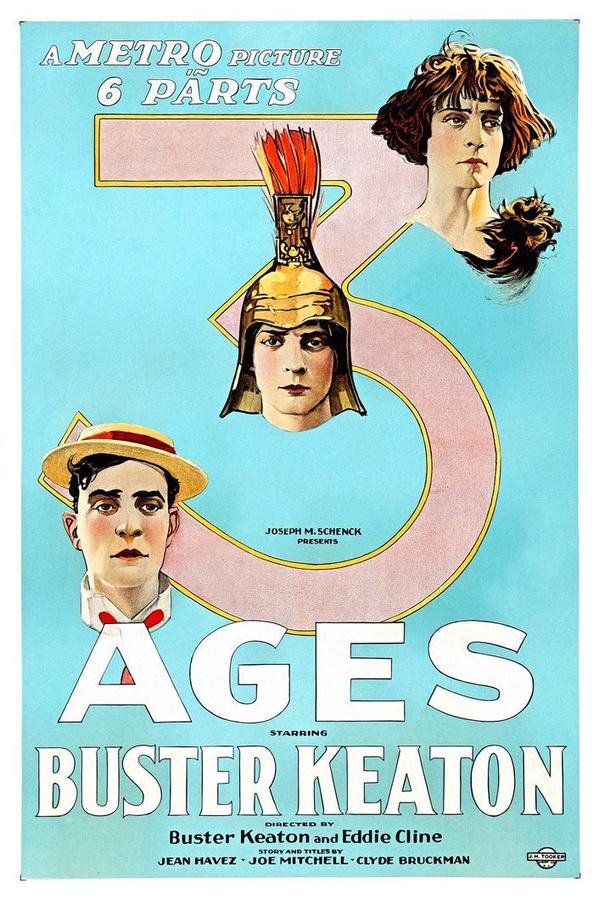
A definitive 7/10 rating for a film that redefined the boundaries of cult cinema. Three Ages remains a cornerstone of transgressive art.
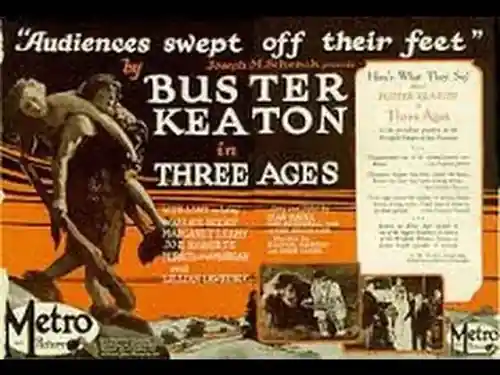
Buster Keaton, the inimitable 'Great Stone Face,' embarked on his feature-length directorial journey with 1923's Three Ages, a film that serves not merely as a comedic vehicle but as a profound philosophical rumination on the cyclical nature of human desire, rivalry, and the eternal quest for love. This audacious debut, structured as a triptych of parallel narratives across distinct historical epochs, firmly established Keaton as an auteur whose ambitions stretched far beyond the confines of the two-reeler. It’s a work of remarkable foresight and execution, daring to compare the primal instincts of the Stone Age with the structured gladiatorial contests of Ancient Rome and the burgeoning complexities of the modern 1920s.
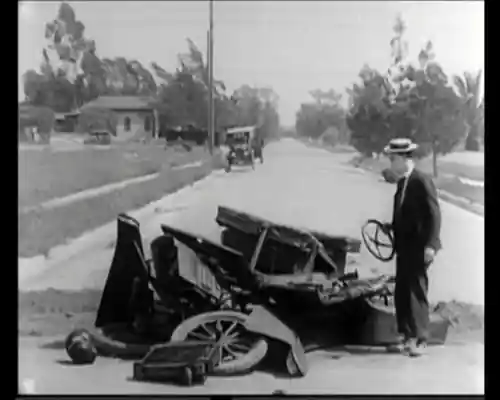
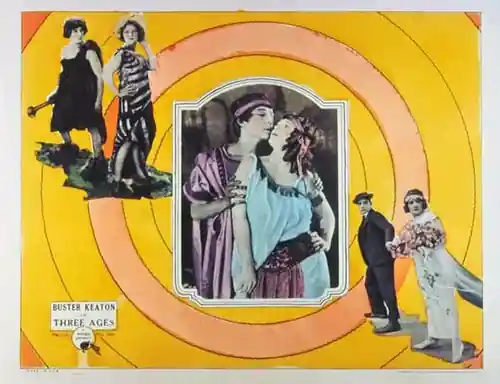
The premise itself is an act of comedic genius: a single narrative thread—the 'Boy' (Keaton) pursuing the 'Girl' (Margaret Leahy) while fending off the 'Villain' (Wallace Beery)—is replicated in three vastly different settings. This structural innovation, often cited as a parody of D.W. Griffith’s Intolerance, allows Keaton to explore how human nature, despite technological and societal shifts, remains stubbornly consistent. The film argues, with a wink and a breathtaking stunt, that the fundamental drives of love, jealousy, and the desire for social standing are as old as time itself.
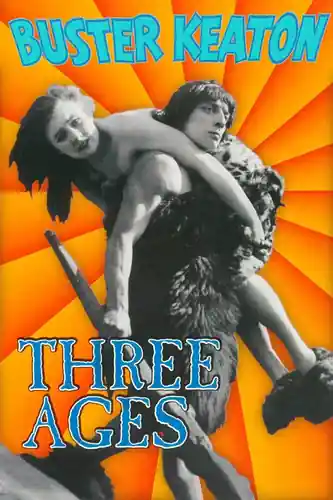
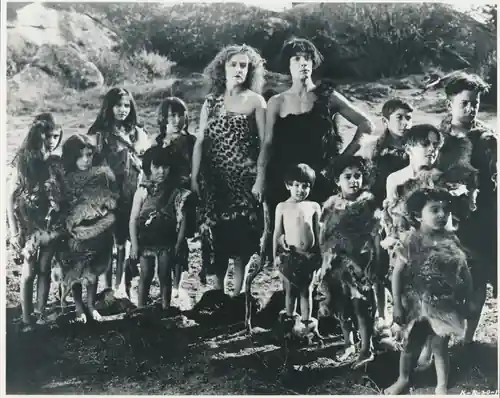
Our journey begins in a delightfully anachronistic Stone Age, where cave dwellers, clad in furs, navigate a landscape populated by dinosaurs (achieved through surprisingly effective stop-motion animation for its time) and the brutal simplicity of club-wielding courtship. Here, Keaton's 'Boy' is a scrawny, earnest suitor, immediately outmatched by Wallace Beery’s hulking 'Villain.' The physical disparity is a recurring motif throughout Three Ages, amplifying Keaton’s comedic plight. His character is never physically imposing, but his intellect, agility, and sheer refusal to yield are his superpowers. In this primal setting, the gags are broad and physical: a giant rock used as a love token, a precarious tightrope walk over a chasm, and a frantic chase involving a dinosaur. Keaton's ability to maintain his deadpan composure while performing increasingly absurd and dangerous feats is already fully formed. The Stone Age sequence is a masterclass in visual storytelling, where every gesture and prop is imbued with comedic potential. It’s a world where the laws of physics are often bent to the will of laughter, a testament to the collaborative vision of writers Buster Keaton, Clyde Bruckman, Jean C. Havez, and Joseph A. Mitchell.
Transitioning seamlessly, we find ourselves in the grandeur of Ancient Rome, a setting that allows for a different kind of spectacle. Here, the 'Boy' is a Roman citizen, still hopelessly devoted to the 'Girl,' a beautiful patrician, and still locked in a bitter rivalry with Beery’s formidable gladiator. The shift in setting brings a change in comedic tools and obstacles. Instead of clubs, we have chariots; instead of raw strength, we have the structured violence of the arena. Keaton’s character, once again, is an underdog, forced to prove his worth through trials of strength and skill that he clearly lacks. Yet, through a series of ingenious contrivances and breathtaking escapes, he manages to survive and even thrive. The chariot race sequence is particularly memorable, showcasing Keaton’s unparalleled ability to choreograph complex action sequences that are both thrilling and uproariously funny. His ingenious use of a dog to steer his chariot, or his narrow escapes from various traps, are emblematic of his unique brand of physical comedy. The opulence of the Roman sets, contrasted with Keaton's often humble circumstances, adds another layer of visual humor. This era highlights the societal structures that govern courtship, moving beyond raw physicality to include social standing and public spectacle. It's a stark contrast to the more dramatic historical narratives of the era, such as Maharadjahens yndlingshustru I, which might focus on romantic drama within a similar historical context, whereas Keaton subverts it for pure comedic effect.
Finally, we arrive at the film’s contemporary (for 1923) setting: the bustling, modern city. Here, the 'Boy' is a young man navigating the complexities of urban life, still pursuing the 'Girl' against the machinations of Beery’s wealthy and influential rival. The gags here are born from the trappings of modernity: cars, apartment buildings, and the intricacies of societal rules. Keaton’s character, a man perpetually out of step with the world yet always finding a way to master it, becomes entangled in a series of misunderstandings and escalating chases. The climax, involving a precarious leap from a skyscraper into a fireman's net, is a legendary stunt that perfectly encapsulates Keaton’s fearless approach to comedy. It’s a testament to his belief that the physical gag, executed with precision and daring, could transcend any narrative or period. The modern age segment, while perhaps less visually distinct than its historical counterparts, allows Keaton to comment on the burgeoning anxieties and absurdities of contemporary life, from the pressures of wealth to the intricate dance of social etiquette. The recurring characters, Blanche Payson as the 'Girl's Mother' and Joe Roberts as the 'Girl's Father,' provide consistent comedic foils across the ages, their reactions often mirroring the societal norms of their respective epochs.
What truly elevates Three Ages beyond a mere collection of gags is Keaton’s meticulous craftsmanship. Each scene is constructed with an architect’s precision, every movement calculated for maximum comedic impact. His 'Great Stone Face' is not a mask of indifference but a canvas upon which the audience projects their own reactions to his escalating predicaments. It’s a genius stroke that allows the audience to feel the full weight of his struggles without the distraction of overt emotional expression. The film’s pacing is relentless, moving from one elaborate setup to another with remarkable fluidity. The ensemble cast, including Bernard Berger, George Davis, George Bookasta, F.F. Guenste, Kewpie Morgan, Louise Emmons, Lionel Belmore, Basil Bookasta, and Lillian Lawrence, expertly supports Keaton’s central performance, reacting to his antics with a mix of awe, bewilderment, and frustration that grounds the fantastical elements in a relatable human context. The collaboration with Clyde Bruckman, Jean C. Havez, and Joseph A. Mitchell in crafting these intricate scenarios is evident in the seamless integration of visual comedy and narrative progression. This attention to detail and narrative structure is something that sets Keaton apart, even from contemporaries who also excelled in physical comedy; his films often possess a deeper, more thoughtful underpinning, a quality that might be less apparent in a straightforward action film like The Fighting Guide, which prioritizes direct conflict over thematic exploration.
The recurring theme of the underdog triumphing against seemingly insurmountable odds resonates profoundly. In each age, Keaton’s 'Boy' is a symbol of resilience, ingenuity, and the power of the human spirit to adapt and overcome. He may not be the strongest or the wealthiest, but he possesses an indomitable will and an almost supernatural ability to turn disadvantages into advantages. This narrative archetype is timeless, making Three Ages as relevant today as it was a century ago. It’s a testament to the universal appeal of his character, a relatable figure who, despite his extraordinary circumstances and physical feats, feels deeply human. The film doesn't just make you laugh; it makes you root for the little guy, for the triumph of wit over brute force, of love over rivalry. This emotional connection, forged through laughter and awe, is a hallmark of Keaton’s best work.
Visually, the film is a delight. The production design for each era is remarkably detailed, especially considering the budgetary and technological constraints of early silent cinema. The costumes, sets, and props all contribute to the immersive quality of each segment. The Stone Age, with its rocky landscapes and primitive tools, feels authentically ancient, while the Roman sequences evoke the grandeur of the empire. The modern era, though familiar, is imbued with Keaton’s unique perspective, turning everyday objects into instruments of comedy. The camera work, often static to allow Keaton’s full body to be seen in action, is deceptively simple, yet incredibly effective in capturing the intricate choreography of his stunts. This understated elegance in cinematography is a recurring strength in Keaton’s filmography, ensuring that the focus remains squarely on the performer and the gag.
As Keaton's first full-length feature, Three Ages is a critical milestone. It marked his transition from short films to the more ambitious canvas of the feature film, a move that would define the golden age of silent comedy. While other comedians like Charlie Chaplin were also making the leap, Keaton's approach was distinctly his own. He wasn't just expanding the running time; he was expanding the narrative and thematic scope of his work. This film showcases his burgeoning confidence as a director, his mastery of visual storytelling, and his unparalleled ability to blend audacious stunts with character-driven comedy. It’s a bold statement from an artist who was clearly ready to challenge the conventions of filmmaking and push the boundaries of what was possible in the nascent medium.
The influence of Three Ages can be seen in subsequent films that play with historical settings or episodic structures, though few manage to weave them together with such comedic grace. The sheer audacity of its concept, coupled with Keaton's flawless execution, makes it a timeless piece of cinema. It’s a film that reminds us of the power of visual comedy to transcend language and cultural barriers, speaking directly to our shared human experiences. The film's structural ambition, though perhaps a response to the epic scale of films like D.W. Griffith's works, still feels remarkably fresh and original. It's a testament to the creative freedom and experimental spirit of the silent era, where artists like Keaton were constantly innovating and redefining the cinematic language. One might draw a parallel to the bold narrative choices in films such as Phantom, which explored psychological depth in a singular, intense setting, contrasting with Keaton's lighthearted, broad historical sweep, yet both represent a daring step in cinematic storytelling.
In essence, Three Ages is more than just a comedy; it's a cinematic thesis on the unchanging nature of humanity. It posits that regardless of whether we live in caves, Roman villas, or modern apartments, our desires, our rivalries, and our capacity for love remain constant. Keaton, with his stoic demeanor and boundless physical energy, becomes the perfect avatar for this enduring human spirit. It is a work that demands repeat viewings, not just for the sheer pleasure of its gags, but for the intricate details and subtle commentaries woven into its fabric. For anyone interested in the foundational works of cinematic comedy, or simply in witnessing a true genius at the peak of his powers, Three Ages remains an indispensable and utterly captivating experience. It’s a film that, much like its protagonist, stands the test of time, forever charming and astonishing audiences with its timeless appeal.
IMDb —
1928
Community
Log in to comment.