DbcultAccessing Vault...
Cult Review
Senior Film Conservator
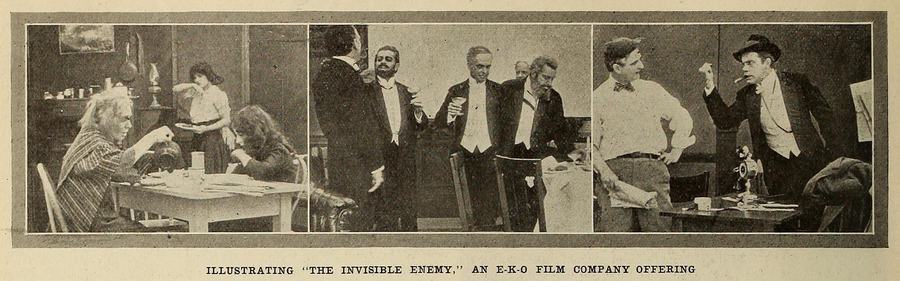
The year 1916 stands as a monumental crucible in the history of the moving image, a period where the primitive flickers of the nickelodeon began to coalesce into the sophisticated visual grammar we now recognize as high-art cinema. Amidst this transformative epoch, The Invisible Enemy emerges as a startlingly prescient work, a celluloid artifact that manages to transcend its chronological constraints. While many films of the era were content with simple slapstick or rudimentary morality plays, this production—penned with sharp intellectual rigor by Emma K. Oswald—dives headlong into the anxieties of a world teetering on the edge of modernity.
To watch The Invisible Enemy today is to witness the birth of the techno-thriller. The narrative architecture, though seemingly straightforward by contemporary standards, possesses a layered complexity that was radical for its time. The film introduces us to a protagonist whose mastery of chemistry represents the dual-edged sword of the industrial age. Unlike the overt theatricality found in Hamlet, Prince of Denmark, where the conflict is rooted in Shakespearean soliloquies, the tension here is purely atmospheric, driven by the looming threat of theft and the misuse of scientific brilliance.
Frederick Vroom delivers a performance of remarkable restraint. In an age where 'overacting' was often the default mode to compensate for the lack of synchronized sound, Vroom utilizes his physicality to convey a deep-seated paranoia. His movements are measured, his glances darting with a frantic intelligence that mirrors the audience's own growing unease. This isn't the swashbuckling heroism one might find in Jack Chanty; rather, it is a precursor to the noir protagonists of the 1940s—men caught in gears of their own making.
One cannot overstate the importance of Emma K. Oswald in this production. As a female writer in the early film industry, Oswald brought a distinct sensitivity to the power dynamics on screen. She doesn't merely treat the 'enemy' as a cartoonish villain. Instead, the antagonism is diffused throughout the environment, creating a sense of omnipresent dread. This thematic depth reminds one of the social stratifications explored in The Wall Between, yet Oswald pivots from social commentary to a more existential form of suspense.
The pacing is deliberate, eschewing the frantic cuts of modern action for a slow-burn accumulation of detail. We see the laboratory not just as a set, but as a sanctuary under siege. The use of light and shadow—pre-dating the full bloom of German Expressionism—suggests a world where the light of reason is constantly threatened by the darkness of human avarice. This visual storytelling is far more sophisticated than the contemporary Call of the Bush, which relied more heavily on external landscapes rather than internal psychological states.
Lucille Young provides a luminous counterpoint to the film’s grittier elements. Her presence on screen is magnetic, carrying a weight of emotional intelligence that anchors the more abstract scientific plot points. There is a specific scene—a moment of quiet domesticity shattered by the realization of an intruder—where Young’s facial economy tells a story more profound than any intertitle could. Her performance suggests a hidden strength, a thematic thread that echoes the title of A Woman's Power, though here that power is utilized within the framework of a high-stakes thriller.
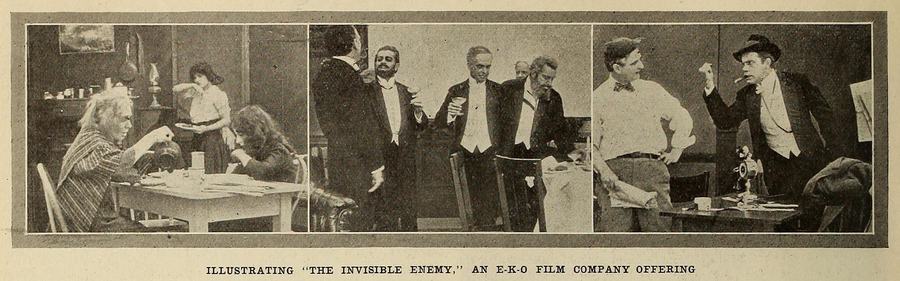
The supporting cast, including William Parsons and Leon De La Mothe, operate with a clockwork precision. Each character feels like a necessary gear in the film’s machinery. Unlike the more whimsical or episodic nature of The Kid, every interaction in The Invisible Enemy serves to tighten the noose. The 'enemy' of the title is never fully humanized, which is a brilliant creative choice; by keeping the threat somewhat abstract, the film taps into a universal fear of the unknown that remains potent over a century later.
From a technical standpoint, the cinematography is surprisingly agile. The camera doesn't just observe; it pries. There are moments of framing that feel incredibly modern, focusing on hands, vials, and half-opened doors to build a tactile sense of reality. This focus on the 'minutiae of the crime' places the film in the same vanguard as the Italian masterpiece Filibus, though without the latter’s campy theatricality. In The Invisible Enemy, the stakes feel grounded and dangerously real.
The set design deserves its own accolade. The laboratory is a labyrinth of glass and copper, a temple of the new age that feels both fragile and formidable. When the inevitable breach occurs, the destruction of this space feels like a violation of the mind itself. This level of environmental storytelling is a far cry from the more stagey presentations of Du Barry or the religious fervor of John Redmond, the Evangelist. Here, the setting is an extension of the protagonist’s psyche.
The film’s climax is a tour de force of silent editing. As the various plot threads converge, the tension is ratcheted up through a series of cross-cuts that must have left 1916 audiences breathless. The resolution is not a simple 'happily ever after' but a somber reflection on the permanence of the threat. The enemy may be defeated, but the 'invisibility' of the danger—the idea that it could return at any moment—remains. This haunting quality is something it shares with The Eye of God, where the gaze of the moral universe is never quite averted.
In the broader context of the era’s output, The Invisible Enemy sits comfortably alongside complex dramas like The Secret Orchard or the intricate legal maneuverings of Signori giurati.... It eschews the sentimentalism found in Silver Threads Among the Gold in favor of a cold, clinical look at the vulnerabilities of the modern age. Even compared to the domestic dramas like His Daughter's Second Husband or the regal tragedy of Alexandra, this film feels uniquely tuned to the frequency of the future.
"The Invisible Enemy is not merely a film about a formula; it is a formula for the modern thriller itself, calculating the exact ratio of shadow to light required to induce pure cinematic dread."
Ultimately, the brilliance of this work lies in its restraint. It understands that what we cannot see is far more terrifying than what is presented in plain view. By centering the conflict on an 'invisible' foe, the film forces the audience to engage their imagination, filling in the blanks with their own anxieties. It is a sophisticated piece of psychological manipulation that proves the pioneers of 1916 were far more advanced than history often gives them credit for. For any serious student of the medium, The Invisible Enemy is an essential viewing experience—a chilling reminder that the most potent threats are those that walk among us, unseen and unheard, waiting for the perfect moment to strike.
As we look back through the grain of over a century, the film doesn't feel like a museum piece. It feels like a warning. In our own age of digital shadows and invisible data breaches, the plight of Vroom’s chemist feels remarkably contemporary. We are all, in some sense, guarding our own 'formulas' against an enemy that doesn't need to break down the door to get inside. This is the enduring power of The Invisible Enemy: it captured a fear that is not bound by time, but is instead a permanent feature of the human condition.
IMDb 5.1
1936
Community
Log in to comment.