DbcultAccessing Vault...
Cult Review
Senior Film Conservator
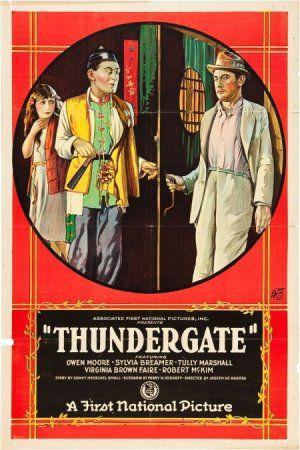
When the dust of the 1920s settles on the silver screen, few works capture the uneasy intersection of East and West as poignantly as Thundergate. Directed by the enigmatic duo Sydney Herschel Small and Perry N. Vekroff, the film weaves a tapestry of colonial intrigue, personal dislocation, and the relentless march of industrial ambition. Its narrative hinges on Robert Wells (portrayed with a haunting blend of innocence and resolve by Owen Moore), a young man whose bicultural upbringing renders him both a bridge and a battleground for competing ideologies.
The opening sequence, shot in chiaroscuro that accentuates the looming blackness of the construction site, immediately immerses the viewer in a world where steel girders claw at the sky like the spires of a distant empire. The cinematography, reminiscent of the stark compositions found in The Iron Heart, employs low-angle shots to convey both the enormity of the bridge and the insignificance of the human figures laboring beneath it. This visual language sets the stage for the film’s central conflict: the clash between progress and preservation, embodied in the antagonist Ray Williams (a sly, conniving presence played by Bernard Siegel).
Williams, masquerading as a benevolent overseer, clandestinely administers a narcotic to Wells—a potent opiate that dulls his senses and erodes his sense of duty. This plot device, while melodramatic by modern standards, functions as a metaphor for the insidious influence of foreign powers on native labor. The film’s treatment of addiction is surprisingly nuanced; the camera lingers on Wells’s glazed eyes, the slow dissolve of his surroundings mirroring his internal dissolution. The audience is forced to confront the fragility of identity when external forces dictate internal collapse.
The narcotic’s impact is not merely physiological; it becomes a narrative catalyst that propels the story into its most compelling act—the identity exchange. In a serendipitous encounter, the wayward son of the Lord of Thundergate, a gaunt figure draped in traditional garb, recognizes in Wells a mirror image of himself. Their exchange of names and destinies is executed with a theatrical flair that recalls the mistaken‑identity tropes of classic farce, yet it is underscored by a palpable tension that hints at deeper psychological undercurrents.
As Wells assumes the mantle of the Lord’s son, he becomes entangled in a covert conspiracy aimed at sabotaging the bridge—a venture that would cripple the Chinese government’s infrastructural aspirations. The conspirators, a shadowy cabal of imperialist agents, operate from a hidden enclave beneath the river’s mist, their machinations revealed through a series of intercut close‑ups that heighten suspense. The film’s pacing during this segment is relentless; each cut feels like a hammer strike, echoing the very construction that forms the story’s backbone.
Amidst the espionage, a tender romance blossoms between Wells and a Chinese‑reared white woman, Li‑Mei (the luminous Sylvia Breamer). Their connection transcends linguistic barriers, communicated through lingering glances and delicate hand gestures. The chemistry between Moore and Breamer is a study in restrained passion, reminiscent of the subtle courtship in The Very Idea. Their love story provides a counterpoint to the surrounding chaos, suggesting that personal bonds can endure even when geopolitical forces threaten to tear them asunder.
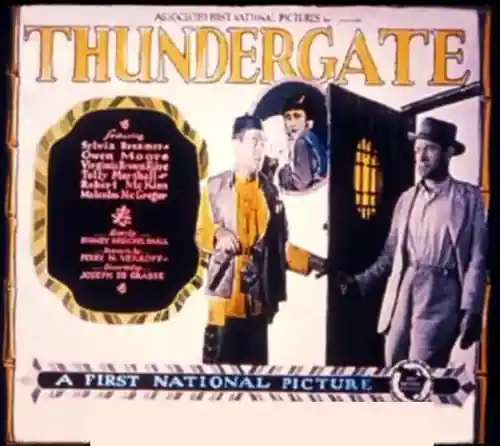
Wells’s journey toward physical rehabilitation is portrayed with a visceral intensity that elevates the film beyond mere melodrama. After a near‑fatal collapse of a scaffold, he is left with a broken leg, a symbolic representation of his fractured identity. The rehabilitation montage—set against a backdrop of sunrise over the river—uses slow motion to emphasize each painstaking step he takes. This sequence, scored by a plaintive piano motif, mirrors the broader theme of reconstruction, both literal and metaphorical.
The film’s climax converges on the moment the bridge is finally completed, its steel arches gleaming like a promise fulfilled. Wells, now fully recovered and having reclaimed his true self, stands atop the structure, gazing out over the waters that once threatened to drown his aspirations. The final tableau, bathed in the amber glow of dusk, is a visual ode to resilience—a fitting conclusion that resonates with the viewer long after the screen fades to black.
From a formalist perspective, Thundergate excels in its use of visual symbolism. The recurring motif of bridges—both architectural and interpersonal—serves as a conduit for exploring themes of connection, division, and transformation. The film’s mise‑en‑scene is meticulously crafted; the contrast between the stark, industrial set pieces and the lush, natural landscapes underscores the tension between man‑made progress and the timelessness of the environment.
The performances merit particular commendation. Owen Moore delivers a nuanced portrayal of a man torn between two worlds, his eyes conveying a depth of sorrow that dialogue alone could not achieve. Virginia Brown Faire, as the enigmatic Lady of Thundergate, infuses her role with a regal poise that anchors the film’s aristocratic subplot. Meanwhile, Willie Fung’s depiction of the loyal Chinese foreman provides a grounding presence, his stoic demeanor offering a counterbalance to the film’s more flamboyant characters.
Narratively, the film walks a fine line between melodrama and political allegory. While some contemporary critics dismissed its plot as overly contrived, modern scholarship recognizes its subtextual commentary on colonial exploitation. The narcotic subplot, for instance, can be read as an allegory for the intoxicating allure of Western modernity that seduced, yet ultimately destabilized, traditional societies.
In terms of pacing, the film maintains a deliberate rhythm that mirrors the methodical construction of the bridge itself. The first act establishes character motivations with measured exposition; the second act accelerates as conspiracies unfurl; the third act resolves with a satisfying crescendo. This structural symmetry is reminiscent of the narrative architecture found in When Men Betray, where tension builds methodically before a cathartic release.
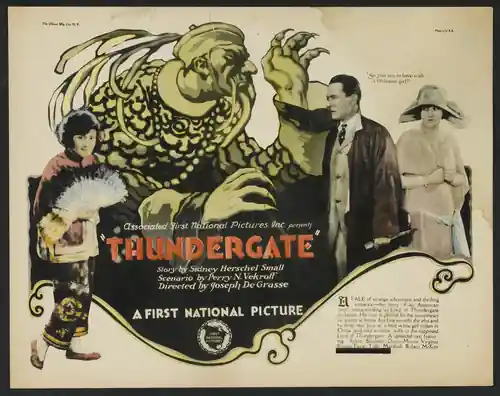
Cinematographer Tully Marshall employs a palette dominated by stark contrasts—deep shadows juxtaposed with blinding highlights—to evoke the moral dichotomies at play. The use of Dutch angles during sabotage scenes heightens disorientation, while the serene, wide‑shot panoramas of the river convey a sense of timelessness. The film’s set design, particularly the intricate replica of the bridge’s scaffolding, showcases an impressive attention to detail that rivals the production values of later silent epics.
The editing, though occasionally abrupt—a hallmark of the era—serves the narrative’s urgency. Cross‑cutting between the bridge’s construction and the conspirators’ clandestine meetings creates a rhythmic interplay that keeps the audience engaged. This technique is employed with similar efficacy in The Night Riders, where parallel action heightens suspense.
Although a silent film, Thundergate benefits from a meticulously crafted musical score that underscores each emotional beat. The orchestration shifts from somber strings during Wells’s addiction to triumphant brass as the bridge reaches completion. Intertitles are sparingly used, each rendered in an elegant serif that complements the film’s aesthetic. The brevity of the text forces viewers to rely on visual storytelling, a testament to the directors’ confidence in the medium.
In the decades following its release, Thundergate slipped into relative obscurity, eclipsed by the advent of sound cinema. However, recent restorations have revived interest among scholars of early transnational cinema. Its depiction of a bicultural protagonist predates and arguably influences later works such as Kiss Me, Caroline, which also grapples with identity in a rapidly globalizing world.
The film’s exploration of imperialist sabotage resonates with contemporary discussions about infrastructure projects in geopolitically contested regions. The bridge, as a symbol of connectivity, becomes a battleground for competing narratives—a theme that echoes in modern documentaries about the Belt and Road Initiative.
Moreover, the romance between Wells and Li‑Mei challenges the era’s prevailing racial attitudes, presenting a partnership based on mutual respect rather than exoticism. This progressive portrayal anticipates later cinematic milestones that foreground intercultural love, such as Frozen Thrills.
Thundergate stands as a testament to the silent era’s capacity for sophisticated storytelling. Its layered narrative, compelling performances, and visual artistry coalesce into an experience that rewards attentive viewing. While certain melodramatic elements may feel dated to modern eyes, the film’s core themes—identity, resilience, and the cost of progress—remain strikingly relevant. For cinephiles seeking a window into the complexities of early 20th‑century cross‑cultural cinema, this work offers a richly textured journey that bridges past and present.

IMDb —
1919
Community
Log in to comment.