DbcultAccessing Vault...
Cult Review
Senior Film Conservator
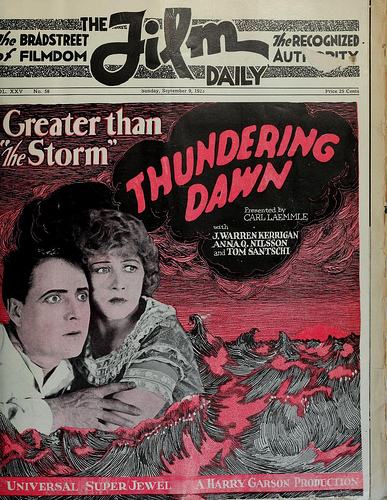
The year 1923 stood at a precarious crossroads in cinematic history, a moment when the silent medium had mastered the grammar of visual storytelling but had not yet succumbed to the rigid formulas of the late-decade studio system. Thundering Dawn, directed by Harry Garson, emerges from this era not merely as a melodrama, but as a visceral exploration of the fragility of the Western ego when confronted with the overwhelming entropy of the tropics. It is a film that breathes through its atmosphere, utilizing the primitive yet potent special effects of the early twenties to craft a narrative where the environment is as much a character as the tortured Jack Standish.
Jack Standish, portrayed with a haunting vulnerability by J. Warren Kerrigan, is the quintessential 'lost man' of post-Victorian fiction. His flight to the South Seas isn't a quest for adventure, but a retreat into the void. Unlike the protagonists in The Lost Paradise, who grapple with industrial morality, Standish is fleeing the intimate shame of familial failure. The film captures his disintegration with a startling lack of sentimentality. The Java we see here is not a postcard paradise; it is a claustrophobic, fever-dream landscape where the air seems thick with the scent of fermenting fruit and cheap spirits.
The introduction of Gordon Van Brock (Tom Santschi) provides a sharp, jagged contrast to Standish’s lethargy. Van Brock represents the predatory side of colonial expansion—a man who has thrived in the heat by shedding his humanity. Santschi plays the role with a hulking, physical menace that makes the psychological entrapment of Standish feel terrifyingly tangible. This isn't just a business rivalry; it is a battle for the very agency of a human soul. The dynamic reminds one of the stark moral dichotomies found in The Despoiler, where the environment serves to strip away the veneer of civilization.
No discussion of Thundering Dawn can ignore the presence of Winifred Bryson as Lullaby Lou. In the lexicon of silent film, the 'vamp' was often a caricature, yet Bryson imbues Lou with a predatory grace that feels dangerously modern. She is the siren of the archipelago, the physical manifestation of the inertia that keeps Standish tethered to his bottle. Her performance is augmented by the presence of a young Anna May Wong, whose brief but luminous appearance hints at the tectonic shifts occurring in Hollywood’s racial and aesthetic hierarchies. While Lou is the primary antagonist of the heart, Wong’s presence adds a layer of authentic 'otherness' that the film’s white protagonists struggle to navigate.
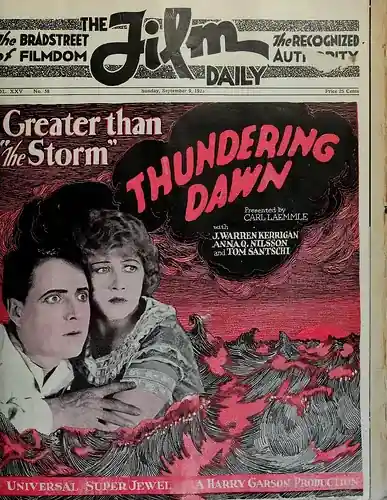
The contrast between Lullaby Lou and Mary Rogers (Anna Q. Nilsson) is handled with a sophistication that avoids the typical 'Madonna-Whore' trap of the era. Nilsson plays Mary not as a passive victim, but as a woman of immense fortitude. Her journey to Java is a reclamation project that requires more than just love; it requires a physical and mental stamina that rivals the men around her. Her efforts to resuscitate Standish’s spirit are depicted with a gritty realism, a far cry from the lighthearted romances seen in The Country Flapper.
The technical centerpiece of the film is, without question, the climactic typhoon. In an age before CGI, the sheer scale of the practical effects used to simulate the destruction of the coastal settlement is breathtaking. The screen is filled with a cacophony of wind, water, and splintering timber. It is a sequence that rivals the elemental fury depicted in The Flower of the North. The storm serves a dual purpose: it is the literal engine of the plot’s resolution, sweeping away the physical remnants of Standish’s degradation, and it is a metaphorical baptism.
As the waves crash through the bamboo structures and the wind howls through the palm fronds, we witness the death of the 'Old Jack.' The storm forces a clarity of action that months of Mary’s pleading could not achieve. It is a moment of pure cinema—where the visual language of chaos translates into the internal language of redemption. The editing during this sequence is frantic, utilizing quick cuts that were revolutionary for the time, a sharp departure from the more languid pacing of A Youthful Affair.
The screenplay, a collaborative effort by five writers including Lenore J. Coffee and Sada Cowan, possesses a literary density often missing from contemporary blockbusters. There is a preoccupation with the concept of 'Honor'—not as a social grace, but as a foundational psychological need. This thematic obsession mirrors the narrative stakes in Stolen Honor, yet Thundering Dawn elevates the stakes by placing them against the backdrop of an uncaring, violent nature. The dialogue titles are sparse but poetic, allowing the actors’ expressions to carry the burden of the complex emotional subtext.
The film also touches upon the existential dread of being 'forgotten.' Standish’s fear isn't just that he failed his father, but that he has become a ghost while still inhabiting a living body. This spectral quality is emphasized by the cinematography, which uses deep shadows and high-contrast lighting to isolate Standish within the frame. It evokes the same sense of fated doom found in Das ganze Sein ist flammend Leid, where the protagonist is consumed by their own internal fire.
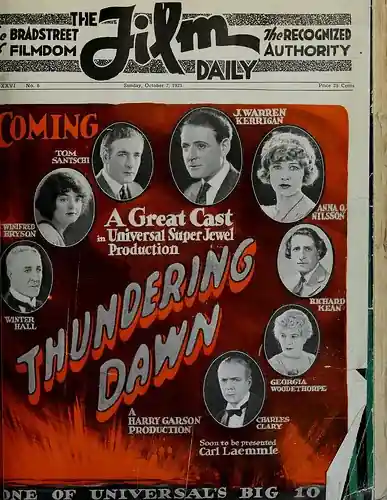
Harry Garson’s direction is surprisingly disciplined. He resists the urge to overplay the exoticism of the setting, instead focusing on the psychological toll of the environment. The pacing is deliberate, building a sense of impending doom that only finds release in the final reel. J. Warren Kerrigan, a major star of the period, delivers what might be his most nuanced performance. He avoids the histrionics common in silent acting, opting instead for a slumped posture and a vacant gaze that perfectly communicates the hollowed-out nature of an alcoholic.
Anna Q. Nilsson provides the necessary emotional anchor. Her Mary Rogers is a beacon of sanity in a world gone mad. The chemistry between her and Kerrigan feels earned, rooted in a shared history that the film cleverly alludes to without over-explaining. Their struggle against the combined forces of Van Brock and Lullaby Lou feels like a struggle against the very concept of moral decay. This is a far more mature exploration of partnership than the whimsical dynamics in High Speed.
While Thundering Dawn may have been overshadowed by the larger-than-life epics of Griffith or DeMille, it remains a vital piece of cinematic history. It is a bridge between the Victorian melodrama and the burgeoning psychological realism of the mid-1920s. Its portrayal of the South Seas as a place of both destruction and rebirth predates the 'tropical noir' films of the 1940s by two decades. The film’s ability to weave together a personal story of redemption with a large-scale disaster epic is a testament to the ambition of its creators.
In the pantheon of silent films that explore the dark corners of the human psyche, Thundering Dawn deserves a prominent seat. It is as intense as The Combat and as visually arresting as Flower of the Dusk. For the modern viewer, it offers a window into a world where nature was the ultimate judge, and where the only way to find one's dawn was to survive the thunder of one's own failures. It is a harrowing, beautiful, and ultimately triumphant piece of art that reminds us that even in the deepest miasma of Java, the human spirit is a stubborn, resilient thing.
Final Rating: 4.5/5 Gin-soaked Palm Fronds.
IMDb 7.2
1921
Community
Log in to comment.