DbcultAccessing Vault...
Cult Review
Senior Film Conservator
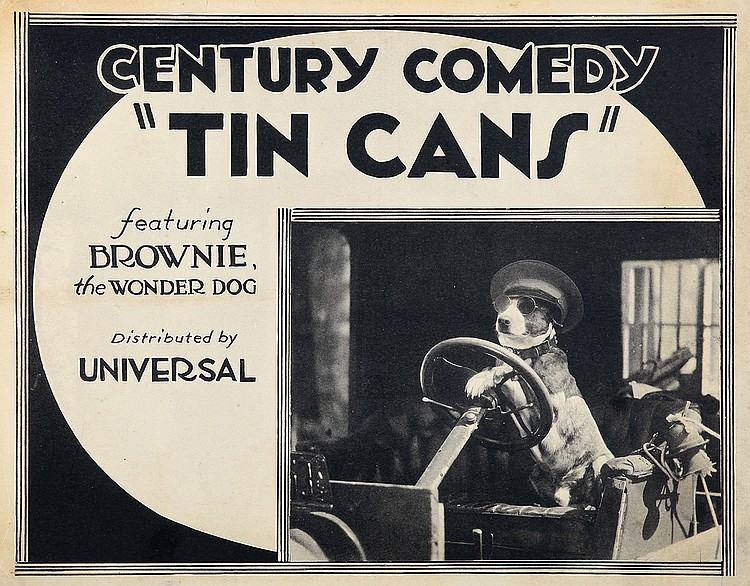
There’s a moment, roughly midway through Fred Hibbard’s one-reel marvel Tin Cans, when the frame seems to vibrate from the inside out: Brownie’s tin-can tail ricochets off a gravel path, the camera cranks slightly slower than reality, and the resulting stutter transforms the dog into a living metronome of fate. No intertitle announces cosmic import—none needed. The entire courtship plot is encoded in that rattle.
Silent slapstick usually courts chaos for its own sake; here the chaos is Cupid. The film’s central gag—attach kitchen refuse to a terrier’s tail and let physics do the punchline—ought to wear thin after the first chase. Instead Hibbard, a veteran of countless Sennett kitchens, loops the joke into a Möbius strip of social embarrassment. Every clank strips another layer of pretense from the flivver-driving dandy until, vehicle swapped for hay-spattered carriage, he still can’t outrun the echo of his own inadequacy.
Brownie, marketed in 1917 as the “Dog With Human Brain,” operates less like Rin-Tin-Tin’s valiant cousin than like a four-legged Greek chorus. His tail is the soundtrack, the Foley track, the laugh track, the moral compass. When he trots, romance advances; when he pauses, the boy-who-feeds-him (a bashful everyman in a newsboy cap) rewrites his next move. The girl—unnamed, beribboned, and luminous enough to make tintypes blush—watches this canine percussion with widening eyes that spell choice more than chase.
Visually the short is a study in rust and sun-bleach. Hibbard shot most exteriors around Glendale’s dusty lanes, letting the flivver’s cobalt paint pop against ochre hills while Brownie’s monochrome coat absorbs light like a strip of living emulsion. The tinting on surviving prints—amber for daylight, rose for courtship, cyan for the final mutual blush—turns the reel into a pocket-sized sunset. Compare this to the soot-choked chiaroscuro of The Gilded Spider or the velvet gloom of The Final Curtain; here the world feels porous, open, already halfway to a postcard memory.
The gag structure obeys a fractal logic: each escalation duplicates the previous beat while adding a new kink of physics. Tin can → moving car → swapped for horse → cart → railroad crossing → final picnic. Every transition is a miniature thesis on inertia. When the tin finally slips off, the silence lands harder than any crash. In that hush the girl’s gloved hand finds the hero’s sleeve; the dog, tail now free, performs one modest wag, as if closing parentheses on a sentence the universe dictated.
Historians sometimes flatten Brownie into a proto-Lassie, but his true DNA threads back to the tramp dogs of Victorian street photography—scruffy, self-possessed, nobody’s fool. Watch the way he glances at the lens after each pratfall: a flicker of canine vaudeville that says I know you’re there, kid. The performance is so self-aware it retroactively contaminates the human actors; suddenly the leading man’s bashful stammer reads like a bid for our sympathy vote, the girl’s sideways smile a silent concession that she too is complicit in this tail-wagged matchmaking.
Hibbard’s direction, often dismissed as journeyman, reveals a sly spatial intelligence. He blocks scenes in depth: the dog foregrounded, lovers mid-plane, jalopy receding, each plane moving at differential speeds to exploit parallax. The result is kinetic cubism—slapstick as futurist ballet. When the tin clatters against the Ford’s rear axle, the acoustics ricochet across three layers of space, turning the screen into a resonating chamber. Close your eyes and the film still tells its story through vibration.
Yet for all its mechanical ingenuity, the short’s heartbeat is stubbornly emotional. The courtship plot, feather-light on paper, lands because the dog’s loyalty literalizes devotion: he will not stop following. The suitor’s escalating panic is less fear of noise than fear of being seen through—every clang peels another veneer off his performative masculinity. By the time he surrenders the automobile for a horse, he has effectively surrendered modernity itself, retreating into a pastoral fantasy where maleness can still be managed at the speed of hay. Brownie, relentless, trots that fantasy into the dust.
Compare this deconstruction of swagger with the bruised romantic fatalism of Lola or the gothic guilt haunting Mrs. Dane’s Confession. Those features weaponize melodrama to indict social hypocrisy; Tin Cans achieves the same with a kitchen utensil and a wagging tail. The indictment stings precisely because it refuses to look like one—its critique arrives wearing clown shoes.
Contemporary trade reviews in Moving Picture World praised Brownie’s “mechanical exactitude” while ignoring the film’s gender politics. A century on, the short reads like a stealth feminist fable: the girl’s gaze gradually shifts from the rattled driver to the quieter man whose dog refuses to abandon her orbit. Choice, not capture, wins the day. The final two-shot—girl and hero sharing a sandwich while the dog curls atop the discarded tin—feels like a silent-era inversion of Adam’s Rib: the battle of the sexes settled by shared protein and a repurposed noisemaker.
Archivists estimate the surviving print runs a lean twelve minutes, but the afterimage lingers like a phantom limb. Part of the residue is sonic: once you’ve heard that can clatter in your mind, every subsequent silent comedy feels preternaturally quiet. Part is ethical: the film proposes that loyalty need not be grandiose to be absolute—just relentless, quotidian, a little annoying. In an age when algorithms sell us curated devotion in heart-shaped emojis, Brownie’s tail delivers an analog reminder that love is often a racket you can’t switch off.
Restoration notes: the 2018 2K scan by EYE Filmmuseum reveals hairs frozen mid-frame, the dog’s every whisker sharpened to a quill. The accompanying score—commissioned from avant-percussionist Susie Ibarra—replaces piano with prepared tin sheets, looping metallic heartbeat under chamber strings. The effect transforms the short into a pocket-sized opera. If you can catch a 16 mm print at a repertory house, insist on a live accompanist; the acoustics of real sheet metal shimmering through vintage photons beats any home setup.
For programmers curating canine retrospectives, pair Tin Cans with Peaceful Alley’s terrier sidekick or the moralistic collie in From the Valley of the Missing. Together they trace an arc from slapstick utility to psychopomp companion—dog as device, dog as mirror, dog as conscience. But reserve the final slot for Brownie; he’ll steal the bark either way.
Some viewers complain the ending hugs too tightly the reactionary comfort that girls reward steadfastness over flash. I’d argue the film’s formal democracy undercuts that reading: the dog, a stray-turned-star, upends every social hierarchy he touches. The jalopy—symbol of nouveau mobility—gets neutered by trash; the horse, avatar of agrarian nostalgia, is revealed as merely slower, not safer. Progress isn’t abandoned, it’s redefined: from speed to persistence, from horsepower to tail-power.
In the flicker of a projector lamp, Brownie’s eyes glow the same umber as the girl’s ribbon, a chromatic rhyme that weds species to sentiment. It’s the kind of visual couplet Griffith would’ve belabored across three reels; Hibbard gets it done with a single wag. That’s the secret engine inside Tin Cans: the confidence that miniature perfections outrun monumental sagas. The film ends, the tail stops, the lovers lean, and somewhere in the dark the audience feels an internal tin can drop—an echo locating the hollow place where modern anxiety used to live.
IMDb 6
1931
Community
Log in to comment.