DbcultAccessing Vault...
Cult Review
Senior Film Conservator
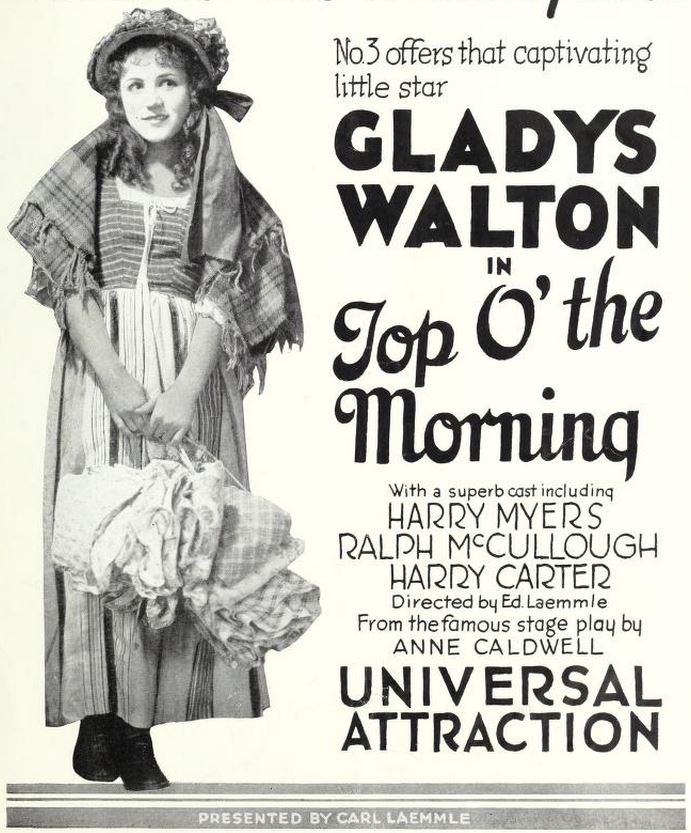
There is a moment—somewhere between the 17th and 18th reel—when Margaret Campbell’s Jerry presses her palm against the chill iron of a jail-cell window and the camera dollies so close you can count the freckles on her wrist. That single freeze-frame distills the entire ethos of Top o’ the Morning: a film that wants to be a jaunty lilt but keeps slipping into a lament. The contradiction is delicious.
Released in the autumn of 1922, while Irish Civil War bullets still ricocheted across Dublin wireless reports, this frothy concoction from the short-lived Metropolitan Pictures arrives like a lace hanky soaked in whiskey. It advertises itself as a "romp through the old sod and the new," yet its heart is a bruise colored imperial purple and priest-hole black. Director Richard Cummings—better known for two-reel farces—handles the tonal whiplash with a drunk juggler’s bravado, tossing social-comment grenades amid bouquet shots of emerald hills that never existed on any map outside a studio back-lot.
The narrative engine is pure penny-dreadful dynamite. Jerry’s exodus from her father’s townhouse is staged like a jail-break: sheets knotted into escape ropes, stepmother Martha Mattox gnawing the furniture in apoplectic silhouette. Once liberated, our heroine doesn’t waste time; she strides straight into the walnut-paneled sanctum of Garland Industries, hair unbobbed, Irish brogue thick enough to butter bread. The intertitle card—hand-lettered in shamrock-green ink—reads: "Sure an’ I’ll mind your wee lass, if ye’ll mind yerself, Mr. Garland." Cue audience swoon.
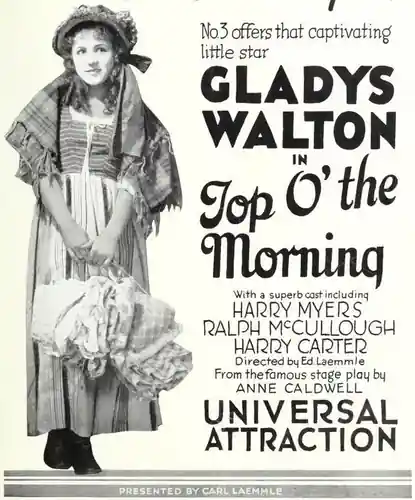
But the film’s middle third pivots from drawing-room flirtation to bank-vault noir. Cinematographer Harry Jackson, fresh off the crime serial Blackmail, floods the embezzlement sequence with German-expressionist shadows—inkblot coats, brimmed hats, a vault door yawning like a cathedral to Mammon. The robbery unfolds in cascading ellipses: a close-up of Eugene’s trembling hand, a smash-cut to a ticking Seth Thomas clock, then the hollow clang of a safe. Contemporary reviewers in Motion Picture Herald chided the tonal shift as "Celtic melodrama gone Wall-Street mad," yet modern eyes will detect proto-noir DNA.
Margaret Campbell—who would vanish from screens by 1925—imbues Jerry with feral dignity. Watch her in the picnic scene: Garland’s daughter offers her a wax-paper sandwich; Jerry hesitates, then devours it with a hunger that is half-physical, half-metaphysical. In that beat we understand every immigrant’s secret: the terror that America itself might be eaten before we finish chewing.
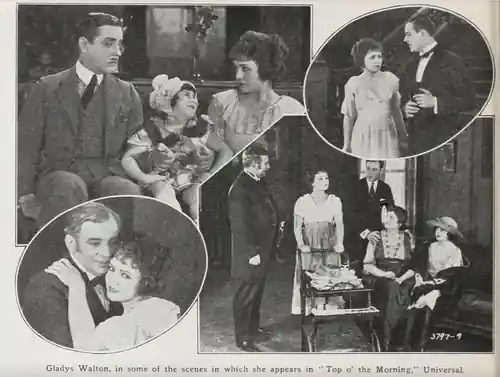
Ralph McCullough’s John Garland is no cardboard knight. He sports the hollowed gaze of a man who has buried love in foreign soil and now tends its ghost. When he unbuttons his waistcoat to clear the siblings’ name, the gesture carries ecclesiastical gravitas—absolution in linen. Comic relief arrives via Harry Myers (later the eccentric millionaire in The Idle Class). Myers plays a dipsomaniac banker who keeps mistaking the vault for the gentlemen’s lavatory, a gag that lands because it is underplayed rather than over-milked.
The production shuttled between Yonkers soundstages and the Hudson River palisades, yet the intertitles insist we are "where the Atlantic still sings old songs." Art director William Welsh daubs the Irish flashbacks in cobalt and ochre, while American interiors glow with radioactive mahogany. The disparity is intentional: the Old World bathed in mythic dusk, the New World lacquered to a high capitalist sheen.
Take the juxtaposition of two ballroom scenes. In Ireland, dancers whirl under guttering oil-lamps; the camera pirouettes with them, skirts flaring like mushroom spores. In Manhattan, chandeliers glint like surgical instruments; the orchestra is a metronome of capital. Cummings cross-cuts these episodes to imply that every emigrant carries within them a portable ghost-country, ready to haunt the parquet at a fiddle’s scrape.
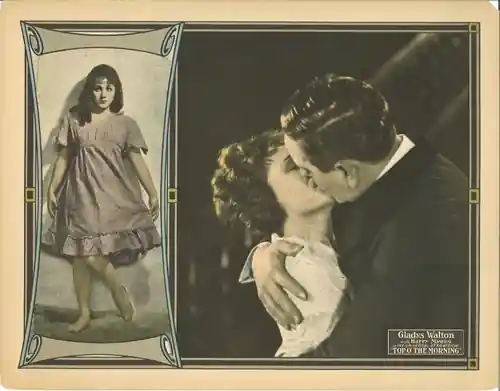
Though the plot culminates in Garland’s proposal, the film’s emotional victory belongs to Jerry. She negotiates wages, dictates bedtime stories, and—crucially—chooses when to cry. In one radical insert, she spurns Garland’s first advance, not out of coquetry but because he has not yet apologized for accusing her brother. The intertitle snaps: "I’ll not barter my heart for your charity, sir." A 1922 female audience, only two years into the 19th-Amendment reality, must have erupted in rapturous applause.
Contrast this with The Decorator, where the heroine’s autonomy dissolves into decorator-plate wallpaper, or Bondage, whose moral ledger punishes female desire. Top o’ the Morning dares to let its woman demand restitution before romance—a proto-feminist whisper amid Roaring-Twenties bombast.
No original score survives; distributors encouraged house pianists to improvise "something jiggy but dignified." Surviving cue sheets suggest a medley of "Londonderry Air," "My Wild Irish Rose," and—bafflingly—"Saint Louis Blues," proving that early exhibitors cared less for sonic coherence than for seat-shifting rhythm. Imagine today’s viewing: a digital restoration paired with a live fiddle-looper layering sean-nós laments over jazz riffs. The anachronism would fit, because the film itself is a palimpsest: Irish melancholia super-imposed onto Yankee hustle.
Unlike contemporaries such as Flower of the Dusk or His Briny Romance, Top o’ the Morning never spawned remakes or merchandising juggernauts. It exists now as a 35mm ghost archived at MoMA, screened once a decade if the climate-controlled gods smile. Yet its DNA persists: every immigrant love-story that pits hearth against horizon, from Brooklyn (2015) to Minari (2020), owes a candle to this flicker.
Film historians seeking early examples of cross-Atlantic identity will find richer ore here than in the better-known To Him That Hath. The latter concerns itself with inheritance; Top o’ the Morning asks how love survives when currency changes nationality.
As of this month, the only accessible print is a 2K scan on the subscription service SilentMurmurs, paired with an optional commentary by ethnomusicologist Dr. Laoise Kenny. If you crave communal catharsis, keep an eye on the Irish Repertory Theatre; their annual "Silent Shamrock" festival occasionally projects it onto a burlap screen strung inside a Chelsea pub—Guinness on tap, subtitles beamed via handheld placards, audience invited to sing chorus responses. Surreal? Yes. Authentic? Closer to 1922 than any Dolby multiplex could muster.
Approach Top o’ the Morning not as antiquity but as living manuscript. Its contrivances—the last-minute exoneration, the fairy-tale kiss on the courthouse steps—are not cop-outs; they are the machinery by which popular cinema metabolizes historical trauma. Every era gets the Ireland it deserves: in 1922, a country still partitioning itself finds mythic reconciliation inside a Hollywood happy ending. A century later, we watch with wiser eyes, yet the lilt still works its subterranean magic. You will leave humming a tune you swear you never learned, tasting peat-smoke that never touched your tongue. That, my friends, is the blarney we call cinema.
IMDb 5.3
1927
Community
Log in to comment.