DbcultAccessing Vault...
Cult Review
Senior Film Conservator
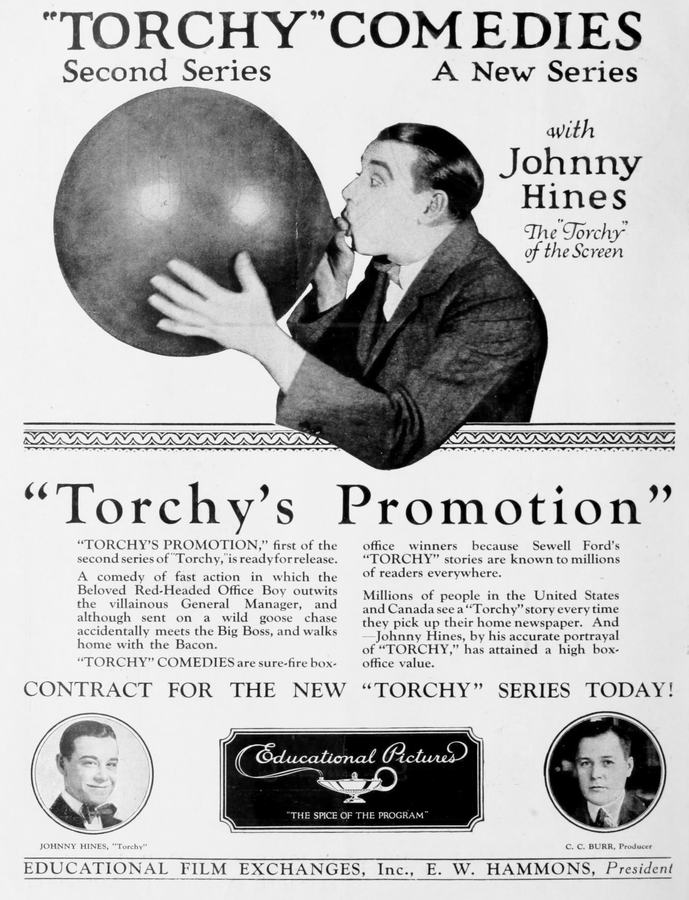
In the annals of pre-Code cinema, few films balance office politics, romantic entanglements, and petty criminality with as much verve as Torchy's Promotion. This 1930s comedy, directed by Sewell Ford, is a masterclass in tonal dexterity, oscillating between the clipped absurdity of a workplace farce and the chaotic energy of a small-time heist. At its core lies Torchy, a character who embodies the spirit of a man perpetually one step ahead of societal expectations—until the universe, in its infinite mischief, conspires to trip him. The film’s charm lies not in its plot twists (predictable as a magician’s sleight of hand) but in the execution: the way Ford and his collaborators layer irony upon physical comedy, and the actors who commit to every punchline with the sincerity of a Shakespearean clown.
The narrative kicks off with Torchy, played with irrepressible charm by Johnny Hines, as the office underdog whose audacity borders on insubordination. His decision to court the boss’s daughter (Helen O’Neil) is less a declaration of love than a provocation—a dare to the status quo. When the business manager (Dorothy Mackaill) dispatches him to Atlantic City to secure a signature from the elusive Mr. Brown, it’s clear this errand is a ploy to rid the office of Torchy’s disruptive presence. Yet, as in all great comedies of intent, the plan backfires spectacularly. The theft of Torchy’s clothes by Tuxedo Harry (Johnny Hines in a dual role?) becomes the catalyst for a sequence that mixes slapstick (a man in a tuxedo jacket sprinting through a casino) with the existential crisis of a man suddenly clad in mismatched attire.
Sewell Ford’s direction is a study in economy. Every scene in Torchy's Promotion is a self-contained farce, yet the film never feels disjointed. Ford’s use of space—particularly in the Atlantic City sequences—turns the setting into a character. The boardwalk, with its garish lights and cacophony of street performers, mirrors Torchy’s internal chaos. When Tuxedo Harry’s antics escalate, Ford employs a series of rapid cuts and exaggerated angles that evoke the anarchic spirit of silent-era comedy, even as the dialogue crackles with the wit of a Broadway revue.
What elevates the film beyond mere slapstick is its understanding of class dynamics. Torchy, though a schemer, is positioned as the audience’s surrogate—a man who defies the rigid hierarchies of the office and the boardroom. His eventual triumph over both Tuxedo Harry and the bureaucratic machine underscores a populist ethos: the underdog who outwits the system, not through grand gestures, but through a combination of wit and sheer stubbornness. This theme is subtly reinforced by the supporting cast, particularly Dorothy Mackaill’s business manager, whose attempts to control Torchy reveal the fragility of authority in a world where chaos reigns.
The film’s success hinges on its performers, and Ford has assembled a cast that meets the material’s demands with gusto. Johnny Hines, as Torchy, is a revelation. His physicality—whether in a pratfall or a flustered attempt to negotiate in a tuxedo—is matched by a vocal delivery that oscillates between deadpan and exasperation. Helen O’Neil’s portrayal of the boss’s daughter is less a romantic interest than a symbol of Torchy’s rebellion; she is both object of desire and obstacle to his ambitions, a duality that O’Neil navigates with deadpan elegance.
Dorothy Mackaill, meanwhile, embodies the archetype of the frustrated authority figure. Her business manager is a study in controlled panic, her dialogue laced with the kind of clipped, bureaucratic jargon that invites both sympathy and mockery. The dynamic between her and Torchy is the emotional backbone of the film—a push and pull between order and anarchy that plays out in escalating stakes and comedic payoffs.
To fully appreciate Torchy's Promotion, one must situate it within the broader landscape of 1930s comedies. Like Something to Do, it leans into the trope of the misguided errand, though Ford’s take is more pointed in its satire. The film also shares thematic DNA with Princess Romanoff, in which a rogue protagonist navigates a web of deception, though Torchy replaces espionage with petty theft and office intrigue. What sets it apart is its commitment to the farcical: Ford doesn’t just hint at chaos; he embraces it, letting the narrative spiral into absurdity with the confidence of a writer who knows the audience will follow.
The influence of earlier comedies, such as The Thunderbolt, is evident in the way Torchy's Promotion uses setting to amplify humor. The Atlantic City sequences, with their over-the-top visual gags, owe a debt to the silent-film traditions of Chaplin and Keaton, yet Ford infuses them with a modernity that speaks to the era’s shifting social norms. This is a film that understands its audience—a generation eager for laughter in the shadow of the Depression—and delivers it with the precision of a well-timed punchline.
While Torchy's Promotion is a triumph of comedic timing and character interplay, it is not without its flaws. The plot’s reliance on coincidence—most notably, the sudden reappearance of Tuxedo Harry and the miraculous acquisition of Mr. Brown’s signature—can strain credulity. However, these moments are so deftly staged that they become part of the film’s charm. The editing, for instance, ensures that each twist feels earned, even when logic falters. Ford’s use of montage in the climax—a rapid-fire sequence of Torchy’s triumphs—transforms what could be a contrived resolution into a jubilant crescendo.
The film’s score, though uncredited, deserves mention. It oscillates between jazzy interludes and dramatic swells, underscoring the film’s tonal shifts with the subtlety of a skilled conductor. This aural texture complements the visual gags, creating a sensory experience that is as immersive as it is entertaining.
By today’s standards, Torchy's Promotion may feel quaint, its gender roles and class hierarchies anachronistic. Yet, this is precisely what makes the film a fascinating artifact. Its embrace of pre-Code irreverence—particularly in Torchy’s relationship with the boss’s daughter—hints at a more liberated cinematic era, one that would soon be stifled by the Hays Code. The film’s unapologetic focus on individual ambition over institutional order also resonates in an age where corporate culture is under constant scrutiny.
For modern viewers, Torchy's Promotion is a reminder of the joy found in simplicity. Its lack of pretension—both in narrative and execution—allows it to exist as pure entertainment. It is a film that trusts its audience, offering no explanations beyond the immediate joke and the emotional payoff of its characters’ journeys. In a landscape saturated with irony and self-awareness, Ford’s approach feels refreshingly direct.
In the pantheon of pre-Code comedies, Torchy's Promotion occupies a unique niche. It is neither a groundbreaking work of art nor a forgotten curiosity but a polished, well-crafted piece of entertainment that succeeds on its own terms. Ford’s direction, the actors’ commitment, and the script’s razor-sharp dialogue combine to create a film that is as much a product of its time as it is a testament to the enduring appeal of the underdog story. For those who appreciate the interplay of humor and heart, the film is a must-see—a reminder that sometimes, the best stories are the ones where the hero wins not through brilliance, but through sheer, relentless will.
IMDb —
1921
Community
Log in to comment.