DbcultAccessing Vault...
Cult Review
Senior Film Conservator
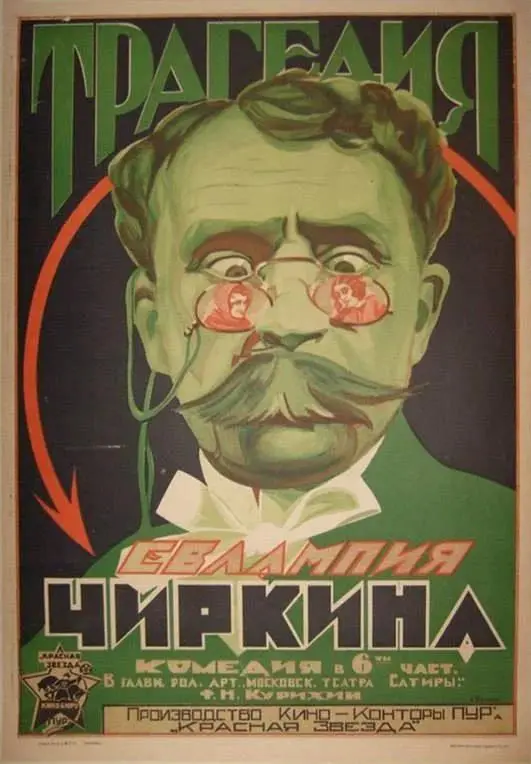
Is Tragediya Evlampiya Chirkina a lost gem of the silent era? Short answer: No, it is a demanding historical artifact that requires immense patience, but it offers a raw, unvarnished look at a world caught in a violent state of flux.
This film is for the dedicated film historian and the viewer who finds beauty in the decay of the old world. It is absolutely not for anyone seeking the fast-paced thrills or the optimistic propaganda often associated with early Soviet cinema.
Before diving into the technical nuances, let us be clear about the film's standing. It is a difficult watch, but one that rewards the observant.
The involvement of Vasili Kamensky as a writer is perhaps the most intriguing aspect of this production. Kamensky was a renowned Futurist poet and aviator, a man obsessed with the forward momentum of modernity. However, in this film, his writing takes a surprisingly somber turn.
Instead of celebrating the machine, Kamensky explores the man who cannot fit into the gears. The dialogue—represented through intertitles—is sparse but heavy with the weight of inevitability. There is a specific scene where Evlampy stares at a newly installed piece of machinery that feels less like progress and more like a tombstone for his way of life. It is a moment of quiet, devastating clarity.
This script doesn't rely on the typical tropes of the era. There are no mustache-twirling villains or glowing proletarian heroes. Everyone is just trying to survive the crushing gravity of history. It works. But it’s flawed in its delivery.
Fyodor Kurikhin delivers a performance that is uncomfortably grounded. In an era where silent acting often leaned into the theatrical and the hyperbolic, Kurikhin remains remarkably still. His face is a map of exhaustion, etched with the lines of a man who has worked the earth only to find the earth no longer wants him.
Consider the sequence where he returns to his village after a long absence. The way he handles a simple wooden tool is telling. It’s not just a prop; it’s an extension of his body. When he eventually realizes he has lost his place in the social hierarchy, the collapse isn't explosive. It’s a slow wilting. This is a far cry from the energetic performances seen in something like Kohlhiesel's Daughters, which operates on a completely different emotional frequency.
The supporting cast, including Yeva Milyutina and Nikolay Gorich, provide a necessary contrast. They represent the world moving on—sometimes with cruelty, sometimes with simple indifference. Milyutina, in particular, captures the pragmatic hardness of the era. She isn't a villain; she is a survivor, and her survival requires the abandonment of the old ways that Evlampy clings to so desperately.
The visual language of Tragediya Evlampiya Chirkina is one of stark contrasts. The director uses natural lighting to an almost oppressive degree. The interiors of the peasant huts are swallowed by shadows, while the exterior shots of the burgeoning industrial sites are blasted with an unforgiving, flat light.
There is no attempt to beautify the struggle. The camera lingers on the dirt, the frayed fabric of the costumes, and the cold, unyielding surfaces of the new world. It lacks the stylized flair of The Avalanche, opting instead for a proto-realist approach that feels decades ahead of its time.
The film does not ask for your sympathy; it demands your witness. It is a cold, hard look at the debris left behind by the march of progress.
The pacing, however, is where the film struggles most. Long takes of manual labor or silent contemplation can become hypnotic, but here they often feel aimless. The editing doesn't have the sharp, intellectual bite of the montage masters. It feels like a film that is breathing heavily, struggling to keep up with its own heavy themes.
If you are looking for a casual evening of entertainment, the answer is a firm no. Tragediya Evlampiya Chirkina is a grueling experience that offers little in the way of traditional catharsis. However, if you are interested in the evolution of social realism and the way early Soviet cinema grappled with the human psyche, it is indispensable.
It serves as a vital counterpoint to the more famous, high-energy films of the 1920s. It reminds us that for every grand revolutionary victory, there were thousands of quiet, personal tragedies. It is a film of ghosts, documenting a lifestyle that was being erased in real-time. For that historical honesty alone, it earns its place in the archives.
Pros:
Cons:
Tragediya Evlampiya Chirkina is a somber, difficult, and ultimately rewarding piece of cinematic history. It doesn't have the polish of a Hollywood production like Morals for Men, nor does it have the avant-garde energy of the top-tier Soviet directors. What it does have is a brutal sincerity.
It is a film that sits in the gut like a heavy stone. It is a reminder that the "new world" was built on the bones of the old, and that the transition was rarely graceful. It is flawed, yes. It is slow, certainly. But it is also deeply human in a way that few films of its era managed to be. It is a tragedy in the truest sense of the word—not because of what happens, but because of what cannot be stopped.
Final rating: A necessary, if painful, watch for the serious cinephile.

IMDb 6.5
1936
Community
Log in to comment.